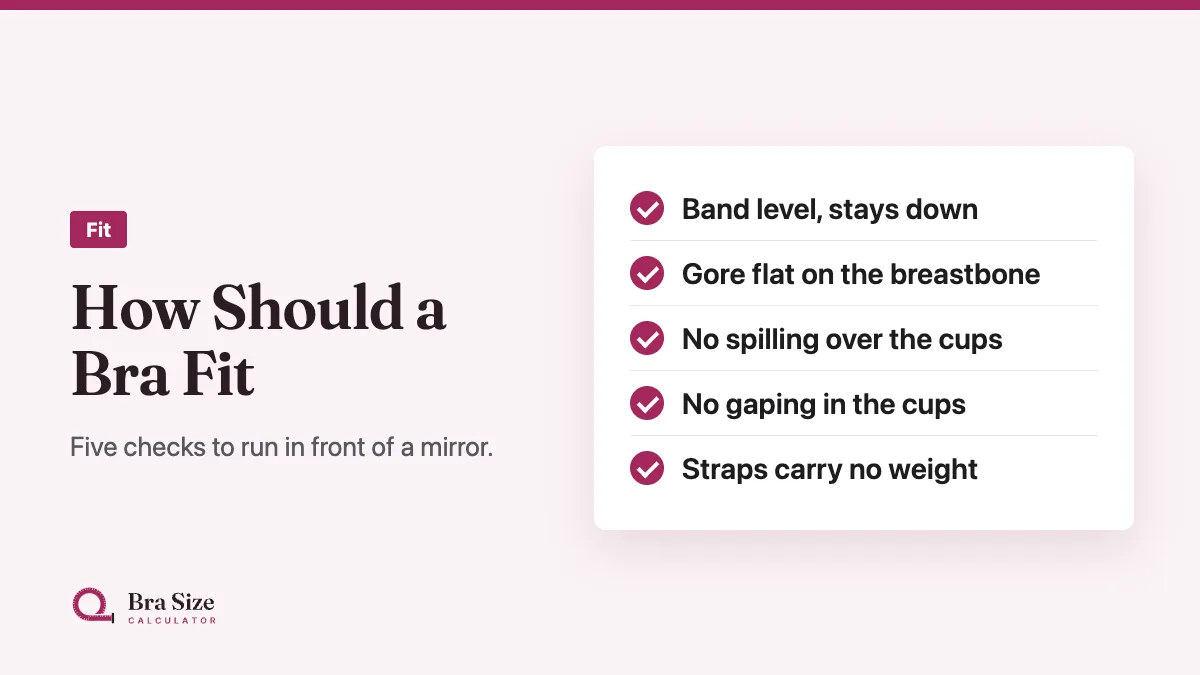
A bra fits when its band stays level around your ribs and pulls no more than about 2 in (5 cm) away from your back. After that, the cups hold all breast tissue, each wire follows the crease and the centre panel touches your breastbone. Most weight should not hang from the straps. How should a bra fit on your body? Test a size from the bra size calculator in that order, band first and straps last.
Table of Contents
How should a bra fit in 60 seconds
A size works when it passes five checks in this order, band, cups, underwire, centre front and straps, and then a move test with your arms raised.
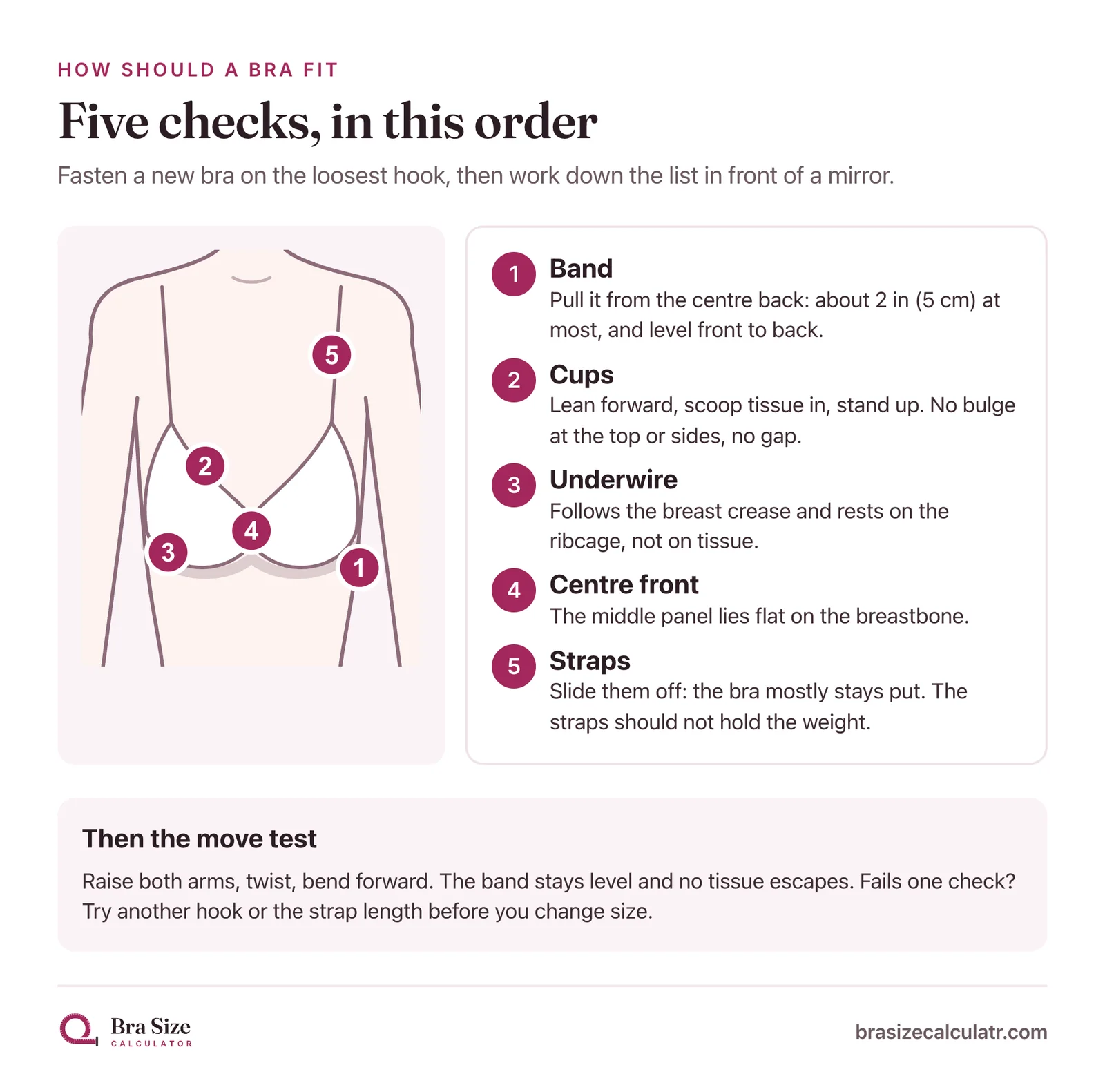
- Band. Close a fresh bra on the loosest hook, then pull the band away at the centre back. It passes at about 2 in (5 cm) of pull or less, sitting level front to back in a side-on mirror view.
- Cups. Lean forward, scoop tissue in from the side, then stand up. All tissue should sit inside, with no bulge at the top or sides and no wrinkles.
- Underwire. Run a finger along each wire to the end under your arm. It should follow the breast crease and rest on the ribcage.
- Centre front. Press a fingertip on the middle panel between the cups. It should lie flat on the breastbone.
- Straps. Slide both straps off your shoulders. The bra should mostly stay in place.
- Move test. Raise both arms, twist, then bend forward. The band stays level and no tissue escapes.
The 5 cm limit and the band-to-straps order are the University of Portsmouth Research Group in Breast Health criteria.
A bra that fails one check can still be the right size. If moving to another hook or shortening a strap clears the fault, it passes, so adjust before you judge.
How should a bra band fit
The band should sit firm and level, pulling about 2 in (5 cm) from your back at most, because it carries the bra. Portsmouth says most of a bra's support comes from the band. A loose band lets the cups and wires slide down and forward, so cups that look wrong may be fine on a firmer band.
A cup letter means nothing without its band, so leave the cup size alone until the band passes.
Fingers come in different widths, so a measured 2 in (5 cm) is a steadier test than the one or two fingers some guides use. Research criteria also count a band that lifts when you raise your arms as too loose (McGhee and Steele 2010).
Bands stretch with wear, which is why a new bra goes on the loosest hook. One retailer says the middle hook instead, but needing the tightest hook from day one means the band is too big.
How should a bra fit at the back? The band runs level with the crease under your breasts, in one straight line with the front.
How should bra cups fit
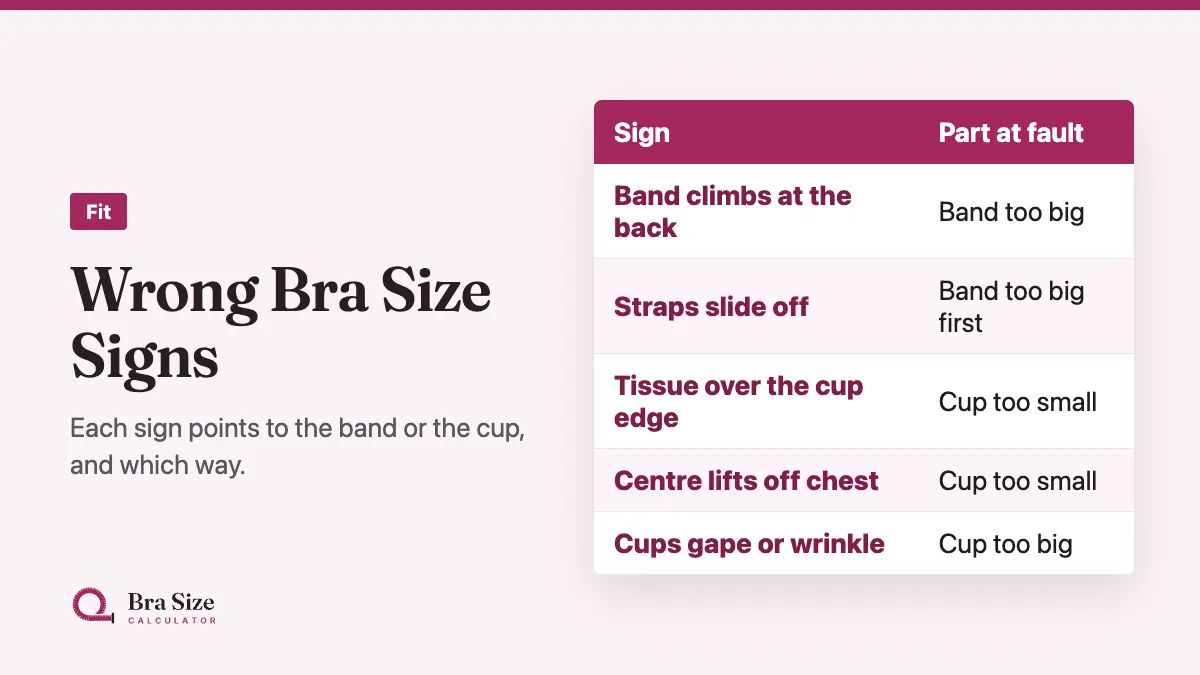
The cups should hold all breast tissue, with no bulge over the edges and no empty folds. A bulge where the cup edge cuts a line means the cup is small, and wrinkles in the fabric mean it is big or the wrong cut.
How to tell if a bra fits by feel
Feel alone is right only about half the time. In a study of 24 women in underwired bras (Haworth et al. 2025), what the women said about their own fit matched the research check in only 51% of cases.
- Wire on breast tissue: felt in all 9 cases, so trust that discomfort.
- Cup too small: felt in all 6 cases, with 13 false alarms, so look for a bulge before going up a letter.
- Cup too big: noticed in only 8 of 15 cases, so check for wrinkles anyway.
Cup feel can also change across the month. A 2019 study (Wang et al.) scanned the breasts of 13 women eight times in one menstrual cycle and found volume rose, then fell.
How the underwire and centre front should sit
Each wire should follow the breast crease and rest on the ribcage, ending behind the breast tissue under your arm. The centre panel between the cups should lie flat on the breastbone.
When the centre front lifts, check the band first. If the band is level and firm, Portsmouth suggests going up a cup. When a wire sits on tissue but the cups and band both pass, Portsmouth says the style may not suit your shape. Try another cut in the same size.
How should bra straps fit
Straps should keep the bra in place without digging, and they are checked last because they do not carry the main load. A strap that slips or digs often clears once the band is firm, so fix the band before you shorten or loosen the straps.
Common bra fit problems and the size to try
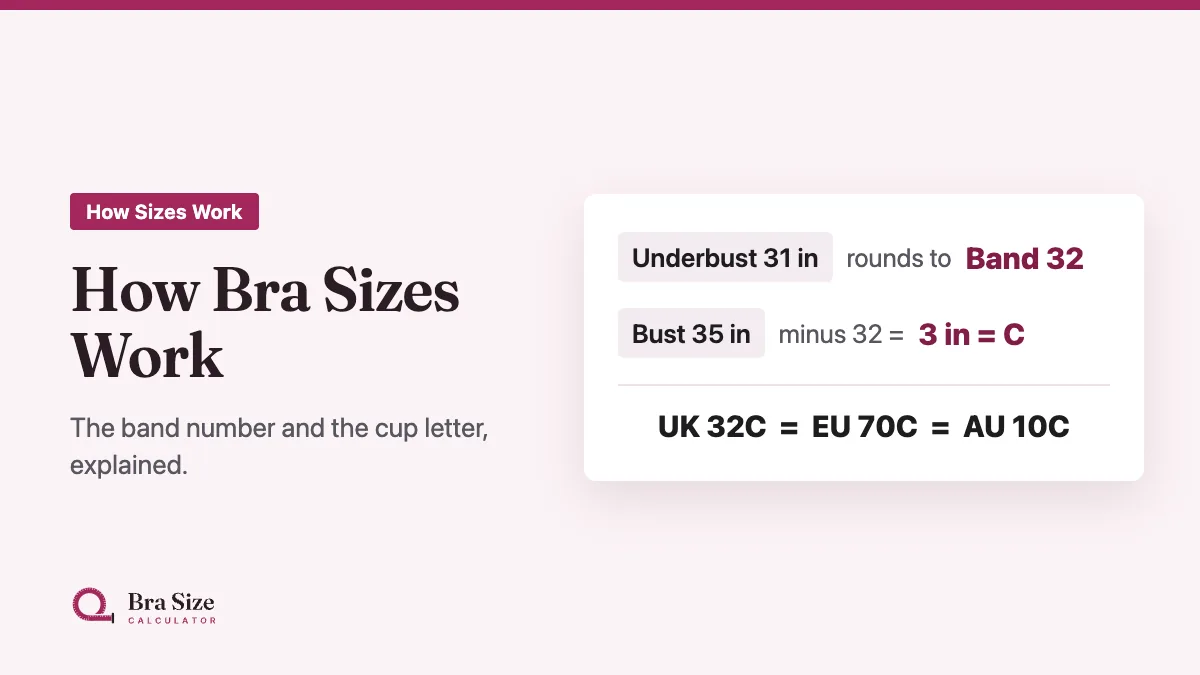
Each fit problem points to one size move: a band fault changes the band number, a cup fault changes the letter, and a style or worn-band fault keeps the size. Every line starts from a UK 40D, and UK and US letters match here except 38E, which US charts call 38DDD.
- Band riding up at the back, more than 2 in (5 cm) of pull: band too loose, try 38DD.
- Band too tight, with pain or a deep mark on the loosest hook: band too small, try 42C.
- Tissue bulging over the top or sides: cup too small, try 40DD.
- Cup gaping that stays after you lean in and scoop: cup too big, try 40C or another cut.
- Underwire poking or hurting though the cups hold everything: same size, different style.
Only the band lines use sister moves, which the sister size chart lists for every size. If 38DD fixes a riding band but tissue now bulges over the top, the cup was small too, so try 38E (US 38DDD).
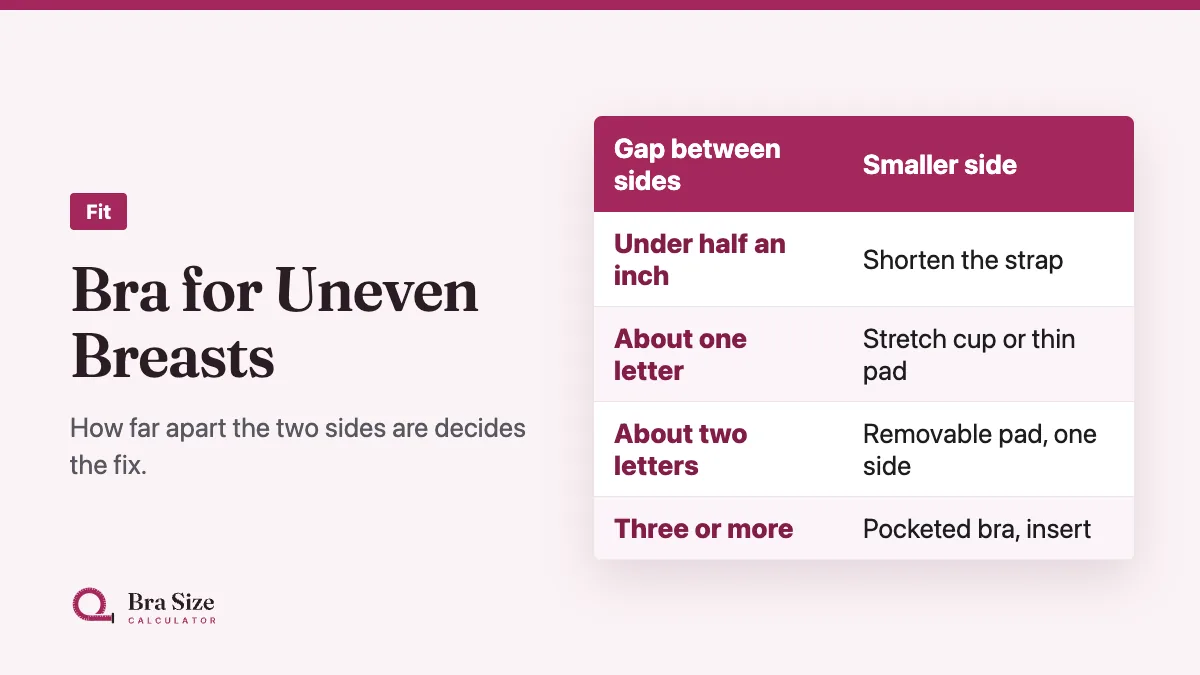
When the left and right cups fill differently, fit the cups to the larger side and shorten the strap on the smaller side. Portsmouth notes that most women have one breast bigger than the other.
Why do my bras never fit right
Bras that never fit usually come down to the size method, your shape, the brand or worn elastic.
- An older plus-four chart adds inches to the band, so measure your band size from the underbust as it is.
- Shape, not size. If band and cup both pass but the wire sits on tissue, try another cup style in the same size.
- Brands size differently, so treat your usual size as a fresh starting point with a new brand.
- The band has stretched. A bra that fitted on the loosest hook and now rides up on the tightest one has worn out.
Bra fitting with a fitter or at home
A shop fitting starts with the same two tape readings you can take yourself, which how to measure bra size walks through. A fitter then runs the checks above on you. How should a bra fit when a fitter chose it? The same way as one you sized yourself, so run the five checks before you pay.
Fitted bras still fail often. In Haworth et al. 2024, 24 UK women with larger breasts and long-term back pain all failed in their own bras, and 21 of 24 standard bras (87.5%) still failed after a professional fitting. Its group was small and specific, with a median size of 34FF.
FAQ
Should a new bra feel tight?
A new bra should feel firm on the loosest hook, with about 2 in (5 cm) of pull at most, but it should never hurt. If the band digs or leaves a deep mark on the loosest hook, it is too small.
What hook should a new bra go on?
Use the loosest hook while the bra is new. Most fit guides give that advice, though one retailer says the middle hook, because bands stretch with wear and the tighter hooks take up that stretch later. A new bra that needs the tightest hook from day one has a band that is too big.
How do you check a bra without underwire?
Run the usual band, cup, centre front and strap checks, and look at the bottom seam of each cup, where a wire would sit. It should lie on the ribcage under the breast, not on breast tissue.
Who should get a professional bra fitting?
Anyone can book one, but it helps most when your bust is at least 14.5 in (36.8 cm) bigger than your band size, which is beyond the standard chart. It also helps when every bra fails the same check, or after breast surgery, when the surgeon or a breast care nurse should answer any medical questions first.
How often should you check your bra size?
Check it again whenever your body changes and whenever you buy from a new brand. The University of Portsmouth Research Group in Breast Health notes that breasts change shape and size through life, and that sizes differ between shops.
Conclusion
Tape numbers and a calculator result give you a size to start from. A bra fits when its band holds level and firm on the loosest hook and the cups, wire, centre front and straps all pass after it. If the band is fine and only the letter looks wrong, the cup size chart shows which letter comes next in UK and US sizing.