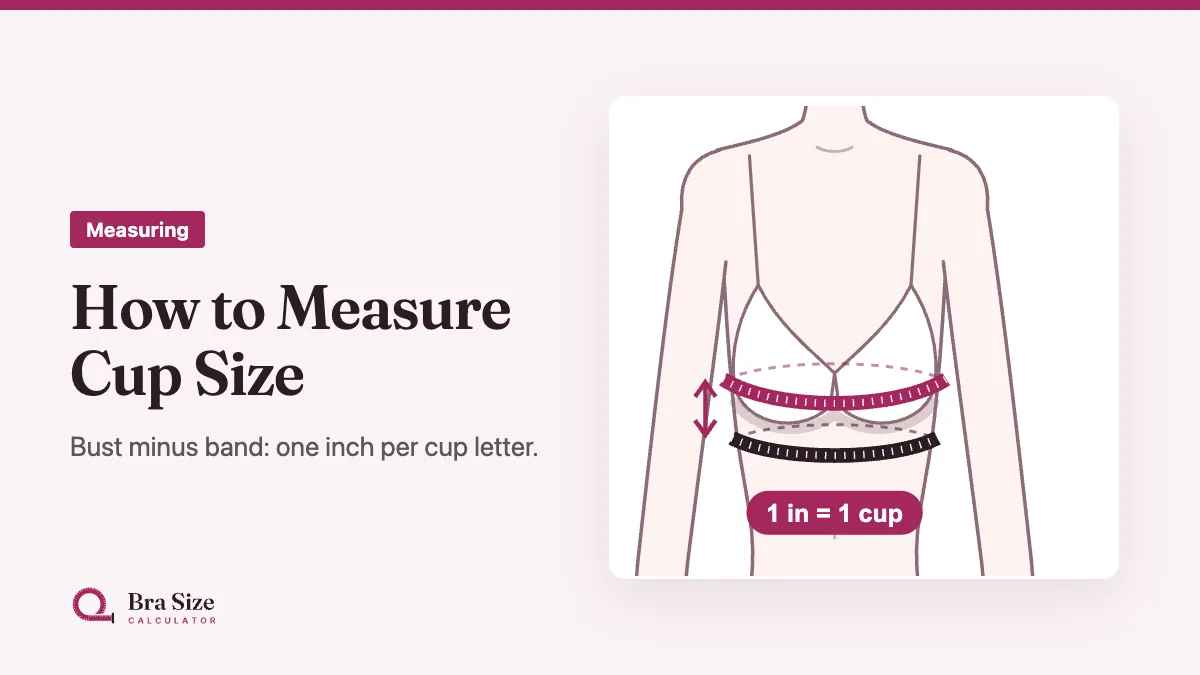
Your cup is the gap between two numbers: your bust and the band you wear. Every whole inch (2.5 cm) of gap is one step up the letters, so 1 in is A, 3 in is C and 5 in is DD. The steps below show how to measure cup size at home with one subtraction and one rounding rule, where any half goes up.
Table of Contents
What does cup size measure?
Cup size measures how far your bust stands out past your band, counted in whole inches, not the volume a cup holds. Each inch is one letter, so a D on a 38 band is a bigger cup than a D on a 32 band.
How to measure cup size in two steps
Step 1 gives you a band number and a bust reading, and Step 2 subtracts one from the other to read the letter. Work in inches if you can; cm readers convert before they subtract. The bra size calculator does both steps from your two tape readings and prints the letter in each system.
Step 1, get your band number and bust reading
Your band is your snug ribcage reading rounded to a whole inch, with an odd number moved up to the next even one, as how to measure band size explains.
For the cup, use the standing bust, or the leaning bust if it reads larger, placed as in measuring your bra size step by step.
Step 2, subtract and read the letter
Take the band number away from the bust, then round the gap to a whole inch. Any half goes up, and each whole inch is one letter. With band 32 and a bust of 36 in (91.4 cm), 4 in is left, so the cup is D.
Measuring cup size in cm
On a metric tape, how to measure cup size stays the same apart from one conversion before you subtract. Divide each centimetre reading by 2.54, keep the decimals, and round only the final gap.
Say the tape shows 82 cm at the ribcage and 93 cm at the fullest point. Dividing 82 by 2.54 gives 32.3 in, an even 32 once rounded. The 93 cm converts to 36.6 in, and 36.6 minus 32 leaves 4.6 in. That gap becomes 5 when rounded, so the size is 32DD.
Cup size chart by inches of difference
The chart turns a rounded gap into a letter: 1 in is A, 4 in is D, and from 6 in up the UK and US letters differ. Find your whole number in the left column and read across; the inch and cm edges of each row are shown too.
| Rounded difference (in) | Bust minus band (in) | Bust minus band (cm) | UK cup | US cup |
|---|---|---|---|---|
| 0 | minus 0.5 to under 0.5 | minus 1.27 to under 1.27 | AA | AA |
| 1 | 0.5 to under 1.5 | 1.27 to under 3.81 | A | A |
| 2 | 1.5 to under 2.5 | 3.81 to under 6.35 | B | B |
| 3 | 2.5 to under 3.5 | 6.35 to under 8.89 | C | C |
| 4 | 3.5 to under 4.5 | 8.89 to under 11.43 | D | D |
| 5 | 4.5 to under 5.5 | 11.43 to under 13.97 | DD | DD |
| 6 | 5.5 to under 6.5 | 13.97 to under 16.51 | E | DDD |
| 7 | 6.5 to under 7.5 | 16.51 to under 19.05 | F | G |
| 8 | 7.5 to under 8.5 | 19.05 to under 21.59 | FF | H |
| 9 | 8.5 to under 9.5 | 21.59 to under 24.13 | G | I |
| 10 | 9.5 to under 10.5 | 24.13 to under 26.67 | GG | J |
| 11 | 10.5 to under 11.5 | 26.67 to under 29.21 | H | K |
| 12 | 11.5 to under 12.5 | 29.21 to under 31.75 | HH | L |
| 13 | 12.5 to under 13.5 | 31.75 to under 34.29 | J | M |
| 14 | 13.5 to under 14.5 | 34.29 to under 36.83 | JJ | N |
A rounded gap of 14 in, UK JJ or US N, is where the standard chart ends. Anything from 14.5 in (36.8 cm) of raw gap upward needs a brand that sizes past JJ.
Which letter system is your result in?
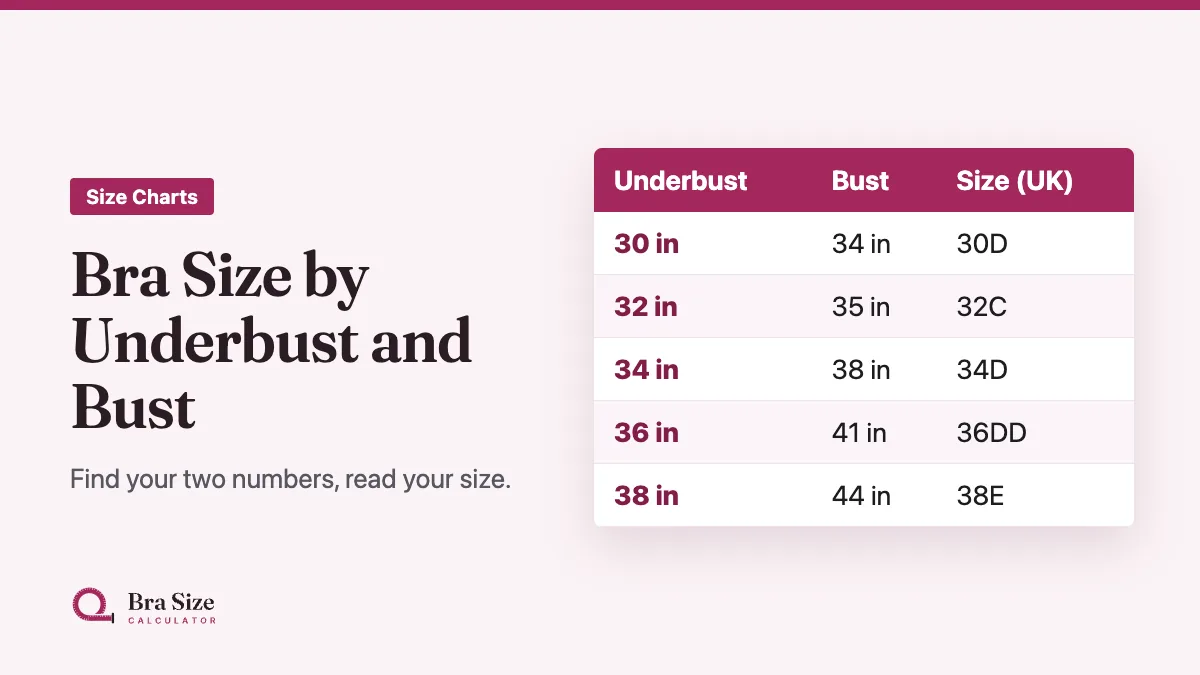
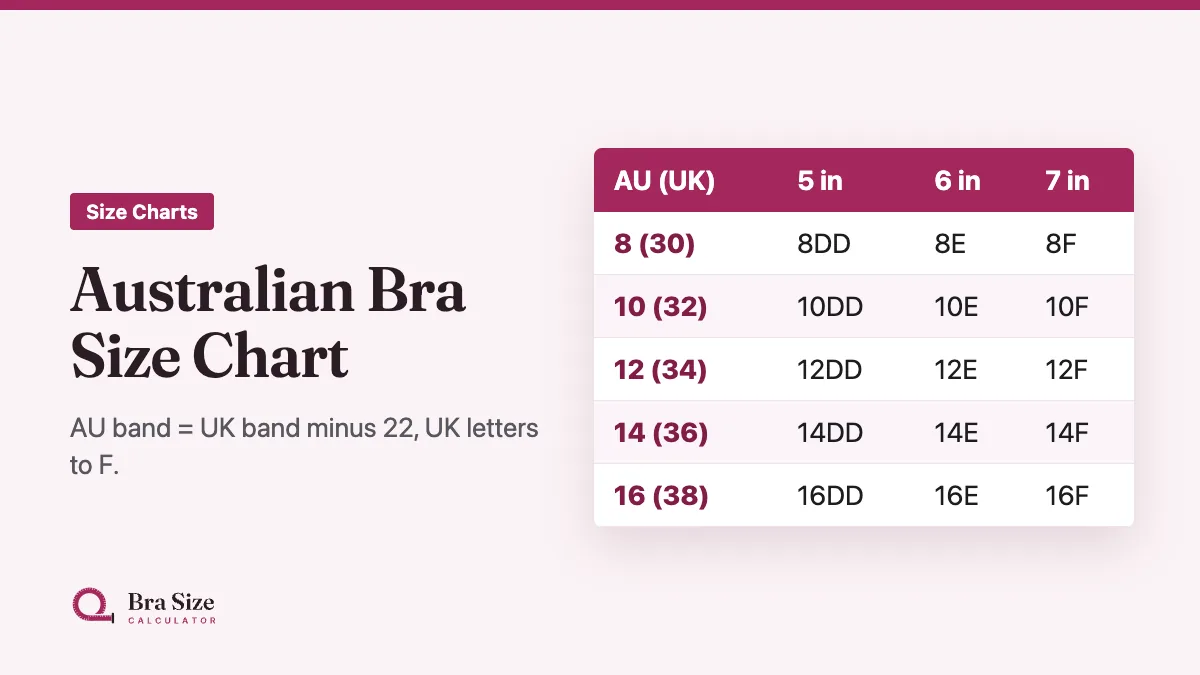
The same printed letter can stand for a different gap. A UK G needs 9 in over the band, but a US G needs only 7 in, so write UK or US next to your letter. The EU, French and Australian letters for every step are lined up in the cup size chart for UK, US and EU letters.
What if the gap is half an inch?
Half an inch always rounds up. Over a 38 band, a bust reading 40.5 in (102.9 cm) leaves 2.5 in, which counts as 3, so the cup is C rather than B.
A reading that lands right on a half is the one most likely to change with a slightly looser or tighter tape. Measure the bust three times and keep the middle number. Do the three readings still sit either side of the line? Then try the B and the C on the same 38 band. Keep whichever passes the five-point bra fit check.
Subtract the band number, not the underbust
The cup is built to sit on the band printed on the label, so the gap is counted from that band. Taking away the raw tape underbust instead gives a different gap whenever the two numbers differ.
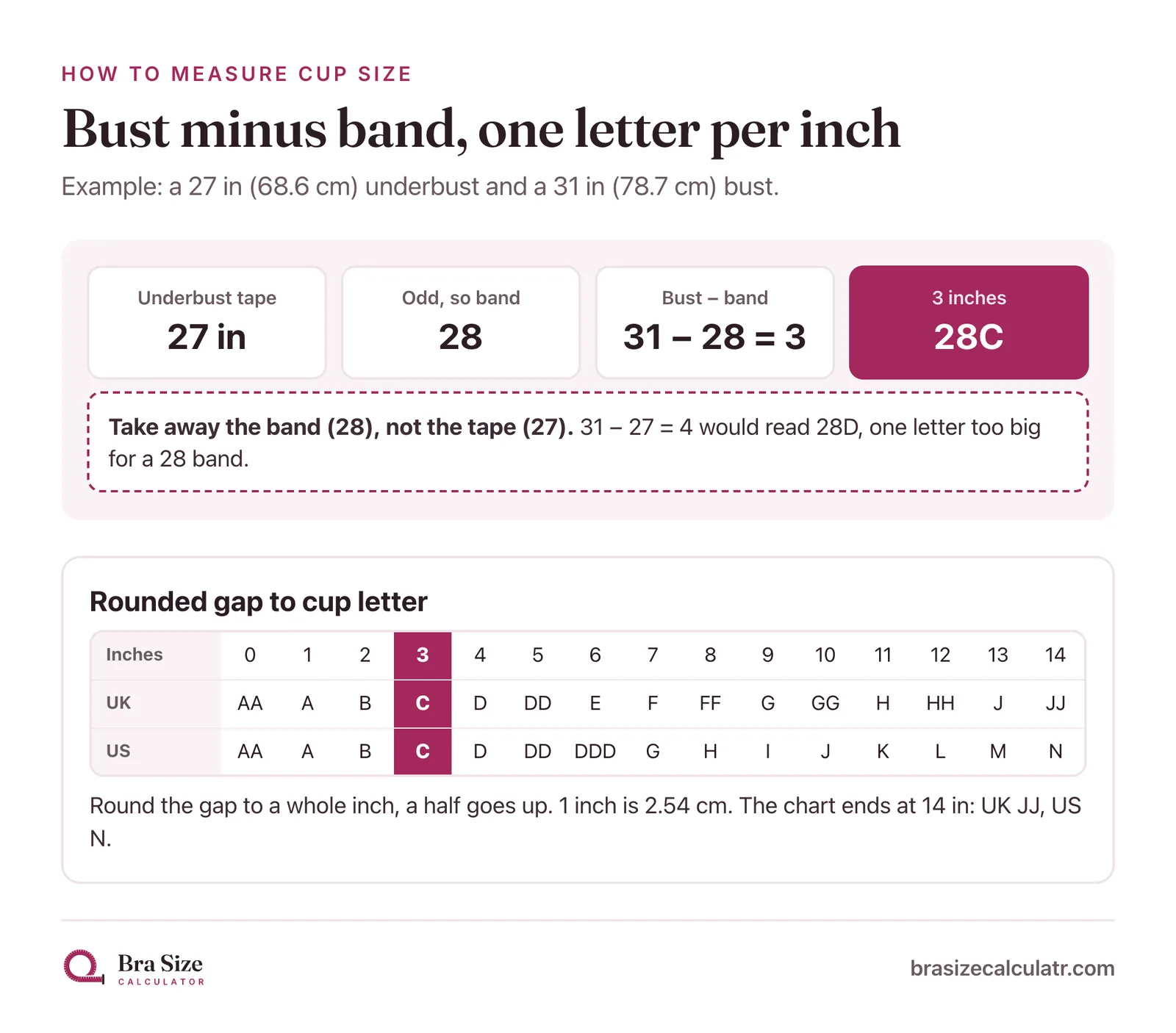
Picture a reader whose ribcage measures 27 in (68.6 cm) and whose bust measures 31 in (78.7 cm).
| Step | Inches | cm | Result |
|---|---|---|---|
| Underbust tape | 27 | 68.6 | Odd, so band 28 |
| Bust tape | 31 | 78.7 | Fullest point, standing |
| Bust minus band 28 | 3 | 7.6 | 28C |
| Bust minus tape 27 | 4 | 10.2 | 28D |
Some online tools subtract the tape number, which is why two of them can hand the same body a 28C and a 28D. The 28C is the one that matches the 28 on the tag. A 28 band also has no smaller standard band below it, so this reader gets no second band to try.
The same trap works in cm. With the 82 cm and 93 cm readings above, 93 minus 82 is 11 cm, or 4.3 in, which reads D. Counted from the 32 band instead, the gap is 4.6 in and the cup is DD.
When do the two ways split? Your band number sits anywhere from 0.5 in below your tape underbust to 1.5 in above it. The higher it sits, the more the raw method inflates the gap. An odd underbust such as 27 in puts the band a full inch above the tape, so the raw method reads exactly one letter more.
How much can a leaning reading change the letter?
For the reader below, a leaning bust that reads 4 cm (1.6 in) more than the standing one moves the cup by two letters. The table follows a made-up reader, not study data, with a 90 cm (35.4 in) underbust.
| Bust reading | Band (in) | Bust used (in / cm) | Gap (in) | Size |
|---|---|---|---|---|
| Standing | 36 | 40.94 / 104 | 4.94, rounds to 5 | UK and US 36DD |
| Leaning 90 degrees | 36 | 42.52 / 108 | 6.52, rounds to 7 | UK 36F, US 36G |
On the tape, 35.4 in becomes 35, and an odd 35 moves up to band 36. Bending forward added 4 cm (about 1.6 in) to the bust. In UK letters that walks the cup from DD past E to F.
The calculator would report 36F here, since it keeps the larger of the two bust readings. An older plus-four chart would put this reader on a 40 band with a much smaller letter. Why one letter holds a different cup on each band is explained in how band and cup letters work together.
Is a tape cup accurate for larger busts?
Most guides on how to measure cup size stop at the tape, but in one small study the traditional tape method missed most on larger and lower-sitting breasts. Treat the letter as your first size to try, and cross-check it when your bust is large.
McGhee and Steele (2006) tested the traditional plus-four tape method on 16 women aged 19 to 40, all C cup or larger. Measured on a breath out, its cup came within one size of each woman's usual cup for only 4 of the 16. On a breath in, it managed 1. The method read the cup too small, and the misses were widest in larger breasts that droop, which hung lower and varied more in shape when standing.
Their yardstick was the size each woman said she wore, not a professional fitting.
How to measure across one breast
Lie on your back without a bra. Lay the tape under one breast from the inner fold to the outer fold, passing over the nipple, without pressing in. Read it in inches. A string marked at both folds and laid on a 12 in (30.5 cm) ruler works just as well.
The scale belongs to Pechter's breast hemi-circumference method. In it, 7 in (17.8 cm) is an A and 8 in (20.3 cm) is a B, with one inch for each further cup. That puts 9 in (22.9 cm) at C and 10 in (25.4 cm) at D. Pechter (1998) proposed measuring the breast itself because standard sizing missed so often, and McGhee and Steele printed the letter scale.
Among their 16 women, the across-the-breast reading matched the usual cup for 6 and came within one cup for 7 more. The same paper cites Pechter's finding of a 2 in (5.1 cm) difference between lying and standing readings across the breast in large-breasted women.
Use this check to question a tape letter, not to replace it; the calculator does not take it as an input. If it points well above your tape result, re-measure with a leaning bust and try both sizes on.
Measure both breasts, because the larger reading sets the cup.
Signs your cup size is wrong
Breast tissue bulging over the edge points to a cup that is too small. Wrinkles or empty space point to one too big, or a poor match for your shape. A bigger measured letter can still gap if the reading itself ran high. Measuring over a padded or moulded bra adds the padding to your bust number, which reads the cup larger than your body is.
Measure again in a thin unpadded bra, or none, and compare the standing and leaning readings before you change size. If the cup still gaps after a careful re-measure, try the letter below on the same band, then a different cup shape if that gaps too.
FAQ
Will cup size be the same in all measurements?
No. The letter is counted from whatever band it sits on, so a smaller band leaves a bigger gap. A 34 in (86.4 cm) bust leaves 2 in over a 32 band, which is B, and 4 in over a 30 band, which is D.
Why are bras measured in cups?
S.H. Camp and Company brought in cup letters in 1932. On a modern tape chart the letter counts how many inches the bust stands out past the band, so it names a step of difference, not a container of fixed size.
How do you measure cup size in cm?
Divide the cm bust by 2.54, take away your band number, and round only that final gap. An 88 cm bust is 34.6 in, so on a 32 band it leaves 2.6 in, a C. EU tags use their own chart of about 2 cm per cup step, so read the brand's EU chart for those.
Can I use my cup size for swimwear or a sports bra?
Yes, when it is sold by band and cup, because it uses the same two readings. For swimwear, or a sports bra sold as S, M or L, match your two numbers to that brand's own chart for the garment.
Does a cup size calculator work for Asian sizes?
The tape readings are the same, but the label differs. Japanese bands use cm numbers like EU bands, but Japanese cup letters have no agreed match to UK letters, so use the brand's own chart.
What if my bust and underbust are the same?
Equal readings give a gap of 0, which reads AA, as long as the bust is no more than 0.5 in (1.3 cm) below the band number. Further below that there is no smaller standard letter, so look at AA or AAA sizes, a smaller band, or a bralette.
Conclusion
Subtract your band number from the larger of your standing and leaning bust, round any half up, and read one letter per inch. Use that letter as a first size to try on. Then compare it with the bust ranges in the bra size chart and each brand's own chart, because bra sizes vary by brand.