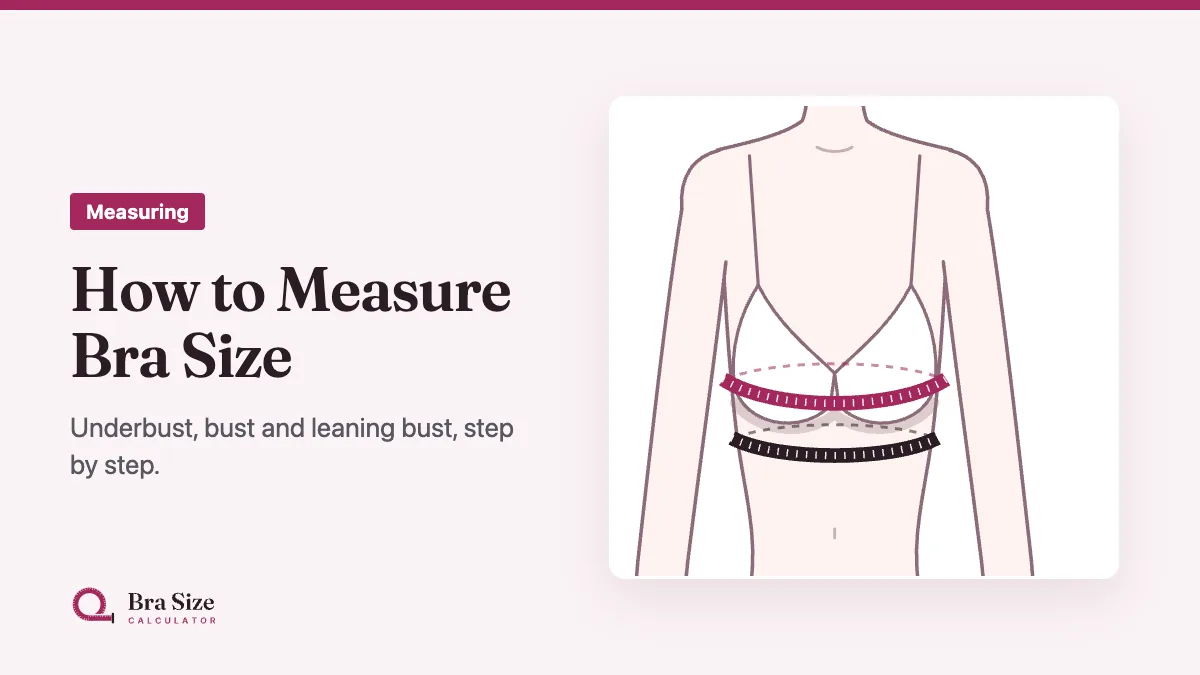
You measure bra size with two soft-tape readings: the snug underbust sets the band, and a loose bust across the fullest point sets the cup. Each inch (2.54 cm) the bust is bigger than the band adds one cup letter. Read both after a gentle breath out. The routine below shows how to measure bra size alone, with a mirror instead of a helper. The bra size calculator turns the pair into a size to try on.
Table of Contents
What you need to measure bra size
You need a soft tape, a mirror, and either a thin bra without padding or no bra at all.
- A soft cloth or plastic tape marked in inches or cm. A metal tool tape will not curve round the ribcage.
- A mirror, ideally full length, so you can see the tape at your side.
- Paper or a phone note for each reading.
A string or charger cable marked where the ends meet and laid on a ruler gives a rough figure.
Bra on or bra off
Measure on bare skin or over a light unlined bra. Foam cups, push-up inserts and the squeeze of a sports bra each shift the bust number.
Wearing a bra does change the number. In a 2006 study of 16 women, McGhee and Steele found the bust tape read larger with a bra on than with the breasts hanging unsupported. The European sizing standard, EN 13402, takes the bust standing during normal breathing, ideally over the type of bra you plan to buy.
A light bra holds tissue close to where a new bra will hold it. Bare, a bust that sits low can read small, which is the job of the leaning reading in Step 3.
Measuring by yourself
You can work out how to measure bra size without a helper if the tape stays level at the back. Check it in the mirror before each reading.
- Hold the zero end of the tape at the front, wrap it round, and read the number where the two ends cross at the front.
- Turn side-on to the mirror, or take a timer photo of your back, to check the tape is level.
- Lower both arms to your sides before you read.
- For Step 3, leave the tape loose round your chest, lean forward, and pinch the point where the ends meet. Stand up and read the number at your fingers.
If someone helps, let them watch the back of the tape while you hold the front and control your breathing.
Step 1, measure your underbust
Wrap the tape round your ribcage directly under your breasts, level all the way round and snug enough not to slip. Read it after a gentle breath out. The underbust becomes your band, the part of a bra that carries most of the support.
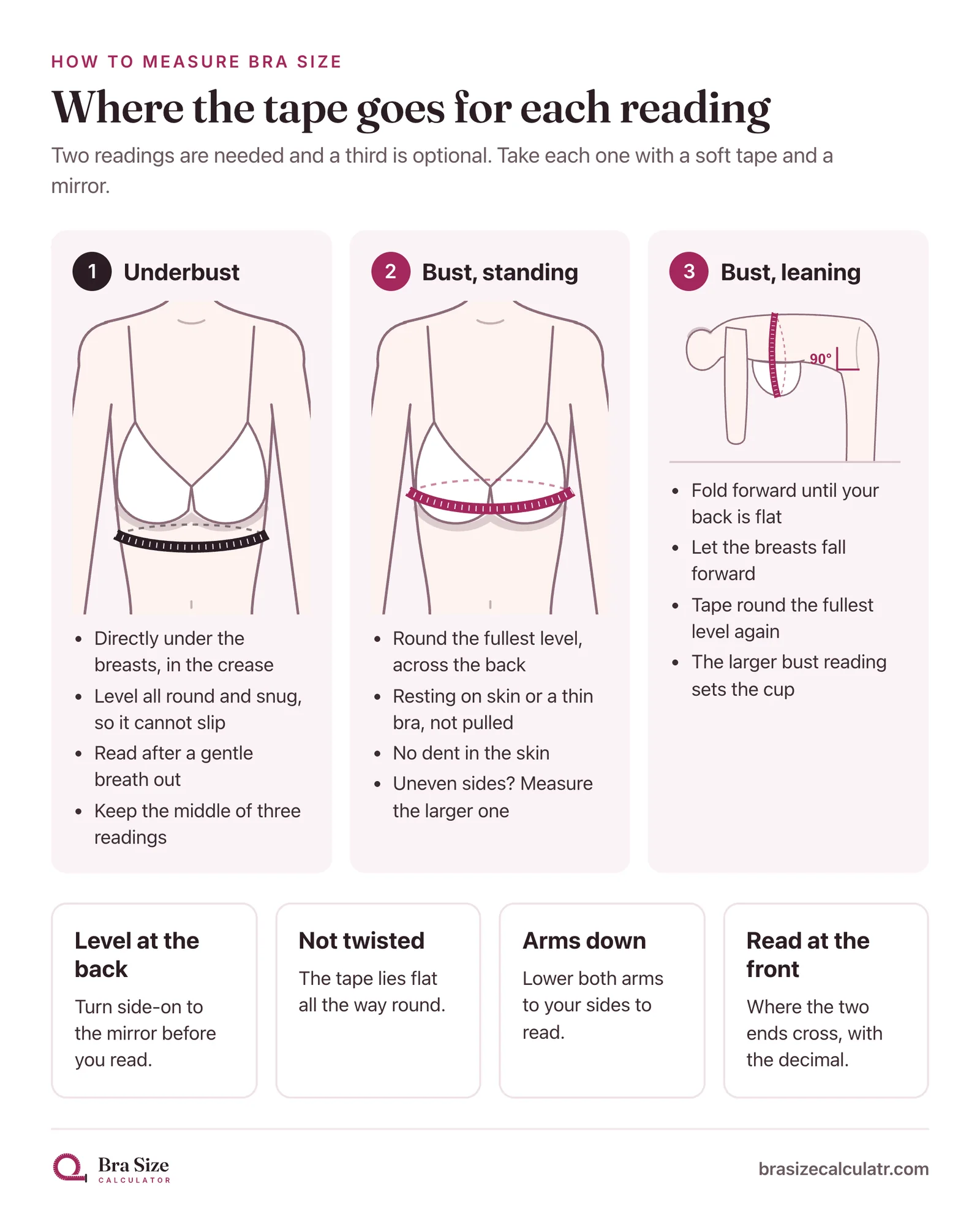
Check three things first. The tape is not twisted. It sits on your body, not on top of a bra band. It hugs the line where each breast meets the ribcage, which is where EN 13402 places the underbust: level, just below the breasts.
Keep the middle of three readings. One bad reading from a slipped tape then cannot throw your size off.
Step 2, measure your bust standing up
Stand straight and run the tape round your bust at its fullest level, which EN 13402 calls the bust prominence, and level across your back. It should rest on the skin or a thin bra without pulling.
A tape that leaves a dent is too tight, and a too-tight bust tape makes the cup come out small.
A side view in the mirror shows where the fullest level is. When one breast is larger, take the tape across the larger side. Small differences between sides are normal. In an MRI study of 15 women, Hussain and colleagues (1999) found the sides differed by about 40 ml on average, 7% of breast volume.
A bust number on its own is not a bra size, and bust size covers how the same figure is used on clothes.
Step 3, measure your bust leaning forward
Fold forward at the waist until your back is flat and your chest faces the floor, about 90 degrees. Let your breasts fall forward, then wrap the tape round the fullest level again without pulling.
The calculator takes whichever bust reading is larger for the cup, because breast tissue that falls forward still needs room inside the cup. The leaning number tends to win for breasts that are soft or sit low on the chest.
The calculator runs from band 28 to 56.
Lying on your back as a cross-check
Some people also take the bust flat on their back. The tape goes round the same widest line, resting on the body, and that figure is written beside the other two.
The calculator does not use this number. It is one of six readings that a longer online sizing method asks for, next to standing and leaning bust and loose, snug and tight underbust. If your lying number sits more than 1 in (2.5 cm) away from both other bust readings, re-take all three before you trust any of them.
Step 4, turn your numbers into a size
Round the underbust to the nearest whole inch for the band, then take the band away from the larger bust reading. Each whole inch left over is one cup letter.
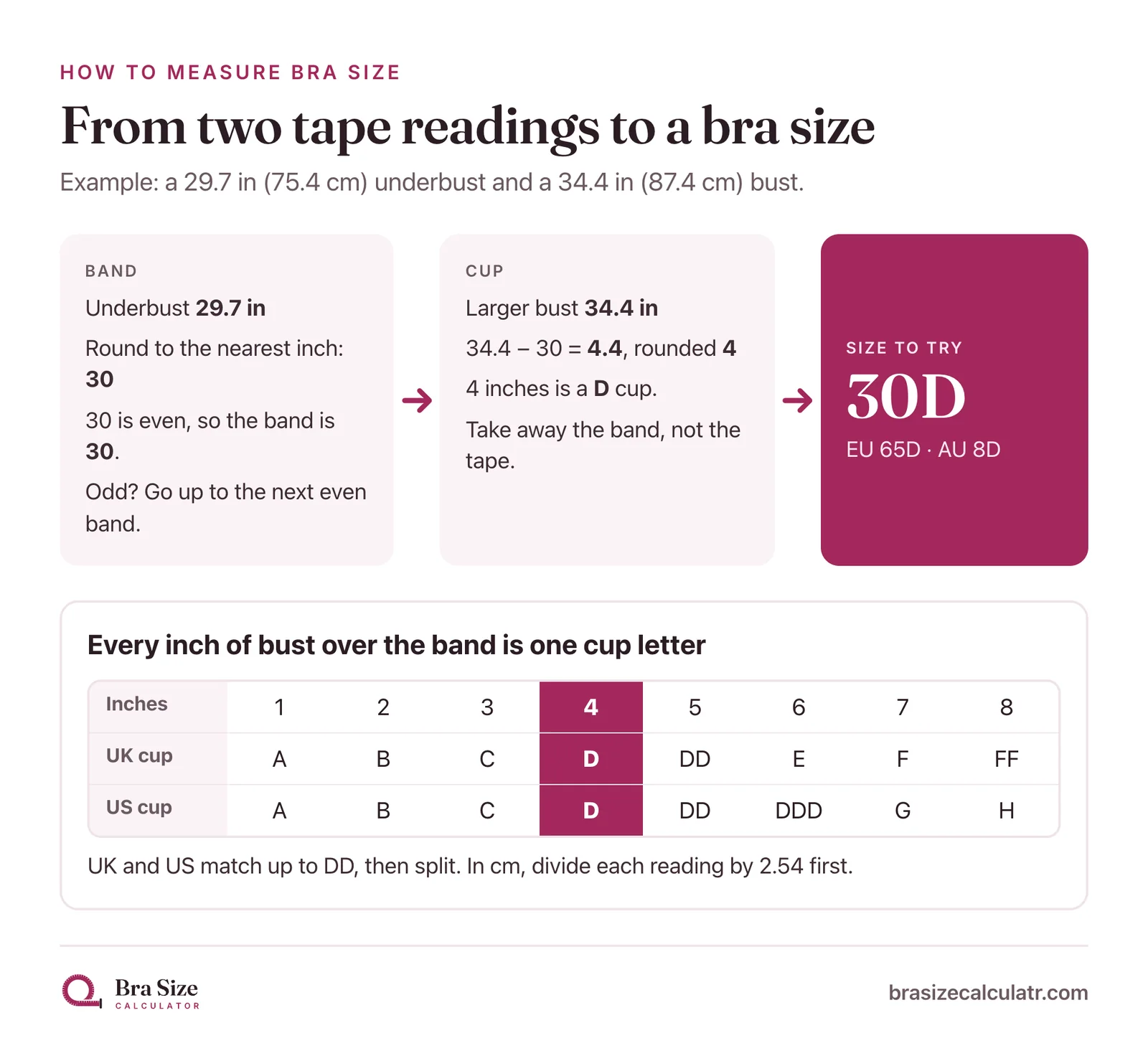
Keep an even result as it is and move an odd one up by one; the guide on how to measure band size covers when the band below suits better.
Say your underbust comes to 29.7 in (75.4 cm) and your bust to 34.4 in (87.4 cm). 29.7 becomes 30, already even, so the band is 30. Take 30 from 34.4 and 4.4 is left. Rounded, that is 4, a D cup, so the tape points to 30D.
To look your two numbers up instead of doing the sum, the bra size chart gives bust ranges for each band and cup. Separate lookup tables by underbust and bust read both numbers at once.
Treat 30D as the size to try first. In White and Scurr's 2012 study of 45 women, the traditional plus-four tape method strayed further from a good fit as bands got bigger. Any tape result, this one included, still needs a try-on.
How to measure bra size in cm
A cm tape changes nothing about how to measure bra size, only the sum at the end. Turn each reading into inches by dividing by 2.54, or switch the calculator to cm, and round last.
Take a 72 cm underbust and an 85 cm bust:
- 72 cm is 28.35 in. Round it to 28, an even number, so the band is 28.
- 85 cm is 33.46 in.
- 33.46 take away 28 is 5.46 in. Rounded to 5, that is a DD cup.
- The size is 28DD in UK and US sizing.
Just 1 cm more bust changes the letter. An 86 cm bust is 33.86 in, a gap of 5.86 in, and 5.86 rounds to 6: UK 28E or US 28DDD. When the difference ends near .5, as 5.46 does, measure again before you choose.
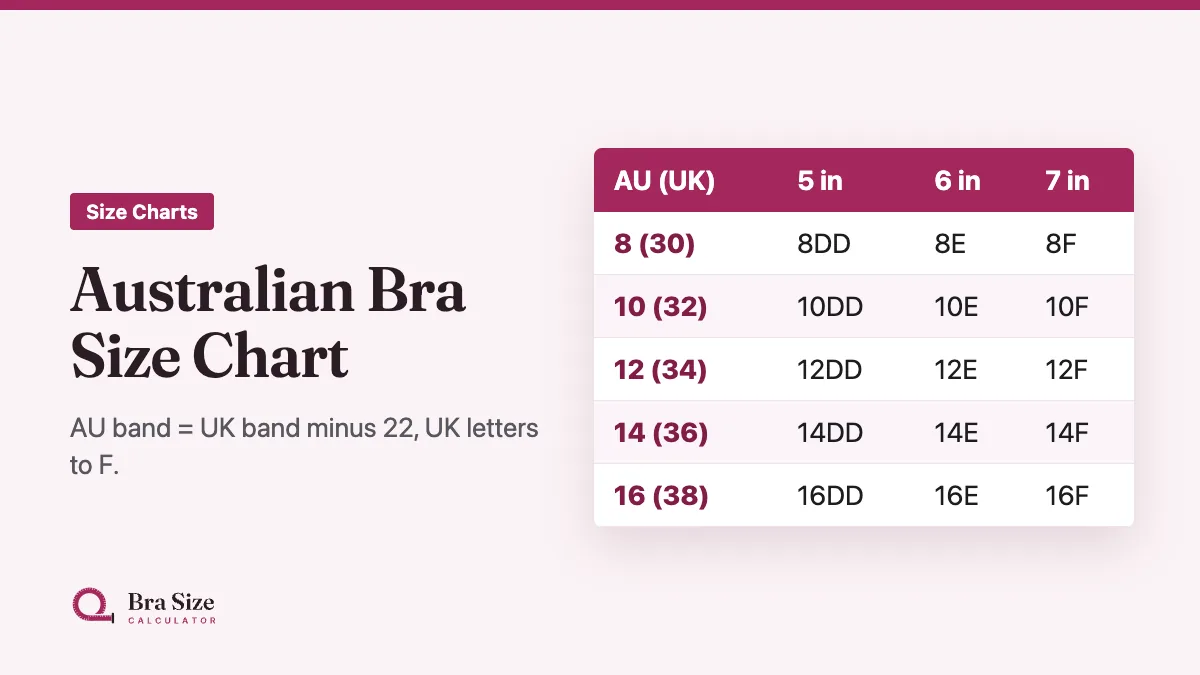
A chart that adds 4 to the band calls the same body 32A, since 28 plus 4 is 32 and only 1 in is left for the cup. Some Indian brand labels are still sized that older way. Europe's own cm sizing rule also lands near 32A rather than 28DD, and how bra sizes work sets out where the cm and inch rules part ways.
UK vs US bra sizes
A tape result reads the same in UK and US sizing until the rounded gap reaches 6 in, so the 30D from Step 4 is 30D in both. The band number never changes between the two. The 86 cm bust from the cm example is where they part: UK 28E, but US 28DDD. Shop in the system the label uses, and how to measure cup size lists every letter past that point. For UK tags, find your band row on a UK size chart and read across, and for US tags use the US bra size chart.
Measuring mistakes that change your size
Most wrong results come from where and how the tape sits, not from the sum.
Each row shows which way one mistake pushes the band and the cup.
| Mistake | What happens to the reading | What happens to the size | Fix |
|---|---|---|---|
| Holding a breath in for the underbust | Underbust reads larger | Calculated band about 2 in (5 cm) larger on average in McGhee and Steele 2006 (16 women); cup smaller | Breathe out gently, then read |
| Tape loose under the bust | Underbust reads larger | Band up, cup down | Snug tape, lying flat |
| Tape tilted or riding onto breast tissue at the front | Read at the wrong place on the body | Band and cup both off | Keep the tape level, directly under the breasts |
| Bust tape pulled tight | Bust reads smaller | Cup down | Let the tape rest on the body |
| Padded or push-up bra | Bust reads larger | Cup up | Thin bra without padding, or none |
| Sports or compression bra | Bust reads smaller | Cup down | Take it off first |
| Standing reading only, with soft or low tissue | Bust reads smaller | Cup down | Add the leaning reading from Step 3 |
| Measuring over a top or jumper | Both read larger | Band up, cup unreliable | Measure on skin or a thin bra |
The breathing row is the only one with a measured size behind it. The rest show direction, not amount.
A tilt changes the tape length less than most people think. By simple geometry, on a chest about 31 in (79 cm) round, a tape 1 in (2.5 cm) higher at the back adds only about 0.1 in (0.2 cm). The real problem is where a tilted tape lands: on breast tissue at the front and on a different part of the ribcage at the back.
Worked example with a held breath
A held breath can push the right size up to its band-up sister size, on a band one step too loose. The 16 women in the McGhee and Steele study all wore a C cup or larger. Breathing in fully raised their calculated band size by a mean of 1.9 in and the bust by 0.75 in.
Suppose a held breath adds about 1.9 in (4.8 cm) to the underbust and 0.75 in (1.9 cm) to the bust. The study's 1.9 in was a change in calculated band size, not in the raw underbust, so treat this as an illustration. The table shows one body measured both ways.
| Reading | Breathed out | Breath held |
|---|---|---|
| Underbust | 31.5 in (80 cm) | 33.4 in (84.8 cm) |
| Bust | 36 in (91.4 cm) | 36.75 in (93.3 cm) |
| Band | 31.5 rounds to 32, even, so 32 | 33.4 rounds to 33, odd, so 34 |
| Difference | 36 minus 32 = 4 in | 36.75 minus 34 = 2.75 in, rounds to 3 |
| Size | 32D | 34C |
The tape now says 34C instead of 32D. The two share roughly one cup volume, yet the 34 band is 2 in (5 cm) longer and would ride up your back.
Check the fit against a bra you own
Compare your tape result with the label and the band of your best-fitting bra, since that bra is a free second opinion.
Find the row that matches your bra. The tape result in this table is 32D, the breathed-out size from the held-breath example.
| What your bra shows | What it suggests | Next step |
|---|---|---|
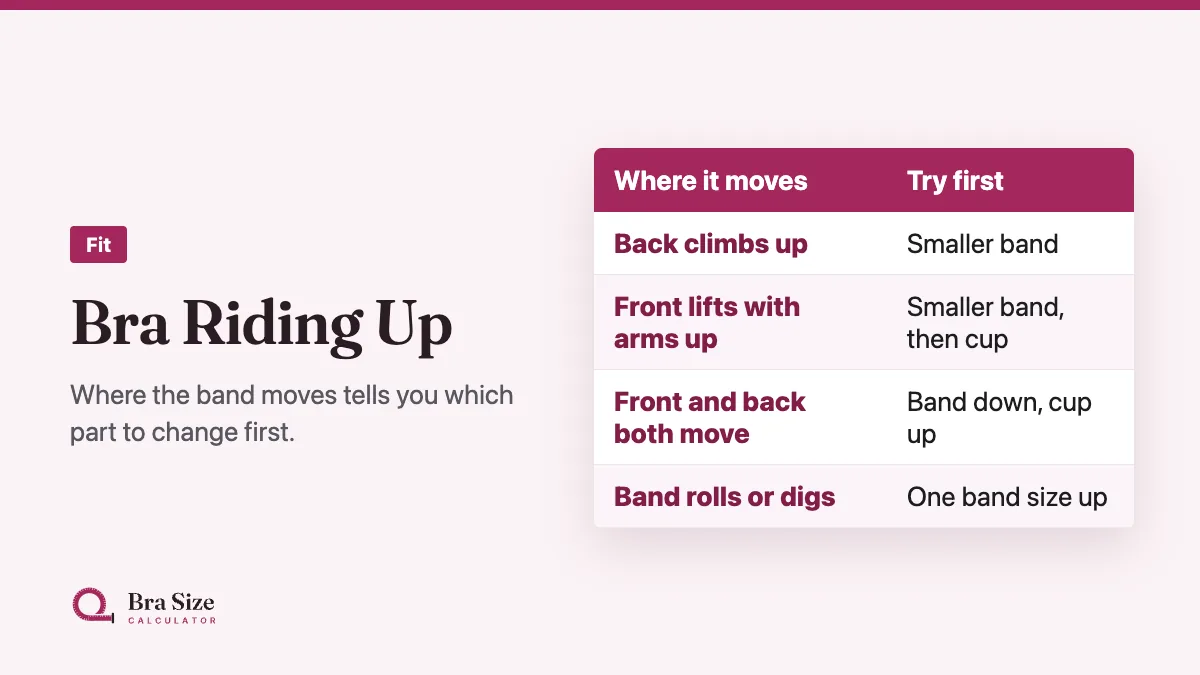
| A 34C worn on the tightest hook, or the band rides up | The band is loose; 32D is its band-down sister, so the tape agrees | Try 32D |
| A 32D that sits level and stays put | Tape and bra agree | Start with 32D |
| A 30 band that feels comfortable even on the loosest hook | The underbust tape may have been loose or taken on a breath in | Redo Step 1 on a gentle breath out |
| A label from a different brand | Labels shift between brands | Compare within one brand where you can |
When to re-measure your bra size
Re-measure whenever your usual bras begin to fit differently. If you have a monthly cycle, avoid the days just before a period and measure at the same point in your cycle each time.
Breast volume rises and falls across the cycle. In the Hussain 1999 MRI study, 14 of the 15 women were scanned at three points: during a period, at ovulation and just before the next period. Mean volume was 5.5% lower at ovulation and 8.1% higher before the period than during it.
Across the cycle, each breast varied by 76 ml on average, 13.6% of its volume during a period. An earlier study measured 4 women daily (Milligan, Drife and Short, 1975) and also found the rise in the second half of the cycle.
Both studies measured volume, not tape length, so the change cannot be read as a set number of inches or cup steps. If your bras feel tight only in the week before a period, take a second set of readings then and keep both.
Weight change, pregnancy, nursing and breast surgery are all reasons to measure again. After surgery, wait until your surgeon or breast care nurse says the area is ready.
Parents choosing a first bra size use the same two readings and should re-measure as the child grows. Write each reading down with its date, and your cycle day if you track it, so a size that seems to move shows its pattern.
FAQ
How do I measure my bust if my breasts sag or sit low?
Take the leaning reading as well as the standing one. Folding forward lets the breasts fall away from the chest, so the tape crosses all of the tissue, and the calculator uses whichever bust number is larger when it works out the cup.
Is bra size measured in inches or cm?
UK and US band numbers are inches, so a cm tape reading only needs dividing by 2.54 before you round it. EU and French labels print cm-based band numbers instead, which is why a UK 32 band is sold as EU 70.
Why do I get a different number every time I measure?
Usually the tape has moved between tries. It twists, slides up at the back, or crosses a different spot at the front. Put a fingertip on the crease under each breast before you wrap, and if two readings differ by more than half an inch (1.3 cm), start again.
Does time of day change my bra measurement?
Probably very little. In the 1999 MRI study by Hussain and colleagues, one woman was scanned at three times of day and her breast volume varied by under 3%. That is one person and a volume scan, not a tape, but the menstrual cycle changed volume far more in the same study.
How do I measure for a sports bra?
Take the same underbust and bust readings as for any bra, then match both numbers to that brand's own sports bra chart rather than guessing from the letter you usually wear.
Conclusion
The tape gives you a size to try, not a promise, and the leaning reading keeps the cup from coming out small when breasts sit low. Keep your dated notes, put the bra on, and run the bra fit check before you take the tags off.