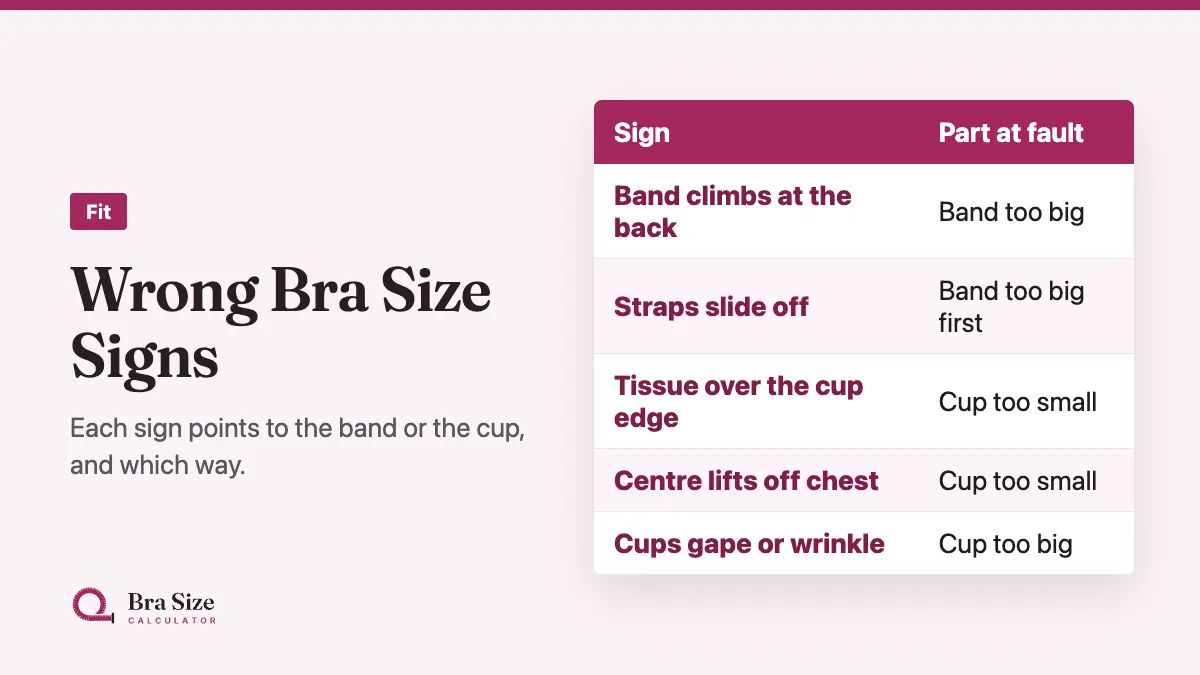
A wrong bra size shows up on the bra you already own. The band climbs or digs, straps slide, cups spill or gape, a wire sits on breast tissue or the centre lifts off your chest. Each sign points at one part and one direction. Your tape readings settle it, not the label. Give the bra size calculator your two tape readings for a size to try on first.
Table of Contents
Signs you are wearing the wrong bra size
One sign alone can be wear, a style or a strap setting. Two or more signs that point at the same part usually mean a wrong size bra. A good fit means a level band, a flat centre, smooth cups and light straps, and how a bra should fit walks through each check.
Band rides up or sits on the tightest hook
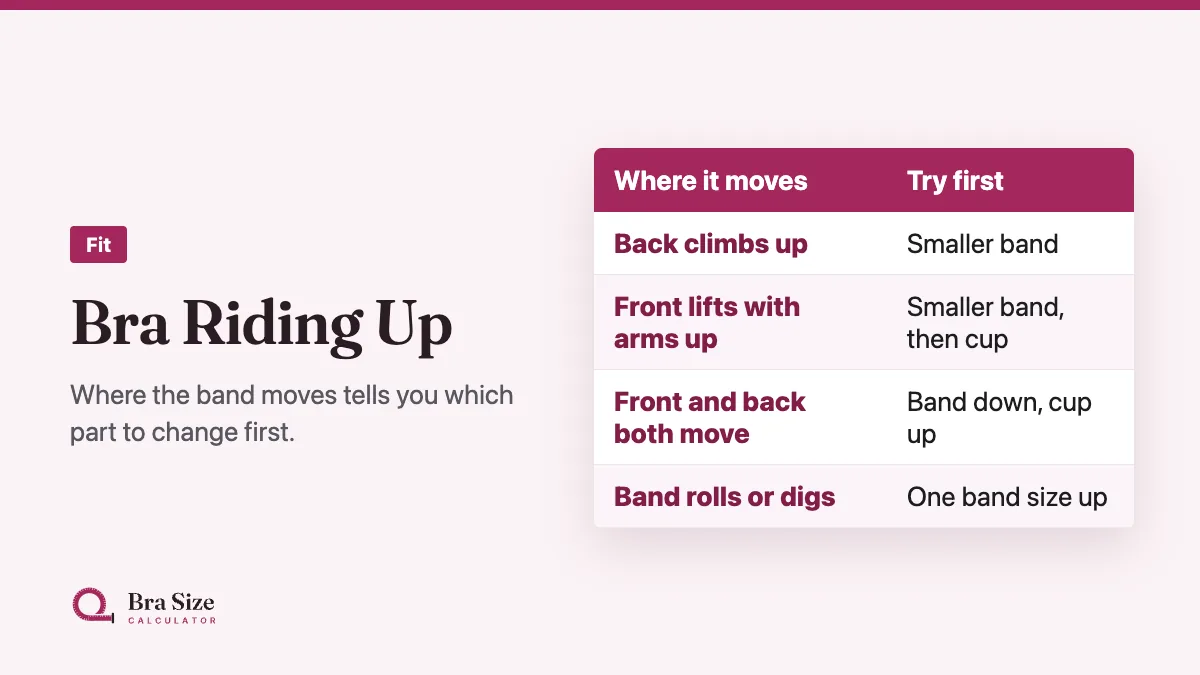
A band that climbs at the back is too big for your ribcage. A new bra should fasten on the outer hooks, leaving room to move inward as the elastic gives. If only the tightest hook holds it from day one, the band is too large. One cause is an older plus-four chart, which adds 4 in (10 cm) to the underbust, as how to measure band size sets out.
Straps slip off or dig in
Strap trouble usually starts at the back: a slack band gives the straps no anchor, so they drift toward your arms. When the band is much too big, your shoulders take the weight and the straps bite in. Length and position come second, as bra straps falling down sets out.
Breast tissue spills over the cup
Spill means the cup is too small: tissue over the top edge, a line cut across the breast, or tissue pushed out toward the arm. The fix is more cup on the same band, so recheck the letter with how to measure cup size.
Cups gape or wrinkle
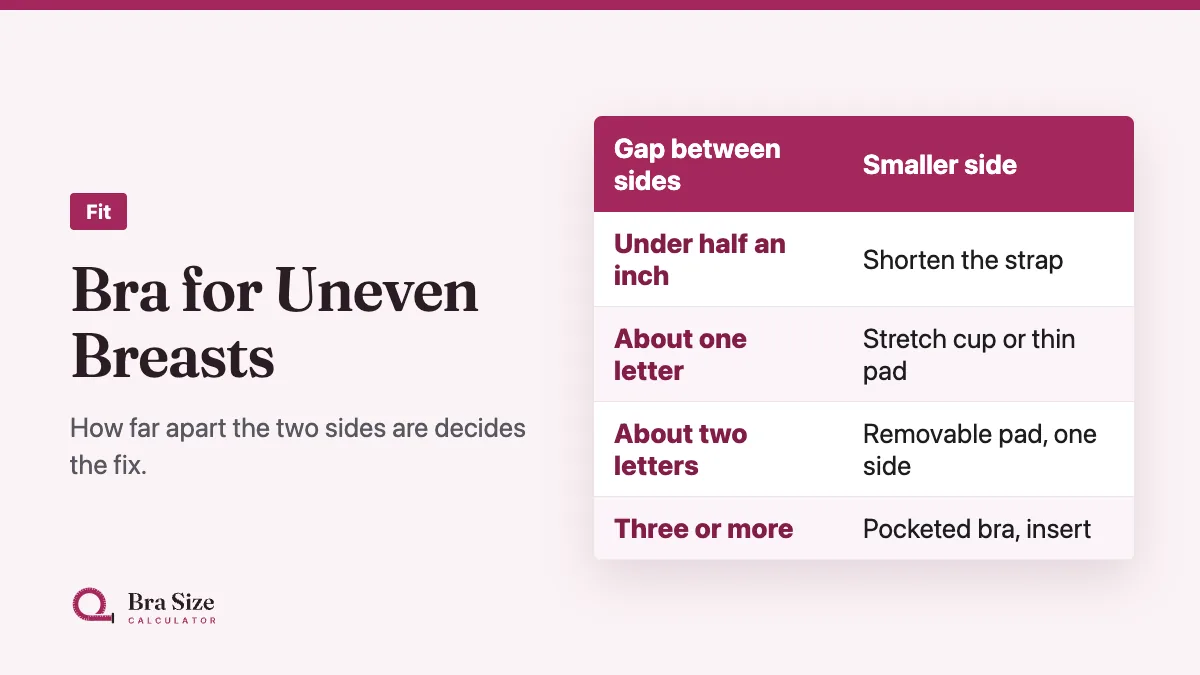
Empty space or folds in the cup point the other way: too much cup, or a cut that does not follow your breast. Where the space sits tells you which, and bra cup gaping reads each spot.
The underwire sits on breast tissue
A wire should rest on the ribcage around the breast, never on the breast itself. A cup short on room pushes the wire out onto tissue, and so does a wire that is too narrow. Sore spots are sorted by place in underwire poking or hurting.
The centre front lifts off your chest
The middle of the bra belongs flat against your breastbone. If it hovers in front, most fitting advice reads that as cups lacking room. Confirm the band is snug first, since a slack band can lift the front too.
Red marks, rubbing or aches
Deep lines all around the ribcage suggest a band that is too small. A rub in one spot points to a wire or seam in the wrong place.
Your body has changed since your last fitting
A size that fitted two years ago can stop fitting with nothing wrong in the bra. Weight change, pregnancy, feeding and the hormone shifts of later life all move the readings, so measure again.
Is your bra too big or too small
Sort each sign by part, then by direction. Correct the band first, because a slack band drags everything above it out of place, then the letter, then straps and style.
At the ribcage, a bra too small leaves marks, while a bra too big climbs. In front, too small overflows and too big leaves empty space. The table tracks one reader who wears 36B but measures 32E.
| Sign on the 36B | Part at fault | What to try |
|---|---|---|
| Band climbs at the back, tightest hook | Band too big (36 on a 31.8 in / 80.8 cm ribcage) | Band 32 |
| Straps slide off | Band too big, then the straps | Band 32 first, then shorter straps |
| Tissue over the top edge | Cup too small (B on an E bust) | 32E (US 32DDD) |
| Wire on tissue at the side | Cup too small or wire too narrow | 32E, then a wider wire if it still sits on tissue |
| Centre front off the chest | Cup too small | 32E |
| Cups gape or wrinkle (not her signs) | Cup too big or a cut that misses | One letter down on the same band, or another cut |
| Band digs in, deep marks (not her signs) | Band too small | One band up, one letter down: 34DD from 32E |
If a sign stays after the size change, look at the cut or cup shape; breast shapes covers why one size suits some styles and not others.
When the band and cup are both wrong
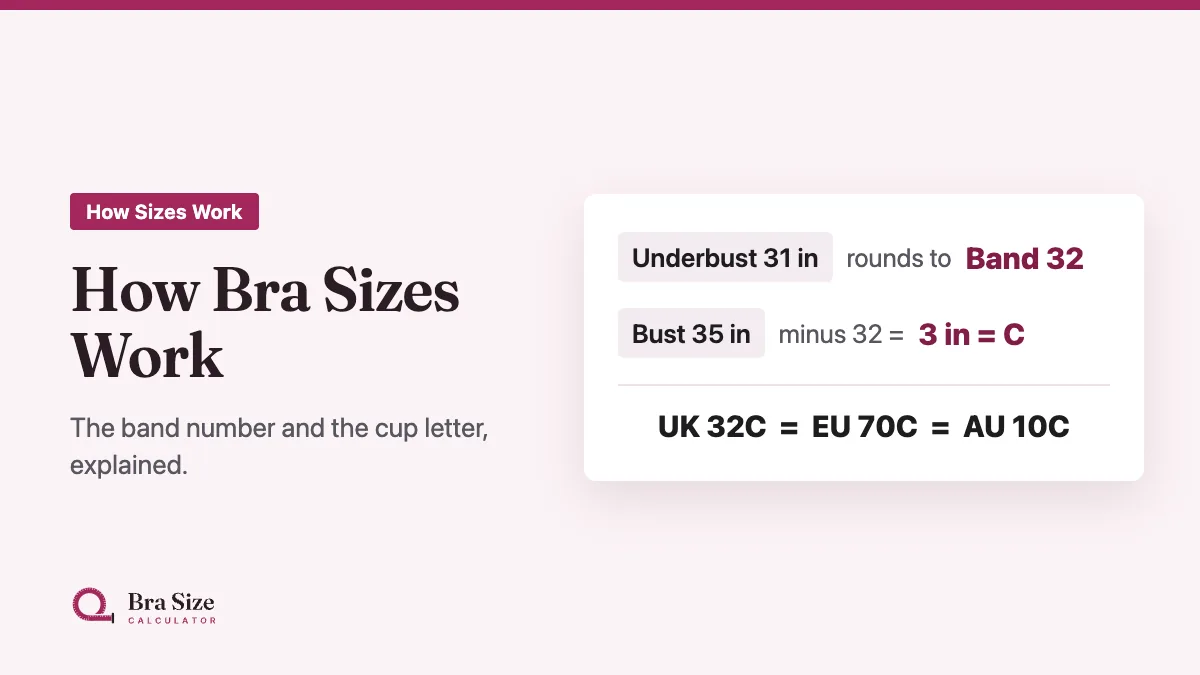
She has bought 36B for years, yet her band climbs, her straps slide and tissue spills at the top of each cup. Snug around her ribcage, the tape reads 31.8 in (80.8 cm), which rounds to the even number 32: her band.
Over the fullest part of her bust it reads 37.7 in (95.8 cm). Subtract her 32 band to leave 5.7 in (14.5 cm). That rounds to 6 in (15 cm), a UK E cup, so her measured size is 32E (US 32DDD).
The plus-four rule adds 4, making her band 36. Taking 36 from her bust leaves only 1.7 in (4.3 cm), close to 2, which gives B: the very label in her drawer. Every sign was real, pointing two ways at once: a band 4 in (10 cm) too loose and a cup too small.
The common trap is to firm the band and keep the volume. Two sister steps down from 36B lands on 32D: the right band, but two letters short of 32E (D, DD, E).
| Size | Band vs her ribcage | Cup vs her 32E | Verdict |
|---|---|---|---|
| 36B (worn, plus-four label) | 4 in (10 cm) looser | Same volume as 32D, two letters short | Both signs at once |
| 34C (one sister step down) | 2 in (5 cm) looser | Same volume as 32D | Still loose, still short |
| 32D (two sister steps down) | Right | Two letters short (D, DD, E) | The trap |
| 32E (measured, US 32DDD) | Right | Right | Try first |
| 34DD (sister of 32E) | 2 in (5 cm) looser | Same volume as 32E | Only if the 32 band digs |
If the 32E band then digs, 34DD holds the same cup on a looser band, and 30F (US 30G) is its other sister; sister sizes gives the rule. A 2012 study of 45 women found her pattern (White and Scurr 2012). Tested as a whole, the traditional tape routine set bands too big and cups too small.
How common is the wrong bra size
Each study below found a large share in the wrong bra size, from two in five to all. The share turns on who was checked and which rule defined "correct", so read the who column before the percentage.
| Study (year) | Who was checked | Wrong size | Which way |
|---|---|---|---|
| Wood, Cameron, Fitzgerald (2008) | 30 women aged 18 to 26, all with upper back or chest wall pain | 24 of 30 (80%) | 21 too small, 3 too large |
| Greenbaum et al. (2003) | 102 women referred for breast reduction | 102 of 102 | Bands a mean 4 in (10 cm) smaller and cups a mean three sizes larger than makers' guides |
| McGhee and Steele (2010) | 104 women, mean age 43.5, in their own bras | 85% | Not reported |
| Lee et al. (2023) | 163 breast reconstruction patients in Seoul, Korean cup standard | 66 of 163 wrong cup (40%), 5 unsure | 34 too big, 32 too small |
| Brisbine et al. (2020) | 112 Australian football and rugby players | 58 of 112 (52%) | Not reported |
| Haworth et al. (2024) | 24 women with D cups or larger and back pain | Every one of their own bras | Faults listed by part |
| White and Scurr (2012) | 45 women | Two methods compared | Old tape routine: band too big, cup too small |
The studies differ on direction too. Wood found most bras too small, Greenbaum found bands smaller and cups larger than makers' guides, and Lee found a near even split. The old tape fitting that White and Scurr tested erred the other way, so no one direction of error fits everyone.
Who is most likely to wear the wrong size
Larger breasts carry the clearest risk of a wrong bra size. In the Wood study they went with worse fit (r = -0.50), and the authors called large breasted women "particularly likely" to be wrong. Lee and colleagues found correct sizing fell as cup size rose.
Higher body weight is the second marker: Greenbaum linked it with a wrong back measurement (r = 0.54). Choosing your own size does not help either: in McGhee and Steele's study, neither trying on a range of bras nor the sizing systems tested improved the size women chose.
Can the wrong bra size cause pain
Sometimes, but the evidence is weaker than most fitting advice suggests. Wood and colleagues checked 30 young women who all had upper back or chest wall pain and found only a negligible link between that pain and bra fit.
Spencer et al. 2020 studied 269 women aged 40 to 85. Each step up in breast size made upper back pain 13% more likely to be reported. That tracks breast size, not bra fit, so it does not show that a wrong bra size causes back pain.
A band that is too small can still press on the ribs and chest, which bra too tight covers. If a sign and pain appear at the same time, fix that part first. Pain that stays after a good fit, or any new lump or change in a breast, needs a doctor.
Finding your right bra size
Measure rather than trust the old label. Tape your ribcage snugly under the breasts, then around the fullest point, in inches or cm, and give both numbers to the calculator. Beside its modern size sits a plus-four comparison line, showing whether your old label came from that older rule.
Treat the result as a starting size to try on. Labels change by country: the reader above is UK 32E, US 32DDD, EU 70F, Australian 10E and French 85F. Brands also use their own charts, so expect to try more than one size.
FAQ
Is my bra size wrong if only one sign shows?
Not always. One sign on its own is often wear, a style or a strap setting, since an old band that has stretched rides up in any size. Two signs on the same part, or one sign in several bras, point to the size.
Do 80% of women really wear the wrong bra size?
The study most often cited for it, from 2008, checked just 30 women aged 18 to 26 who all had upper back or chest wall pain. Other groups gave shares from 40% to 100%, so no single number covers all women.
Can a wrong bra size cause armpit pain?
Two size faults press there. A cup that is too small pushes the wire back toward the arm, and a band that is too tight presses along the side. Find which part hurts and change that part.
Can a sports bra be the wrong size too?
Yes. In a 2020 study of 112 football and rugby players, most wore a sports bra, and 58 of the 112 wore a bra that fitted badly. The same band and cup signs apply to sports bras.
Can you tell your bra size is wrong without measuring?
The signs show which part is off and in which direction, but they cannot give you the number. For that you need the two readings, and a piece of string and a ruler work if you have no tape.
Conclusion
The signs show which part of the bra is wrong and which way it is off, but only the tape gives the number. Take fresh readings with how to measure bra size, then fix the band first and the cup second.