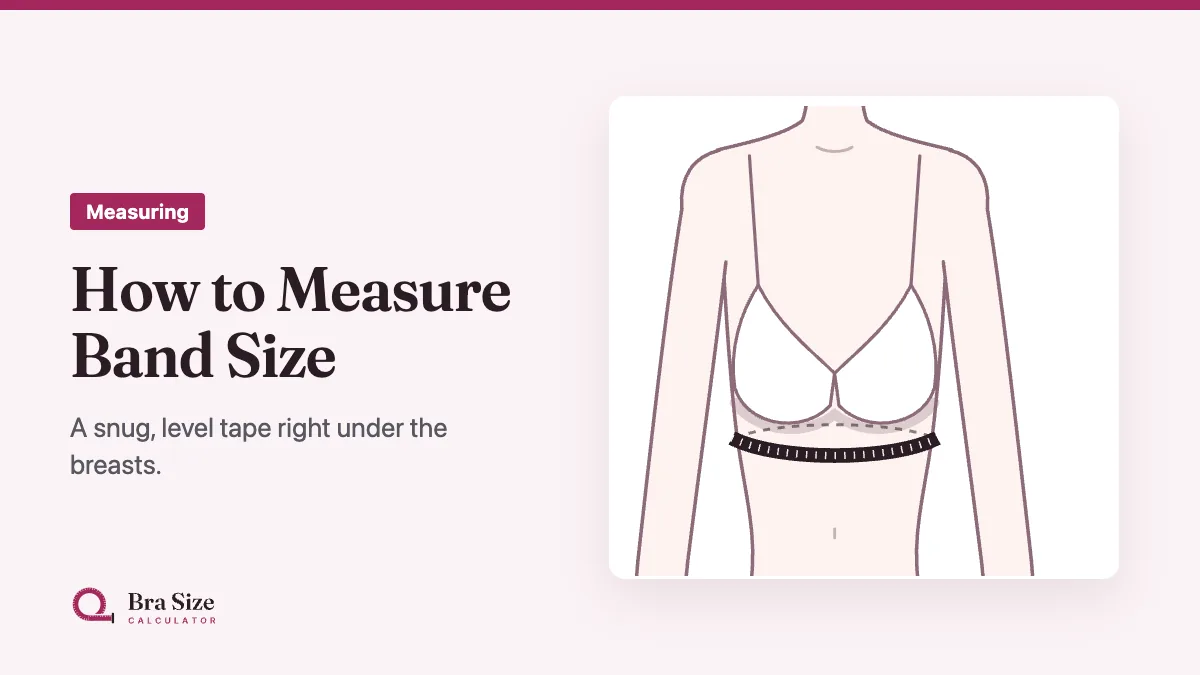
Measure band size with a soft tape on bare skin, snug and level in the crease under your breasts, then round once to an even number. A snug reading of 32.8 in (83.3 cm) rounds to 33, which is odd, so try band 34, then 32. When you learn how to measure band size, finding the crease is the easy part. The pull and the rounding change your label, and the bra size calculator rounds for you.
Table of Contents
What does band size measure?
Band size measures the girth of your ribcage directly below your breasts. On a label such as 36D, 36 is the band and D is the cup.
UK and US bands run in even inches from 28 to 56. A modern chart puts the band up to 1.5 in (3.8 cm) above your underbust, or just under half an inch below it. A plus-four chart prints it about 4 to 5 in (10 to 13 cm) above, so one ribcage can carry two labels. The second tape, round the fullest part, sets the cup and is explained under what bust size means.
How to measure band size step by step
Measure on bare skin in the crease under your breasts, pull the tape to snug, and read it at the end of a gentle breath out. The underbust is the first of three readings in the full bra measuring routine.
Step 1, find the crease and clear the line
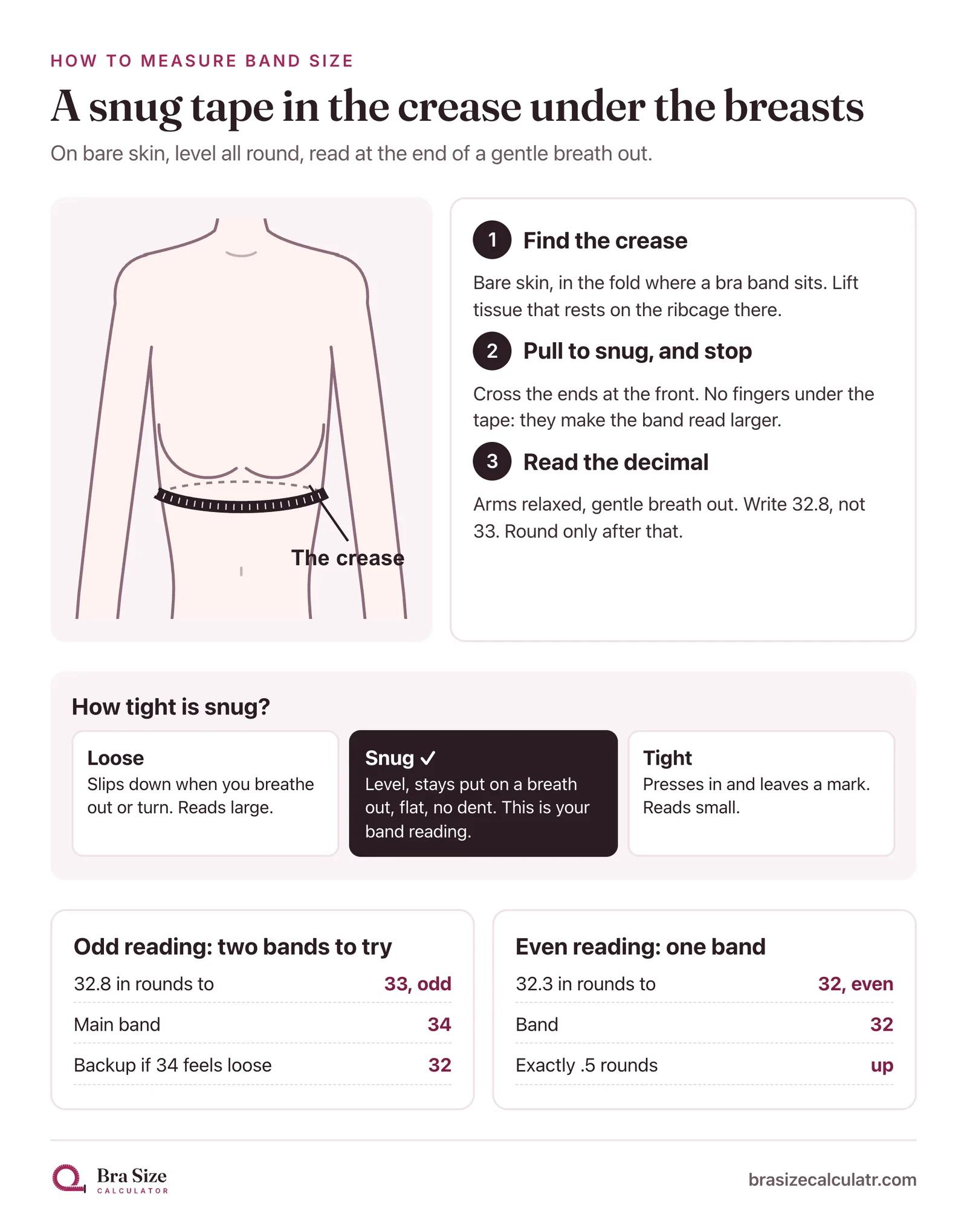
Put the tape on bare skin in the crease under your breasts, the inframammary fold, where a bra band sits on the ribcage. If breast tissue rests on your ribcage there, lift it with one hand first. McGhee and Steele (2006) measured 16 women this way, all C cup or larger, and advised using that raw underbust for the band.
Step 2, pull the tape to snug
Cross the two ends at the front and pull until the tape is snug, then stop. Some guides tell you to slide two fingers under the tape, but fingers add their own thickness, so the band reads larger and the cup smaller.
Step 3, read the decimal and round once
Stand with your arms at your sides, breathe out gently and read where the ends cross. Write the decimal, such as 32.8, not 33. A held breath pushes the number up.
How tight should the tape be?
Snug means the tape lies flat, stays level on a breath out and leaves no dent in the skin. No standard on how to measure band size sets a tension. The European sizing standard EN 13402 defines underbust girth only as a level girth just below the breasts.
The nearest written rule is a health-survey one. The WHO STEPS surveillance manual wants a waist tape "snug but not tight enough to cause compression of the skin", read at the end of a normal breath out.
| Tape tension | What you see and feel | Use it for the band? |
|---|---|---|
| Loose | Touches all round, but slips when you breathe out or turn | No: reads large |
| Snug | Level, flat, stays put on a breath out, no dent | Yes |
| Tight | Pulled as far as it goes, leaves a mark | No: reads small |
Pulling harder does not buy a better band. Kipp, Leahy and Sheel (2024) tested 9 trained runners in sports bras. At maximal pace a tight underband raised their work of breathing to 350 J/min, against 301 J/min with a loose one.
How to turn your underbust into a band size
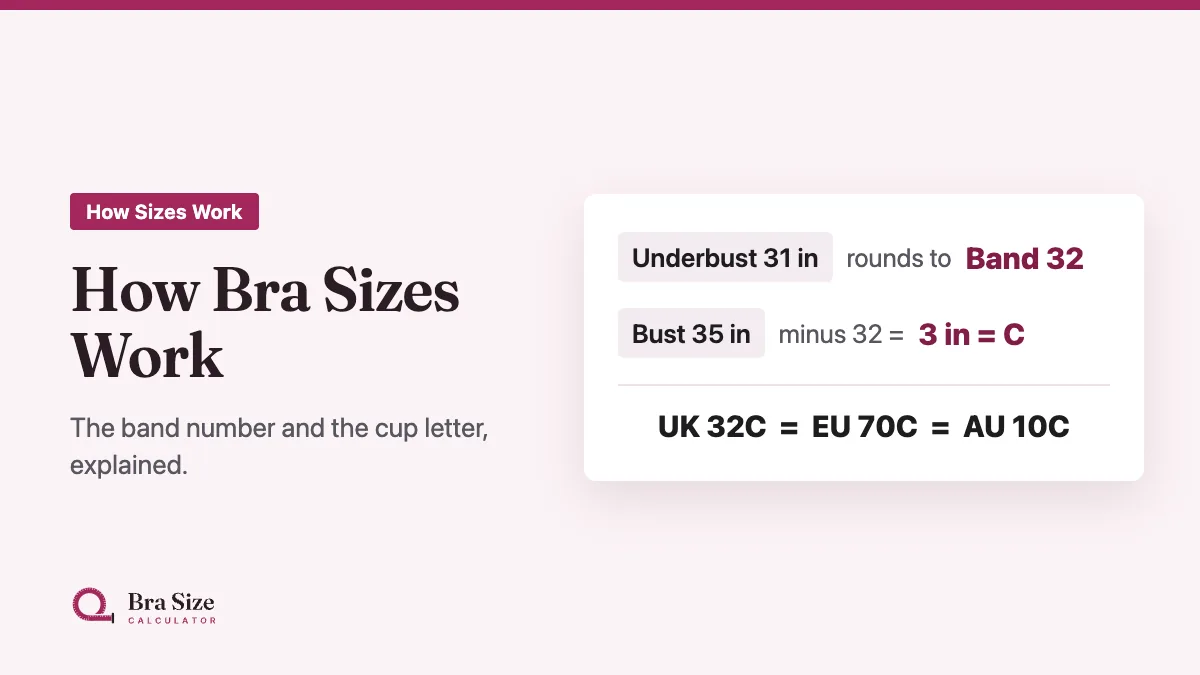
Round the reading to the nearest whole inch, with a half going up. An even result is your band. An odd result points to the even band above, with the one below as a backup.
The 32.8 in reading rounds to 33, so band 34 is the main answer and 32 is worth a try if the 34 feels loose. At 32.3 in (82.0 cm) the reading rounds down to 32, and band 32 stands alone. A rounded 33 sits in the lowest inch of band 34's span, right against band 32's, so only a try-on settles it.
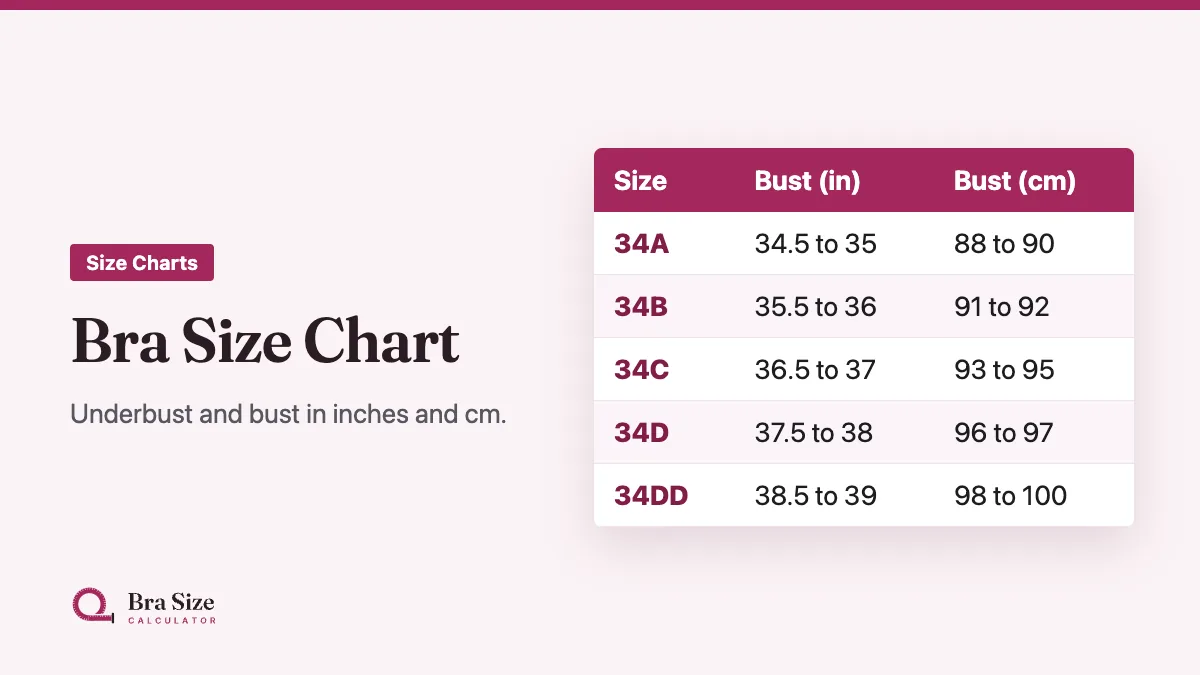
The backup band changes the cup letter too. For a bust of 38.7 in (98.3 cm), band 34 gives 34DD and band 32 gives 32F (US 32G). The reason is that each inch of bust over the band is one cup letter.
A rounded 27 gets band 28 with no backup, because the calculator never offers a 26. Readings under 26.5 in (67.3 cm) or from 56.5 in (143.5 cm) up sit outside the usual range. The size lookup for very small or very large underbust readings shows what to try there.
Underbust measurement in cm
Divide the cm reading by 2.54 and round only that result. A 105 cm reading is 41.3 in, which rounds to an odd 41, so try band 42 first and 40 second. Round it to 41.5 in first and then again, and the 40 is lost.
One centimetre can also flip the main band. At 87 cm (34.3 in) the reading rounds down to band 34 alone. At 88 cm (34.6 in) it rounds up to 35 and points to band 36, with 34 as the fallback.
| UK/US band | Underbust (cm) | Also try the band below at (cm) |
|---|---|---|
| 28 | 68 to 72 | None |
| 30 | 73 to 77 | 73 to 74 |
| 32 | 78 to 82 | 78 to 80 |
| 34 | 83 to 87 | 83 to 85 |
| 36 | 88 to 92 | 88 to 90 |
| 38 | 93 to 97 | 93 to 95 |
| 40 | 98 to 102 | 98 to 100 |
| 42 | 103 to 107 | 103 to 105 |
| 44 | 108 to 113 | 108 to 110 |
| 46 | 114 to 118 | 114 to 115 |
The split repeats in 2 in steps up to 56, and the band size chart gives each band its EU, French and Australian label.
Should you add 4 inches to your band size?
No, not on a modern chart: measure as-is and round. Many store charts explain how to measure band size and then add 4 inches anyway. Add 4, or 5 for an odd number, only when the brand chart you buy from is built on plus-four. Each inch added to the band takes one letter off the cup for the same bust.
The table runs one 39 in (99.1 cm) ribcage through five band rules still in print.
| Band rule | Where it appears | Band for 39 in |
|---|---|---|
| As-is, odd goes up | UK specialist charts, the calculator | 40 (38 if loose) |
| Add 1 if odd, 2 if even | Some makers (Choi-Rokas 2023) | 40 |
| Hybrid table | US Army study (Choi-Rokas 2023) | 38 |
| Add 3, odd goes up | One US retailer guide | 42 |
| Add 4 if even, 5 if odd | Some US and many Indian brand charts | 44 |
One ribcage gets four labels, from 38 to 44, and the Army table even lands below the modern band. Worn bands stray from charts too: Greenbaum and colleagues (2003) checked 102 women referred for breast reduction. All but one wore a band smaller than the makers' fitting guides gave, by a mean of 4 in (10 cm), though the guides' method is not stated.
Nobody has shown where plus-four began. McGhee and Steele used it in 2006 and called the 4 inches arbitrary. The Wikipedia bra size article records Kohl's using it in 2013 and a "war on plus four" campaign around 2011. The popular story about stiff 1950s elastic changes its dates from one telling to the next.
White and Scurr (2012) measured 45 women and found the old tape routine gave bands too big and cups too small, with the error growing as bands got larger. They tested the routine as a whole, so the result counts against old tape fitting in general, not plus-four alone.
How should a new band feel?
Fastened on its loosest hook, a new band should be firm and level, with the tighter hooks left for when it stretches. If it feels too tight, check the cups and the tape before you change size.
Haworth and colleagues (2024) assessed 24 women with larger breasts and back pain in their own bras, and a too-tight band was the most common fault, in 58%.
- Fasten the bra back to front with the cups behind you. If it is comfortable now, small cups were pulling the band.
- Measure again at snug, not tight, since a tight tape gives a smaller band.
- Do not lay the bra flat to judge it. Pechter (1998), as reported by Chan and colleagues (2019), found size 36 bands from 3 makers averaged 27 in unstretched. They gave about 3 in (7.6 cm), 11%, to fit a 30 in ribcage.
- Try the same band in another brand, because brands cut bands differently.
When the band itself is small, one band up and one cup letter down keeps roughly the same cup, the move called a sister size.
FAQ
Is band size measured in inches?
UK and US band numbers count inches, so on a modern chart a 34 band suits a ribcage of about 32.5 to 34.5 in. Your tape can read in cm; divide by 2.54 before you round. EU, French and Australian labels print other numbers for the same band.
What band size is a 45 inch underbust?
A 45 in (114.3 cm) underbust is odd, so try band 46 first, and 44 if the 46 feels loose. A plus-four chart labels the same ribcage 50, which is why one body can end up with two band numbers 4 inches apart.
Why is my measured band smaller than the bra I wear?
Many store charts add 4 to 5 in (10 to 13 cm), so a 38 on such a chart is built for a ribcage of 32.5 to just under 34.5 in (83 to 87 cm). A band that has stretched with wear also feels bigger than its label.
Is band size the same as waist size?
No. The band is taken at the crease under the breasts, while the WHO survey manual places the waist midway between the lowest rib you can feel and the top of the hip bone. A waist number cannot stand in for an underbust reading.
Do men and trans women measure band size the same way?
Yes. The tape goes flat round the ribcage directly under the chest tissue, snug, on a gentle breath out. The same rounding then turns that reading into an even band, with the band below kept as a backup when the rounded number is odd.
Conclusion
The band number rests on two choices: a pull that is snug rather than tight, and a single rounding that sends odd numbers up. Add inches only when the brand's own chart was built on plus-four. Treat the result as a starting band and compare it with how a bra should fit before you cut the tags.