The short answer to why bra sizes vary by brand is that sizing standards describe the body, while each maker decides how the bra itself is cut and graded. A 2025 study of seven makers' 36A to 36DD bras found cup volume differed at every size. Treat any label as a size to try, and start from your own tape readings in the bra size calculator.
Table of Contents
Why bra sizes vary by brand
Sizing standards do exist, but they set the body a bra is meant for, not the bra itself. Two makers can follow the same standard and still sell quite different cups under one label.
The European standard EN 13402 works from body measurements taken in centimetres, and how widely it is used differs from country to country. Its bra labels describe only the wearer: an underbust class and the gap between bust and underbust. Nothing in it says how deep a cup must be or how far a band may stretch.
The table shows which parts of a size a standard pins down and which parts each maker chooses.
| Part of the size | Who sets it | What it means when you shop |
|---|---|---|
| Underbust class | Standard: underbust rounded to the nearest 5 cm (about 2 in) | Band numbers line up between makers that use it |
| Cup letter AA to H | Standard: 2 cm (about 0.8 in) more bust over underbust per letter | The letter names a measured gap, not a volume |
| Cup volume and depth | Each maker | Same letter, different room inside the cup |
| Wire width and shape | Each maker | The wire can sit wide, narrow, tall or short |
| Band fabric and stretch | Each maker | One band number can feel a size apart |
| Letters past H | Each maker's own chart | Letters and steps differ between charts |
So a bra brand size comparison can only ever be a rough guide. The label tells you which body the maker had in mind, while the fit depends on how that maker built the bra. A cm band 75 matches an inch band 34, and EU bra sizes maps the rest. This split between body and bra is the core of why bra sizes vary by brand, even between makers that follow one standard.
Each brand grades from its own fit model
A maker develops one base or sample size first, then grades it up and down into the rest of the range. Every other size is scaled from that one pattern, so it keeps the base's cup shape and wire.
Pattern grading only makes the original shape larger or smaller. It cannot add a shape that the base pattern never had.
Counting size steps shows how far a label sits from its base. Take a made-up maker whose base pattern is a 34B, and read across each row.
| Size | Band steps from the base (2 in / 5 cm each) | Cup steps on that band (1 in, about 2.5 cm, each) | Total size steps |
|---|---|---|---|
| 34B | 0 | 0 | 0 |
| 36C | 1 | 1 | 2 |
| 40DD | 3 | 3 | 6 |
A 40DD sits six steps from that base. Its band is 6 in (15 cm) bigger, and its cup has moved three letters, through C and D to DD. These are steps on the label, used here for counting, not the amounts a pattern maker adds to the paper pattern.
A base shape that suits you carries into every size graded from it, and so does a base shape that does not. When one maker's bras miss in the same way across several sizes, a maker with a different base is often the better next try.
The same label holds different cup volumes
Cup volume under one label changes from maker to maker, and the gap widens as the cup letter rises. Moscarelli and colleagues (2025) at Yale studied 36A to 36DD bras from seven makers. Each bra went on a flat-chested mannequin, and its cups were filled with sizers that were weighed and turned into volume.
Volume differed between makers at every size. The table gives the spread between makers for each cup as a standard deviation in cc (1 cc is 1 ml). Read the right column to see how many times wider each spread is than the spread at A.
| Cup on band 36 | Spread between makers, SD of mean cup volume (cc) | Times the A-cup spread |
|---|---|---|
| A | 30.9 | 1.0 |
| B | 40.1 | 1.3 |
| C | 62.2 | 2.0 |
| D | 69.7 | 2.3 |
| DD | 122.8 | 4.0 |
The spread is about 31 cc at A and about 123 cc at DD, so it is roughly four times wider. Bigger cups also hold more, so part of that wider spread comes with the size itself. The study did not publish average volumes per cup.
One of the seven makers ran larger from C to DD, and two ran small. At A and B the cups still varied, but no single maker stood out as clearly. The work used one band size and a mannequin rather than people, so it shows how cups differ, not how they fit a body. Its authors say the data is most useful at the larger cups, where makers differ most. If you wear a D or above, that is the strongest reason to try a new maker's bra before you buy several.
Volume also shifts along the band, because one letter grows as the band gets bigger. In one measured style, a 34B held 346 ml and a 38B held 480 ml, as the guide to how bra sizes work shows.
Fabric and band stretch change the fit
Two bands with the same number can feel a size apart, because one fabric gives more than the other. Fitting guides note that firm or double-lined bands hold tighter, while stretchy mesh bands give more around the ribcage.
The same guides say to judge a new band on the loosest hook, since elastic relaxes with wear. If a band already digs on that hook, it runs firm for your ribcage, and the steps for a bra that is too tight show what to change first.
Cups follow the same pattern. Fitting guides also say that rigid moulded foam cups leave less room for differences in breast shape than cups cut from soft stretch fabric. That makes a moulded style from a new maker the hardest one to judge from its label alone.
Bra styles fit differently in one brand
A plunge, a balconette, a full cup, a sports bra and a strapless bra shape one size in different ways. A size that fits one style is a good start for another style from the same maker, but it is not proof.
Fitting guides point to four things that only a try-on in the new style shows.
- The band may stretch more or less once it is fastened.
- The wire may sit wider or narrower around the breast.
- The cup may be deeper or shallower from the wire to the top edge.
- The neckline and centre front may sit higher or lower on the chest.
Run a full fit check each time you change style, even when the label stays the same. A strapless or sports cut can need a different band from your everyday bra.
Brands measure and label sizes differently
Makers' size charts start from different rules and systems, so one tape reading can land on two labels before fabric plays any part. Read a new chart for three things before you order.
- Raw underbust or add-four. A 41 in (104 cm) ribcage is band 42 on a raw-underbust chart. Since 41 is odd, the band goes to the next even number up, with 40 to try if the 42 feels loose. It is band 46 on an add-four chart (41 + 5). The two methods are compared on how to measure band size.
- Inches or cm. A chart in cm moves in 5 cm (about 2 in) band steps, so convert your reading before you compare it with an inch label.
- Letters after DD. UK charts go DD then E, while most US charts go DD then DDD, and some print those as E and F. So an E can mean 5 in (13 cm) of difference on a US label but 6 in (15 cm) on a UK one. The full letter runs are on the cup size chart.
Then read that maker's own size chart rather than a general one. A shared chart that lists many makers goes out of date as styles change. The Yale study also found cup volume moving at a single label, which no shared chart can show.
How to find your size in a new brand
Start from your measured size, then let the first try-on tell you which way to move, one step at a time. Picture a ribcage reading of 36 in (91 cm), taken snug, next to a bust reading of 39 in (99 cm).
A whole, even underbust like 36 becomes the band as it stands. Take that band from the bust and 3 in (about 8 cm) is left over, which makes cup C. So 36C is the first size to try in the new brand.
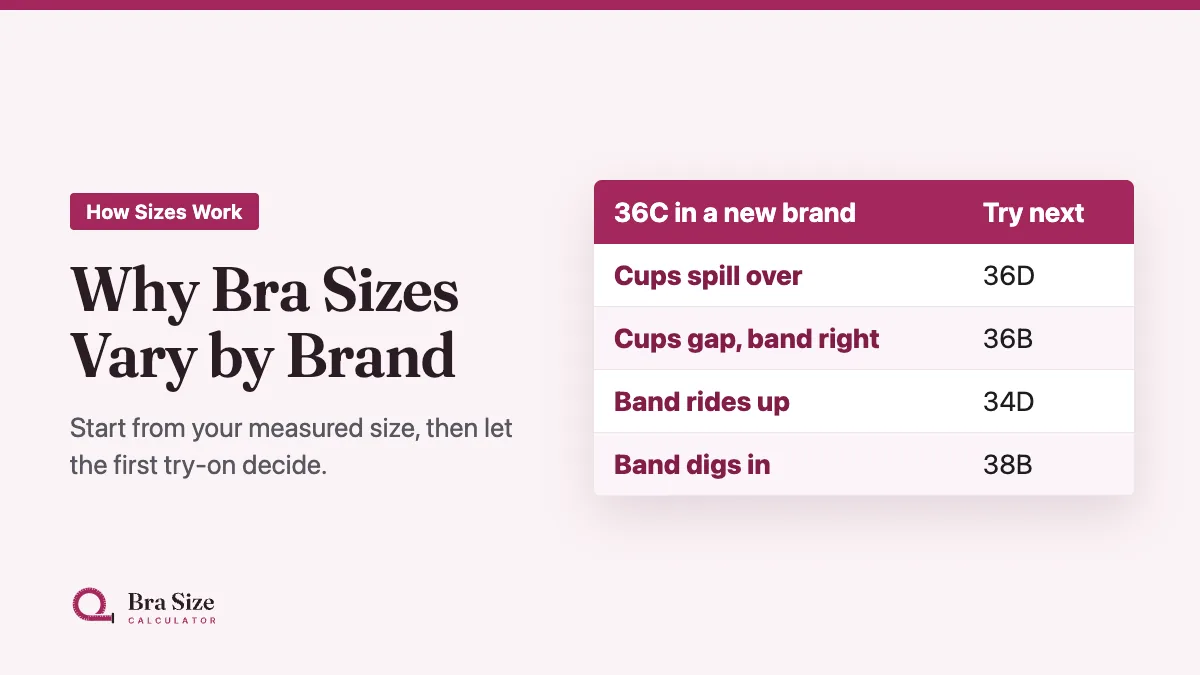
The table maps what you see in that first 36C to the next size to order.
| What you see in the 36C | Next size to try | Why |
|---|---|---|
| Cups spill, or the wire sits on breast tissue | 36D | Same band, cup up one letter |
| Cups gap while the band feels right | 36B | Same band, cup down one letter |
| Band rides up or feels slack on the loosest hook | 34D | Band down, cup up one letter to keep the volume |
| Band digs in on the loosest hook | 38B | Band up, cup down one letter to keep the volume |
The cup letter moves the opposite way to the band because of sister sizes, which keep about the same cup volume. Is the only problem space at the top edge? The notes on bra cup gaping help you tell a cup that is too big from a cup with the wrong shape.
Knowing why bra sizes vary by brand also tells you when to stop changing size. If the second bra fails in the same way as the first, the base shape may not suit you. Try another style or maker before a third size in the same line.
Change one thing per try-on, so you know which part fixed the fit. Then write down the size that worked for each maker and style. A list of your own try-ons by maker is more useful than any general chart, because it rests on your body.
FAQ
Why am I a different bra size in different brands?
Each maker cuts and grades its own bras, so one body can need two labels. A new label does not mean your body has changed. Keep your tape readings as the anchor and read each label as that maker's version of your size.
Why do some bras run small?
A bra runs small when its cups hold less than most bras with the same label, or when its band is cut firm. In the 2025 study of seven makers, two of the seven ran small.
Is there a bra size comparison chart for all brands?
No single chart holds up for long, because makers change their styles and cups differ even at one label. Use each maker's own chart with your measurements, and keep a note of the sizes that fit.
Should I size up or down in a new brand?
Decide by which part fails. Sort out the band first, since it gives most of the support, then the cup, and move only one step at a time. If the band digs, go up one band and down one cup letter to keep the volume.
What is the next cup size up from DD?
On UK charts the next cup up from DD is E, then F. On most US charts it is DDD, sometimes printed as F, then G. The same letter can sit at different steps on the two runs, so read the maker's own chart first.
Do sister sizes work the same in every brand?
A sister size keeps about the same cup volume on paper, but one maker's 34D and another's can hold different amounts. Treat a sister size in a new brand as a first try, not a promise.
Conclusion
A size label is one maker's estimate of the body it was cut for, so your own tape readings stay the anchor. Move one step per try-on and note which size fits each maker. Before you buy from a new maker, re-measure with the steps in how to measure bra size.