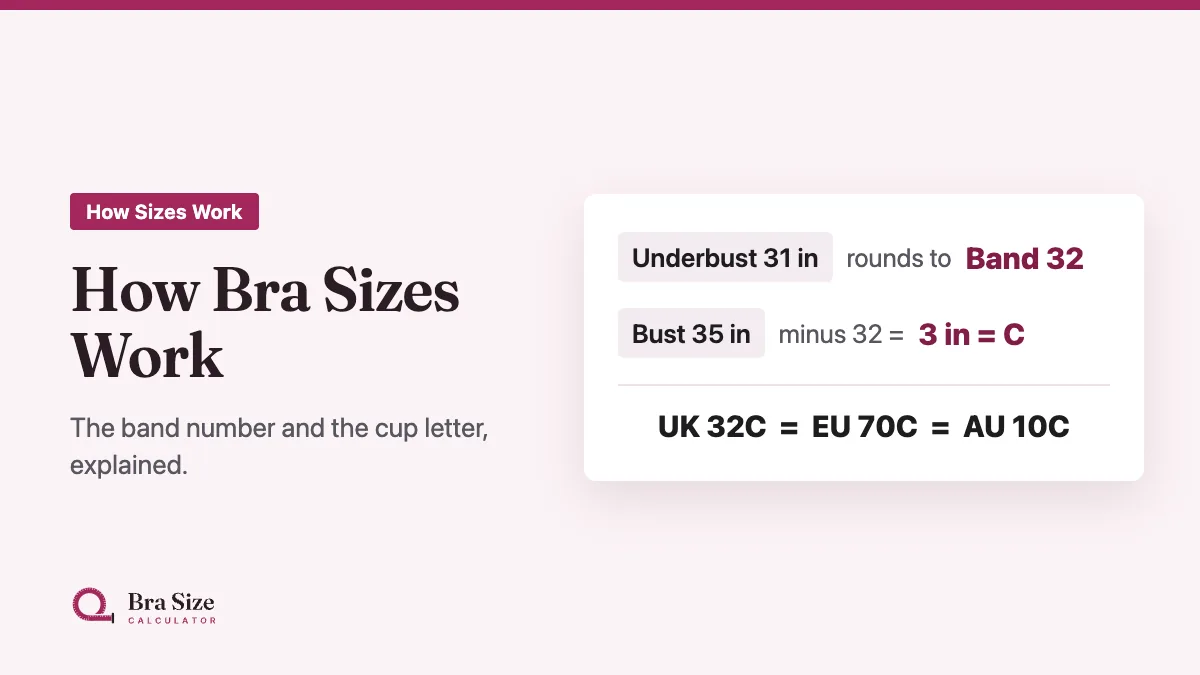
A bra size has two linked parts. The number is the band, set by your ribcage just under the breasts. The letter is the cup, set by how far your bust measures past that band, one letter per inch on UK and US labels. Neither part means much alone. To see how bra sizes work on your own body, put both tape readings into the bra size calculator for a first size to try on.
Table of Contents
How to read the size on a bra tag
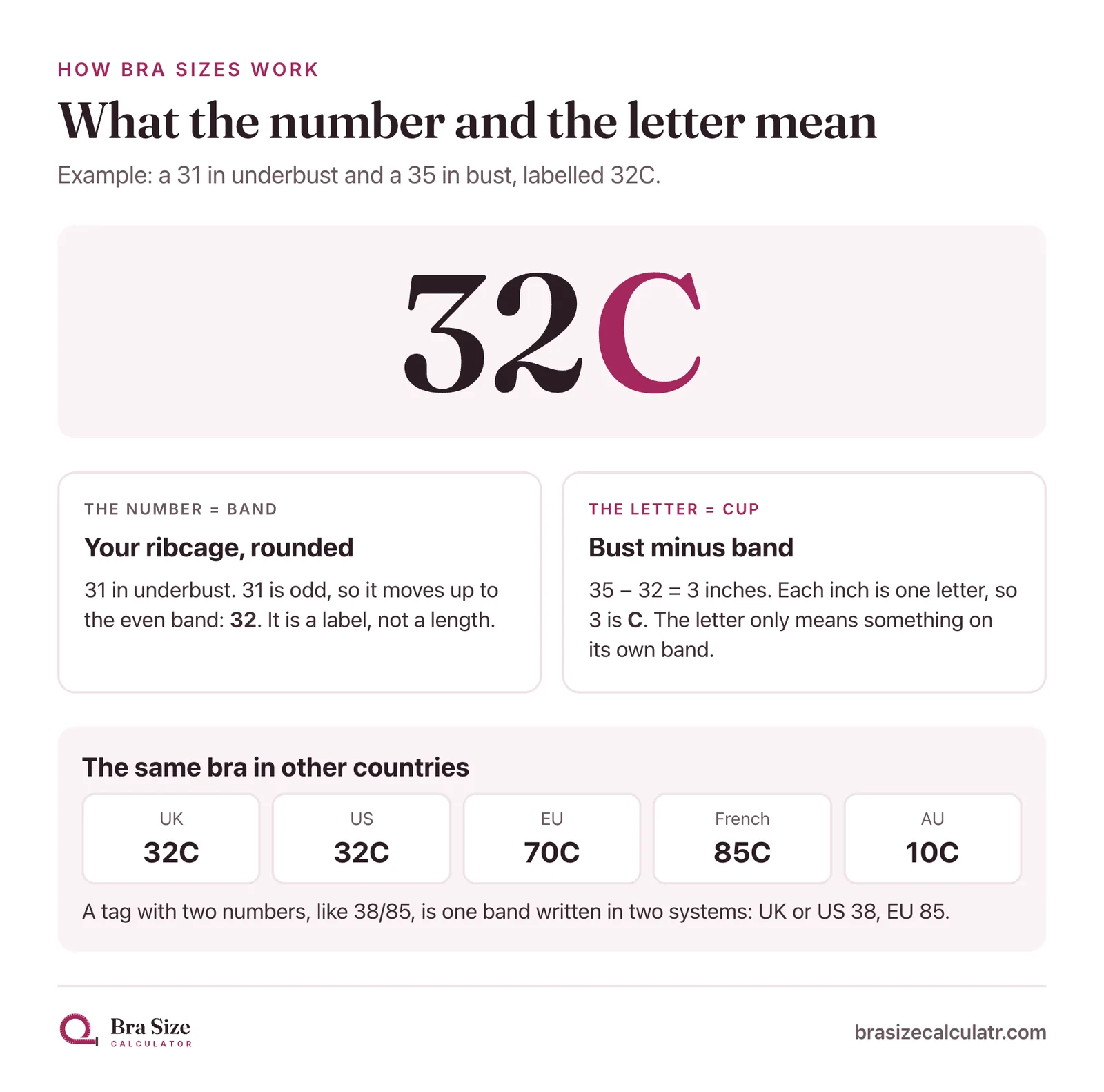
A tag sums up how bra sizes work in one short code: the number is the band and the letter is the cup. When a tag prints two numbers, it is one band written in two systems. A tag reading 38/85, for example, is a UK or US 38 band, which EU labels call 85. Japanese tags may put the letter first, and the bra size converter turns any label into another country's size.
What does the band number mean?
The band number stands for your ribcage just below the breasts, and it matters more than the letter. The band does most of the lifting, and the cup is only ever measured against it. A 2023 US Army sizing paper by Choi-Rokas, Li and Mitchell calls the band "the fundamental support portion" and recommends a firm fit just below the breasts.
The number is a label, not a length. Chan and colleagues report that Pechter (1998) measured size 36 bras from three makers, and their bands averaged only 27 in (69 cm) unstretched. Elastic lets that short band stretch around the ribcage, and its grip holds the bra up.
Each band number takes in about 2 in (5 cm) of underbust, so one tag fits a spread of bodies. The same Army paper warns that two people in one band with the same bust "may have very different breast sizes". Picture two people with a 39 in (99.1 cm) bust and underbusts of 32.7 in and 34.3 in (83.1 and 87.1 cm). Both round to band 34 and both label as 34DD, yet the first has 1.6 in (4.1 cm) more bust past the ribcage. Every band from 28 to 56 sits beside its underbust range in the band size chart.
What does the cup letter mean?
A cup letter is a count of inches: each letter from AA upward adds one full inch (2.5 cm) of bust past the band. DD is a full step, not half a size, so it means 5 in (12.7 cm) past the band against 4 in (10.2 cm) for D. UK and US letters agree up to DD and then part ways, and the cup size chart lines up each system's order.
The letters began as descriptions of breast size and shape. S.H. Camp and Company is usually credited with the first lettered cups, A to D, in 1932. Early makers had no shared standard, so each company decided what its letters meant (history of bra sizing). Historians still disagree on the year in the mid to late 1930s when a maker first tied the letters to volume.
Does band size affect cup size?
Yes. A cup letter records a gap, the inches of bust past the band, so one letter on a larger band is a larger cup.
Chan and colleagues measured this in 2019. They packed modelling clay into the cups of 22 bras, all one style from one Australian maker, and found each cup's volume by water displacement. The study's labels use Australian bands, so adding 22 gives the UK or US band.
| UK/US size | Study label (Australian band) | Cup volume (ml) |
|---|---|---|
| 34B | 12B | 346 |
| 38B | 16B | 480 |
| 36DD | 14DD | 704 |
| 42D | 20D | 933 |
Two bands up, the B cup grew by more than a third. The 42D beat the 36DD by over 200 ml, though D comes one letter before DD. Repeat fills of the same bra differed by up to 7.7%, and the paper notes that another maker's bra in the same size may hold a different amount.
Hold the bust still and change the band, and the letter has to move. A 37 in (94 cm) bust reads very differently on three bands.
| Band | Bust minus band | UK and US size |
|---|---|---|
| 32 | 37 minus 32 = 5 in | 32DD |
| 34 | 37 minus 34 = 3 in | 34C |
| 36 | 37 minus 36 = 1 in | 36A |
The band that sits firm on your ribcage decides which letter counts. These three are not sister sizes, the pairs that keep about the same cup volume, because each one suits a different ribcage.
How bra sizes work on EU cm labels
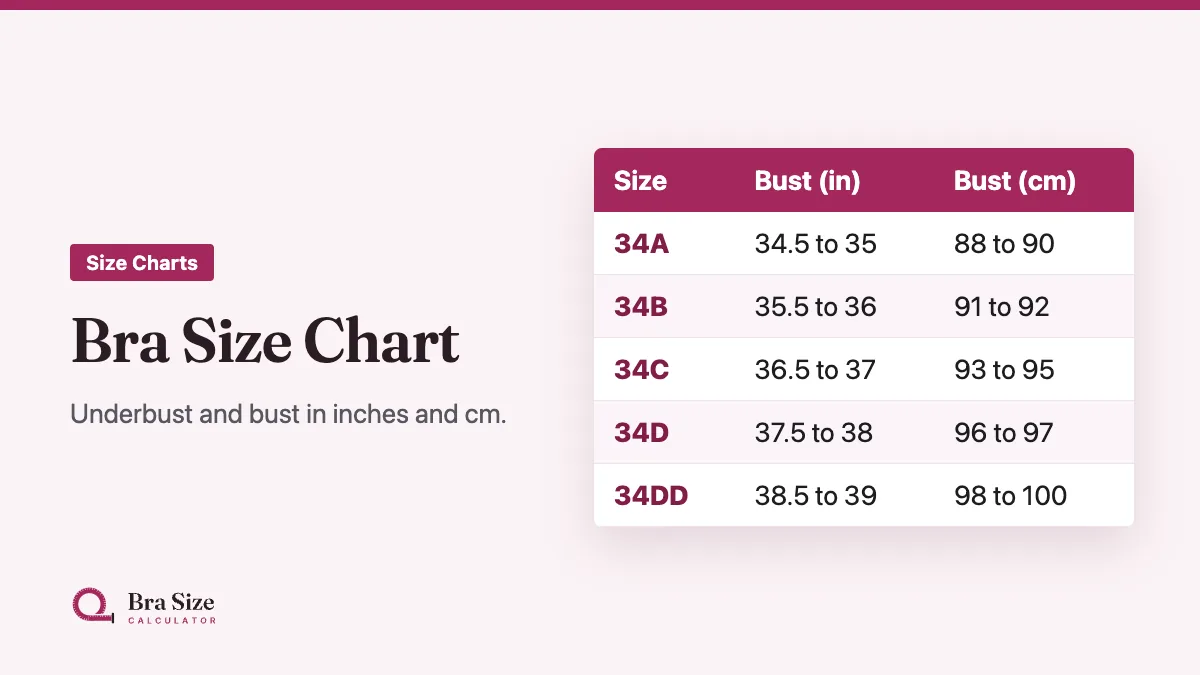
European labels use a cm rule that often lands on a different size than the modern inch method. Under the European standard EN 13402, which came in during 2006, the band number is your underbust in cm, taken to whichever multiple of 5 is closest. Each cup is a 2 cm step of bust minus underbust, with AA at 10 to 12 cm. Every band class and cup step sits in the bra size chart in cm.
Take a ribcage of 30 in (76 cm), with the bust at 35 in (89 cm). Three rules turn those two readings into three tags.
| Rule | Band | Bust minus band | Label |
|---|---|---|---|
| Modern inch method | 30 in is even, so band 30 | 5 in, so DD | 30DD |
| Plus-four chart | 30 plus 4 = 34 | 1 in, so A | 34A |
| EN 13402 cm rule | 76.2 cm falls in 73 to 77 cm, so 75 | 12.7 cm, so A | 75A |
Here the cm rule lands where the plus-four chart lands, because its cup table uses up about 10 cm (4 in) of difference before AA. At larger cups the two drift apart by about a letter, since an EU step is 2 cm and an inch is 2.54 cm.
Whoever builds a sizing system chooses where its letters fall. The Army team built a sports bra system from 2012 survey data on female soldiers and put cup C at the most common gap between bust and underbust. On that scale, A covers a gap of 2.5 to 3.49 in (about 6 to 9 cm), while the modern inch method puts A at 1 in. Each shop's chart follows its own rule, so read the brand's chart in the label's own system.
How to find your bra size
Finding your size takes two tape readings. A snug underbust picks the band number, and the cup letter comes from how far a standing bust reading goes past it. The how to measure cup size steps show where half inches go, and when a leaning reading should replace the standing one.
FAQ
Does a bigger band number mean bigger breasts?
No. The number tracks the ribcage, not the breasts. A 38A suits a bust of about 39 in (99 cm), while a 32DD suits about 37 in (94 cm), so the tag with the smaller number carries the later letter and the smaller bust.
What does E cup mean?
On a UK label, E is a bust 6 in (15 cm) larger than the band. Many US brands use E as a second name for DD, which is one step smaller at 5 in (12.7 cm). The letter alone cannot tell you which, so check which system the tag uses.
Is a B cup smaller than a C cup?
On the same band, yes, by one inch (2.5 cm) of bust past the band. Across bands, not always. A 38B and a 36C hold about the same cup volume, because the bigger band gives the earlier letter more room.
What is the cup size for a 34 band?
A 34 band can take any letter, because the letter depends on the bust. A bust of about 36 in (91 cm) on that band is a 34B, and about 38 in (97 cm) is a 34D. The tape decides the letter, not the band.
What is a bra size 9?
No main sizing system prints a 9. UK, US and Australian bands are even numbers, and EU bands rise in 5 cm steps from 60. A 9 is a brand's own code, so only that brand's size chart can say what body it fits.
Do cup sizes go by volume?
Not in any fixed way. A letter marks inches of bust past the band, so its volume changes with the band and the maker. In a 2019 clay-fill study a 42D cup held 933 ml and a 34B held 346 ml, and the authors warn another brand may differ.
Why does my size change between shops?
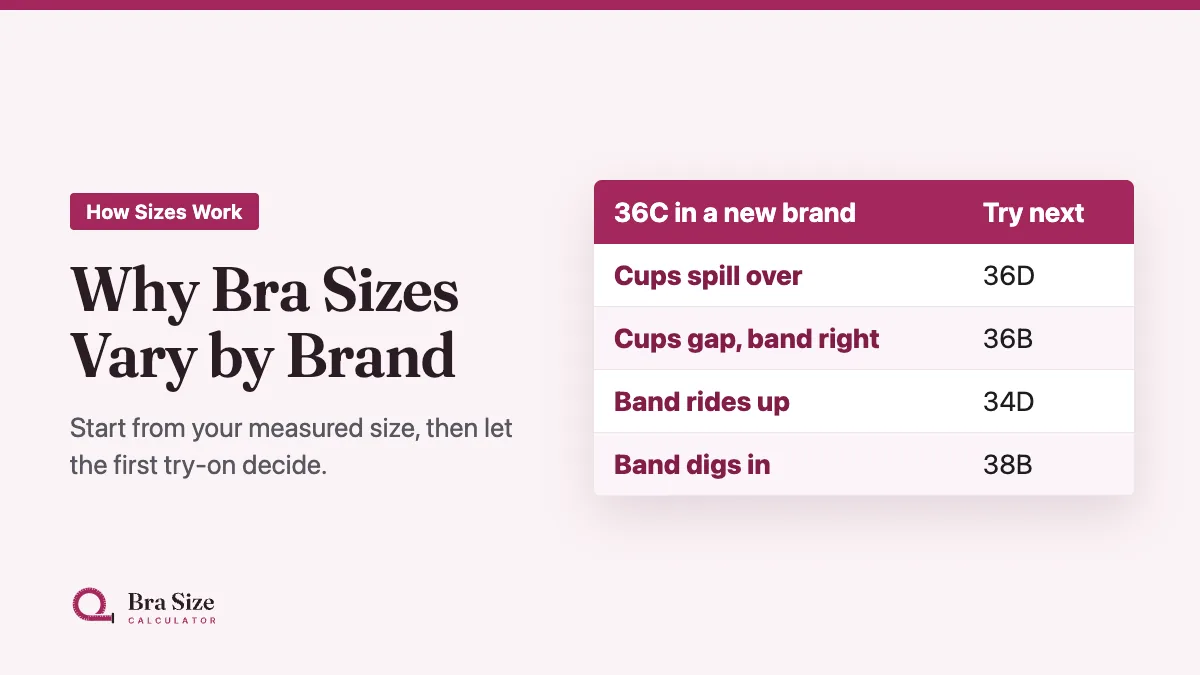
Shops use different band rules. A chart that adds 4 in (10 cm) to the underbust prints a band two steps higher and a cup four letters lower than a chart that uses the underbust as it is. Each brand's own chart matches its own labels.
Conclusion
Two facts carry most of how bra sizes work: the number is a ribcage label, and the letter only means something next to it. The rule behind the tag then decides which chart applies. Treat any result as a starting size, then confirm it on your body with the bra fit check.