Breast shapes are names for how breasts look: how full the top is, how far apart they sit and which way they point. Your shape does not change the size a tape measure gives. It changes which cup cut and wire width fit that size. Get a starting size from the bra size calculator, then use your shape to pick the style you try first.
Table of Contents
Types of breast shapes
Breast shapes are fitting words used by lingerie makers, not medical groups. Lists run from 9 to 13 names, and one body can fit more than one.
Round breasts
Round breasts hold as much tissue above the nipple as below. Most cups suit them, so a poor fit usually means the size is off.
Teardrop breasts
Teardrop breasts carry a little more tissue under the nipple. A small gap at the top of a moulded cup is a cut issue, not a reason to drop a letter.
Bell shaped breasts
Bell shaped breasts are slim on top and much fuller at the base. Fitting guides suggest cups with depth low down and a firm band.
Conical breasts
Conical breasts come to more of a point, with less volume near the chest wall. A rounded moulded cup can dent near the tip, while a seamed cup follows the point.
Relaxed breasts
Relaxed breasts have softer tissue that sits lower. Clinicians call this ptosis and grade it by the nipple's height against the fold under the breast.
In the clinical grades described by Li and colleagues (2016), grade 0 puts the nipple above the fold and grade 1 level with it. Grade 2 is below the fold but above the lowest point of the breast, and grade 3 is at or near that point. Low, soft tissue can read short on a standing tape, so use the leaning reading in how to measure cup size.
Side set breasts
Side set breasts sit apart with a wide space between them. A narrow centre front pulls the cups toward the middle, so fitting guides suggest a wider one.
East west breasts
East west breasts point outward, away from the middle of the chest. A cup facing straight ahead can gap at its inner edge, so try side panels.
Close set breasts
Close set breasts sit near each other with little or no space between. A tall centre front pushes into that tissue, so try a low, narrow centre, as in a plunge.
Asymmetric breasts
Asymmetric breasts differ in size, height or shape. The two sides are rarely the same size, as the screening data below shows. Fit the cup to the fuller side, then pad the smaller one.
Athletic breasts
Athletic breasts are wider than they are deep, over a broad and muscular chest. A big band with a small letter, such as 38B, is a normal result.
Slender breasts
Slender breasts are long and narrow, with little tissue at the top. A full cup can gap above the nipple, so try a half cup in the same size.
What is the most common breast shape
No study has counted how many people have each of the named breast shapes, so any ranking is a guess.
Asymmetry is the one feature with large data. Hudson and colleagues (2020) measured breast volume on the screening mammograms of 54,591 UK women aged 47 to 73. The median gap between left and right was 2.34% of volume, and the absolute gap grew with age. That is volume, not a cup letter, but a small difference between sides is the usual case.
Which bra suits your breast shape
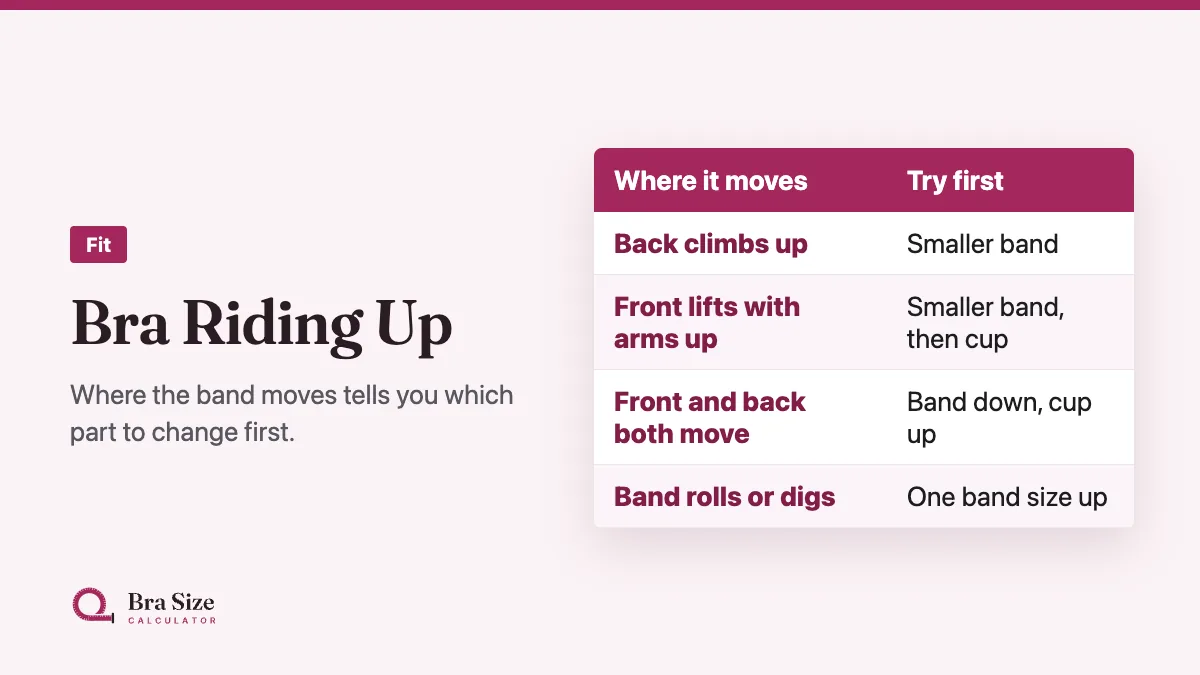
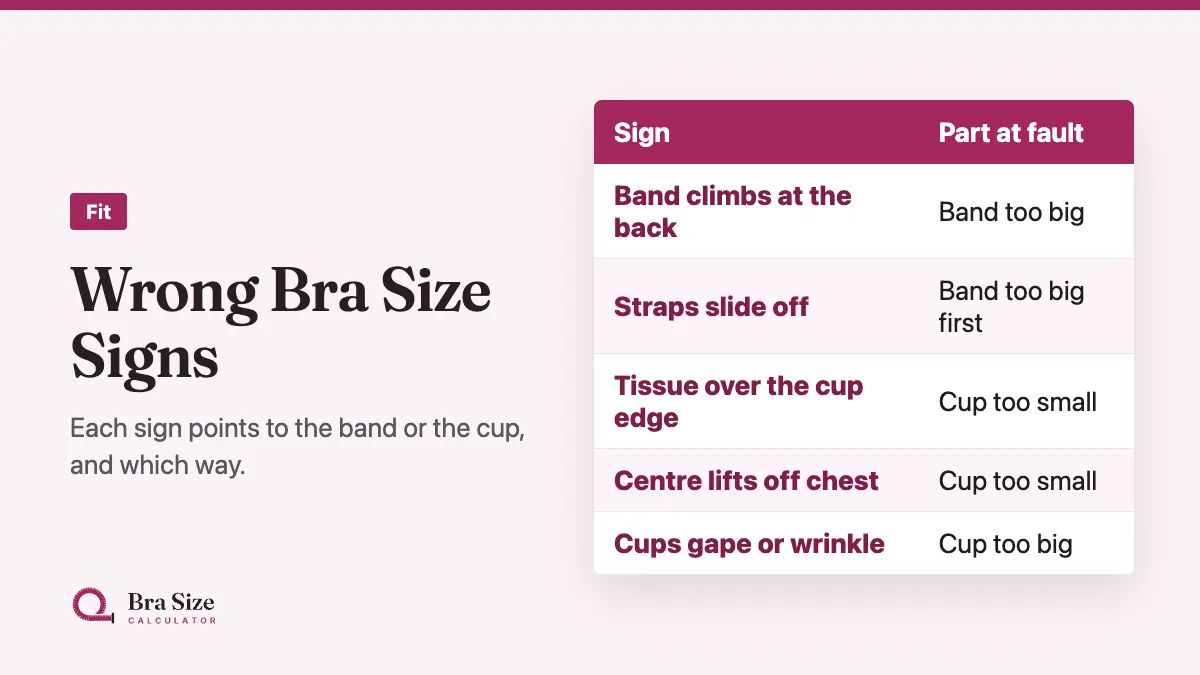
The right bra is one in your measured size whose cup cut and wire width match your tissue. Size comes first, so test band, cups, wire, centre and straps against how a bra should fit before you blame your shape.
Chen, LaBat and Bye (2010) grouped 103 college women by 3D scan, using shoulder slope, bust prominence and back curvature. Those groups made a significant difference to poor support and restricted movement. In 176 plus-size women in South Africa, Pandarum, Yu and Hunter (2011) found the 3D bust minus underbust figure about 11% smaller than the tape one. The authors propose sizing by bust volume and prominence instead, a proposal not yet tested.
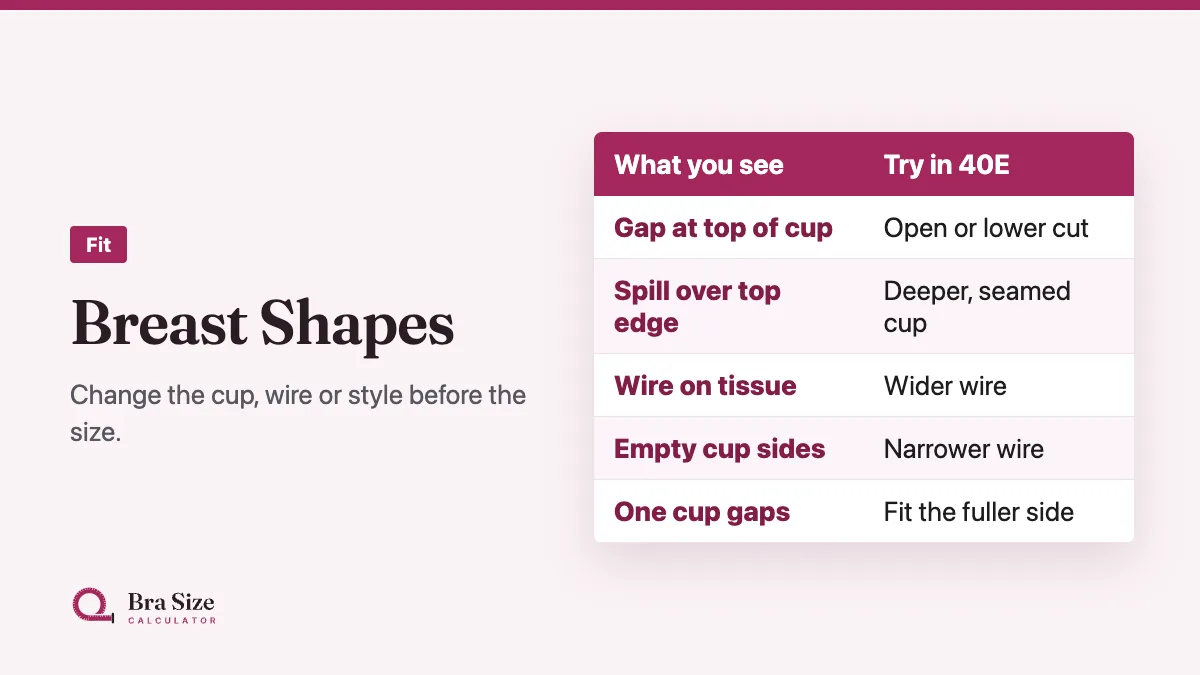
Find what you see in the rows below, then try the change beside it, shown for a measured 40E.
| What you see in the bra | Likely shape cue | What to try for a 40E |
|---|---|---|
| Gap at the top of the cup, lower cup full | Shallow, or full on bottom | An open or lower cut 40E, then 40DD if the gap stays |
| Spill over the top edge, band smooth | Projected | A deeper, seamed 40E, then re-measure before 40F |
| Wire sits on tissue under the arm | Wide root | A 40E with a wider wire |
| Empty cup sides, wire points to the armpit | Narrow root | A 40E with a narrower wire |
| Centre front stands off the chest | Close set or projected | A low, narrow centre in 40E |
| One cup fits, the other gaps | Asymmetric | 40E fitted to the fuller side |
If the band digs whatever the cup does, the size is the problem; see a bra that is too tight.
The size behind that column comes from two readings: 39.7 in (100.8 cm) snug under the breasts and 45.9 in (116.6 cm) around the fullest part. Rounded, the underbust gives 40, an even number, so 40 is the band. The bust sits 5.9 in (15 cm) above it, rounded up to 6 in for a UK E cup. US charts call it DDD. Its sister sizes, 38F and 42DD, fix a band that fails, never a shape problem.
| Underbust and bust | UK | US | EU | French | Australian |
|---|---|---|---|---|---|
| 39.7 in (100.8 cm) and 45.9 in (116.6 cm) | 40E | 40DDD | 90F | 105F | 18E |
How to tell your breast shape
Stand side on to a mirror without a bra and answer three questions.
- Root: does the base run from near the breastbone to under the arm (wide), or cover a small area (narrow)?
- Projection: does the breast stand far out from its base (projected), or spread flat over it (shallow)?
- Fullness: is there more tissue above the nipple or below it?
None of this changes the tape, so measure with the steps to measure your bra size.
Shallow or projected breasts
Shallow breasts spread over a wide part of the chest. A deep cup leaves empty space at the top, which looks like a cup too big, so try a balconette in the same size.
Projected breasts stand far out from a smaller base. They can spill from a shallow cup of the right size, so try a deeper cup first.
Wide or narrow roots
The root is the base where breast tissue meets the chest, and the wire should circle it. A narrow wire rests on a wide root, and a wide wire leaves a narrow root with empty cup sides. Wire width varies between styles of one size.
Full on top or full on bottom
Full on top breasts can spill over a low cut cup, so a higher top edge suits them. Full on bottom breasts can gap in a full cup, so a lower or open top edge suits them.
What determines breast shape
Shape comes from the mix of glandular tissue and fat, the skin and ligaments holding it, and the chest wall beneath. Skin is part of the support, as Coltman, Steele and McGhee note in their 2017 study of breast skin. Weight change adds or removes fat, which shifts both shape and your bust size reading.
Does breast shape change over time
Yes. Breast shape changes with age, weight, pregnancy and breastfeeding, so your shape name can change while your band stays the same.
The 2017 study measured breast skin in 339 women aged 18 to 84. Elasticity fell from the mid 20s and thickness from age 45. The authors say this likely lowers natural support, so a more supportive bra may help with age.
Tuberous, or tubular, breasts are a difference present from puberty, with a narrow base and a high fold. A 2024 review by van Durme and colleagues calls their prevalence uncertain, with reported rates from 6% to 73%. A doctor can confirm it.
Slow change over years is normal. A new change in how big either breast is, or how it looks, is on the NHS list of breast symptoms. See a GP about any change that is not normal for you.
FAQ
Can a bra change your breast shape?
A bra changes how the breasts sit only while you wear it. The lasting shape changes on record come with age, weight, pregnancy and breastfeeding, so choose a bra for fit in your measured size.
What are tubular breasts?
Tubular breasts develop with a narrow base and a high fold, and the two sides often differ. A doctor can confirm it; for a bra, fit the cup to the fuller side.
How do you measure bra size with relaxed breasts?
Measure the band as usual, snug under the breasts. For the bust, compare a standing reading with one taken leaning forward, since soft tissue that hangs lower can read short when you stand.
Is it normal for breasts to be different shapes?
Yes. Small differences in size, height and shape between the two sides are usual. A new change in one breast that is not normal for you is a reason to see a GP or doctor.
Does breast shape change your bra size?
Shape alone does not change the size a tape gives, because the size comes from two girth readings. It changes which cup cut fits. Weight change moves both your shape and your size, so measure again after one.
Conclusion
Your tape gives the size, and your shape tells you which cup cut and wire to try in it. Keep the label when only the cup shape is wrong, and change it only when band or cup volume fails. Look up your two readings in the bra size by underbust and bust tables to confirm the label you keep.