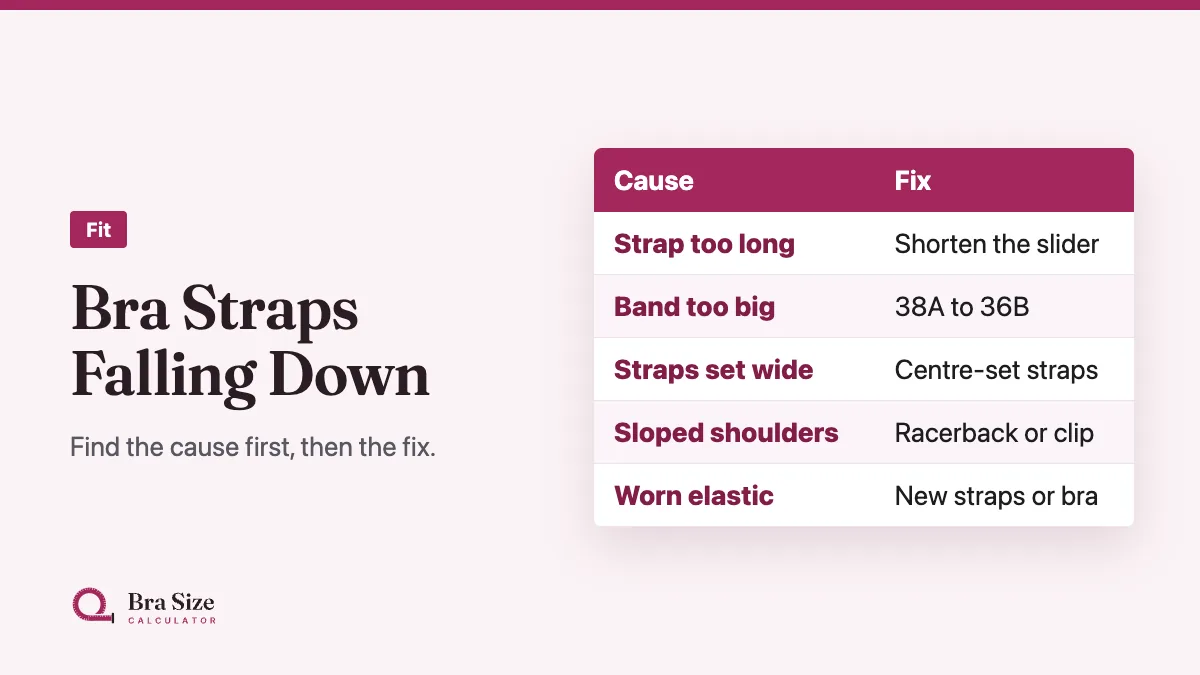
Bra straps falling down most often means the band is too big. A loose band climbs toward your shoulder blades. Fitting guides add that a bigger band sets the straps further apart, so they slide off the edge of each shoulder. Straps set too long, a wide-set style, sloped shoulders and worn elastic cause the rest. Each cause has a quick test and its own fix.
Table of Contents
Why do my bra straps keep falling down
Straps fall when something lets them drift outward or grow longer. The band is the most common reason.
Run the test in each row, and if it matches what you see, make the change in the last column.
| Cause | 10 second test | What to change |
|---|---|---|
| Strap too long | Hook a finger under the strap and lift: it rises well clear of the shoulder with no pull | Shorten the slider until the strap lies flat |
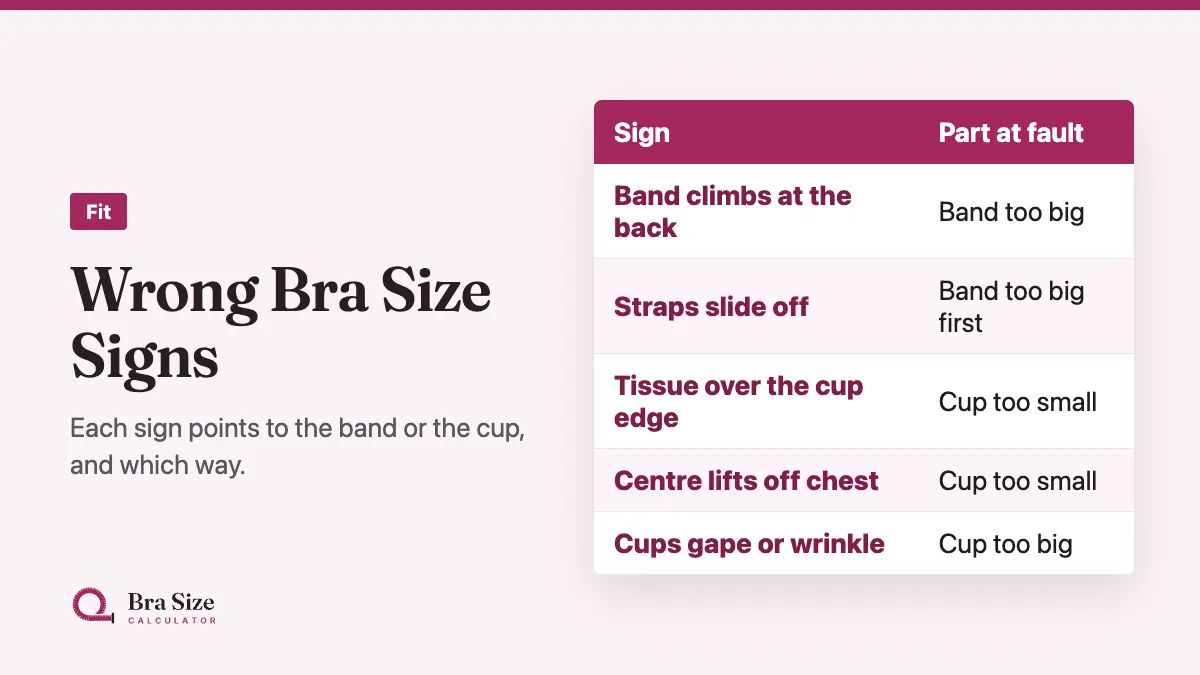
| Band too big | Raise both arms: the band slides up your back, even on the tightest hook | Down one band, up one cup (38A to 36B) |
| Straps set too wide | The band is level and firm, yet the straps rest on the outer edge of each shoulder | A style whose straps join the cup nearer the centre |
| Narrow or sloped shoulders | Straps creep outward when you lift a bag or roll your shoulders | Racerback, crossed-back or a clip that joins the straps |
| Worn elastic or slider | The slider is at its shortest point and the strap still hangs loose | New straps or a new bra |
| Cup too big | Wrinkles or an empty gap along the top edge of the cup | Down one cup letter on the same band (34C to 34B) |
| Cup too small | Breast tissue presses over the top edge of the cup | Up one cup letter on the same band (34C to 34D) |
When the test points to the band or the cup, the bra size calculator turns two tape readings into a starting size to try on.
Fitting guides disagree about the cup. Some say a cup that is too big lets the strap fall, while others blame a cup that is too small. Decide by what you see at the top edge, not by which guide you read. If the edge points to the cup, measure your cup size again before you change letters.
How to adjust bra straps correctly
Adjust the straps with the bra on and fastened, one side at a time.
- Fasten the band and let it settle level around your ribs.
- Lift the cup slightly with one hand, so its weight is off the strap.
- Move the slider a short way, then let go.
- Repeat on the other side, which may need a different setting.
- Raise your arms and roll your shoulders. The strap should stay put and leave no groove.
To shorten bra straps that are too long, keep moving the slider in small steps until the strap lies flat. To loosen a strap, do the same in the other direction. Lengthen any strap that leaves a red line or pulls the back of the band upward.
How tight should the straps be? Fitting guides do not agree, as the table shows.
| Rule in fitting guides | What you do |
|---|---|
| One finger | Slide one finger under the strap without forcing it |
| Two fingers | Slide two fingers flat under the strap |
| About 1 in (2.5 cm) of lift | Pull the strap up from the shoulder with gentle force |
Breast health researchers at Portsmouth skip the finger count and give an outcome instead. Straps should "feel comfortable without sticking into your shoulders". They add that straps keep the bra in place but "are not the main support". Their 5 cm (2 in) figure is about the underband, so it is not a strap rule.
Tight straps are a fit fault too. In a 2024 study of 24 women with large breasts and back pain, Haworth and colleagues found tight straps on 42% of new, professionally fitted bras. Strap length is only one part of how a bra should fit, so judge it alongside the rest.
Bra size and falling straps
When the band is too big, no slider setting will hold the straps for long. The fix is a smaller band with a bigger cup letter, which keeps about the same cup volume. Each band step is 2 in (5 cm), and the letter moves one place the other way, as explained on sister sizes.
To confirm which cause you have before you buy a new size, run this 30 second test:
- Raise both arms over your head. If the band lifts at the back, start with the band.
- Look at the sliders. If they are already at their shortest point, the elastic is worn or the strap sits in the wrong place.
- Roll your shoulders five times. A strap that drops straight down is too long, and one that slides outward is set too wide.
- Check the top edge of each cup in a mirror. A gap points to a cup too big, and pressure over the edge to a cup too small.
Take a worked case. A tape reads 33.6 in (85.3 cm) under the bust and 37.4 in (95.0 cm) over it. The underbust rounds to an even 34. Then 37.4 minus 34 leaves 3.4 in, which rounds to 3, and 3 in is a C. The measured size is 34C, or 75C in EU sizing. The rounding rules for half inches are on how to measure band size.
Now say this reader wears a 38A. Its cup is close in volume to a 34C, but the band is two steps, 4 in (10 cm), too big. That loose band is why the straps slide. The table shows each step down, with the band in inches and the EU band in brackets.
| Size | UK/US band (EU) | Cup | What it is |
|---|---|---|---|
| 38A | 38 (EU 85) | A | Current bra, band two steps loose |
| 36B | 36 (EU 80) | B | First try, one step down |
| 34C | 34 (EU 75) | C | Measured size, two steps down |
Fitters advise moving one step at a time, so try 36B first. If the band still climbs and the straps still slide, move on to 34C.
Bra straps falling down in the right size
If the band is firm and the cups fit, bra straps falling down usually come from where the straps sit, not from the size. Styles differ in where the strap joins the cup. Fitting guides note that balconette styles often set straps wider, while plunge styles bring them closer to the neck.
Shoulder shape matters too. Narrow or sloped shoulders give a strap less of a ledge, so even a well set strap can creep outward. Strap layouts include standard, closer set, racerback, crossed-back and halter. Multiway or removable straps can be clipped into a racerback or crossed shape on the same bra.
Both strap studies in this section tested sports bras on runners. In a 2013 study of 14 women with C cups or larger, Bowles and Steele suggested crossed-back straps could ease slipping. They did not measure slipping, and crossed-back straps raised shoulder pressure. A 2015 study by Coltman and colleagues of 23 runners with D cups or larger found vertical straps less uncomfortable than cross-back ones. Wide straps of about 4.5 cm (1.8 in) had the lowest discomfort and less pressure than the standard-width and gel-padded straps.
No strap layout is proven to stop slipping. A layout that pulls the straps toward your spine is worth a try, and comfort decides whether you keep it.
How to keep bra straps from slipping off shoulders
Work from the bottom up: band first, then strap length, then strap position.
- Get the band right. A firm, level band gives each strap a fixed point at the back.
- Set each strap on its own. If one breast is larger, the two sides may need different settings.
- Bring the straps closer together. A bra strap holder, a small clip that joins the straps between the shoulder blades, works much like a racerback.
- Check the sliders after washing. Straps can creep through the slider with wear, so reset them now and then.
- Measure again after a body change, such as weight change or pregnancy, as how to measure bra size describes.
When to replace a bra with falling straps
Replace the bra when a strap still slips at its shortest setting while the band and cups still fit. That points to worn elastic or a slider that no longer grips.
Tired strap elastic looks wavy, stays long after you pull it, or lengthens as the day goes on. If the underband has lost its grip as well, the whole bra is done.
When only the straps have given out, a tailor can often sew on new ones.
FAQ
Why does only one bra strap keep falling off?
One strap slips when the two sides differ. The University of Portsmouth breast health group points out that most women have one breast bigger than the other, so the straps do not need the same length. Shorten only the side that slips, then check the other side again.
Why do sports bra straps slip when running?
Sports bra straps are a known weak point. In a 2012 survey of 267 Australian women aged 20 to 35 (Bowles, Steele and Munro), straps slipping or cutting in were the two most disliked sports bra features. Almost a quarter said straps were the first part to fail.
Do strap pads or cushions stop straps from slipping?
There is no proof yet. In a 2013 study of 14 runners, strap cushions only lowered peak pressure with crossed-back straps and did not help overall. A 2015 study said gel pads might reduce slipping but called the idea untested.
Is a red groove from bra straps a bad sign?
Yes, a red groove means the straps are carrying more weight than they should. Lengthen them a little, then check the band, because a loose band hands its work to the straps.
Does a strapless bra fix straps that fall down?
A strapless bra removes the straps, so the band has to hold everything on its own. That only works when the band is firm and stays level all day, so the band size matters even more.
Conclusion
Bra straps falling down are a signal to check three things in order: the band, the strap length and where the straps sit. A loose band is fixed with a sister size, such as 38A to 36B to 34C, and the rest with the slider or a closer-set style. To see the bust range each size is built for, use the bra size chart.