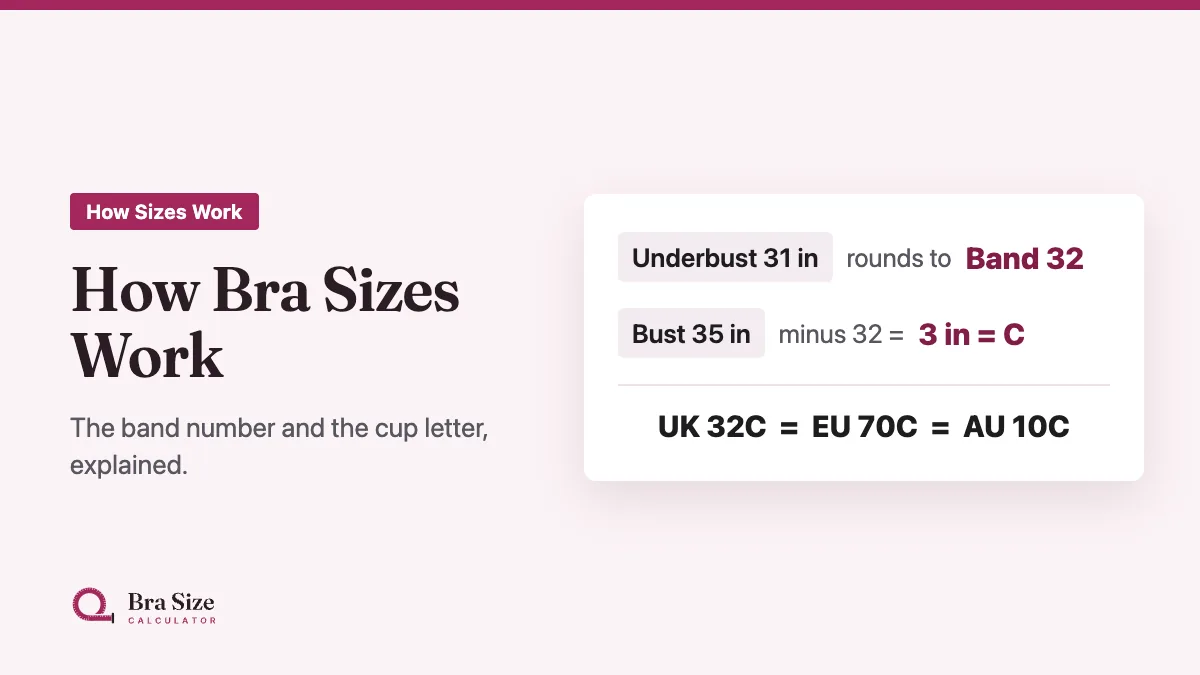
The right bra for uneven breasts has cups that hold your larger side. Spare room on the other side is filled by a pad or taken up by the strap. A tape around both sides reads the average, so the size it gives can be too small for the bigger breast. Tape each half, double the larger reading, and put that into the bra size calculator as your bust for a size to try.
Table of Contents
How common are uneven breasts
Most women have a slight difference between sides, but the figures you read online do not match. One in four is a children's hospital's figure for adult women. Another guide's 40% is the share of its quiz takers who call themselves uneven, and the 90% you may see does not say who was counted. Breast screening data, covered under breast shapes, also finds that a small gap is usual.
3D photos give a clearer idea of scale. Killaars and colleagues (2026) used photos of 98 people with no history of breast surgery. The two sides differed by 102.5 cc on average, about 16% of the left side's volume. Five surgeons and five untrained people then judged the images. In the 52 cases most surgeons called uneven, their vote named the larger side correctly 53.8% of the time. The untrained group got 48.6% of its 35 cases right, close to a coin toss. All came from one plastic surgery clinic, so their gaps may not match yours. Let a tape decide which side is bigger.
When a bra doesn't fit uneven breasts
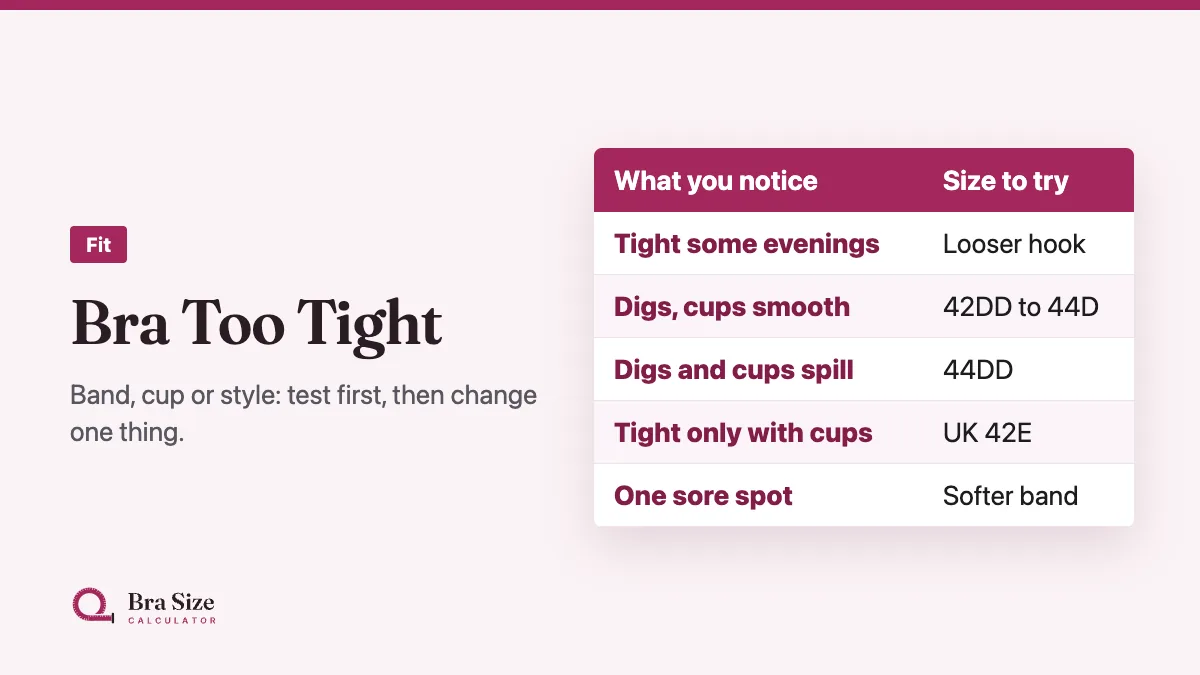
A bra sized to the smaller side, or to the average, fails on the larger one first. Tissue bulges over the cup edge and the centre front tips off the chest. The wire can also land on the breast, and where the underwire hurts tells you which part to change.
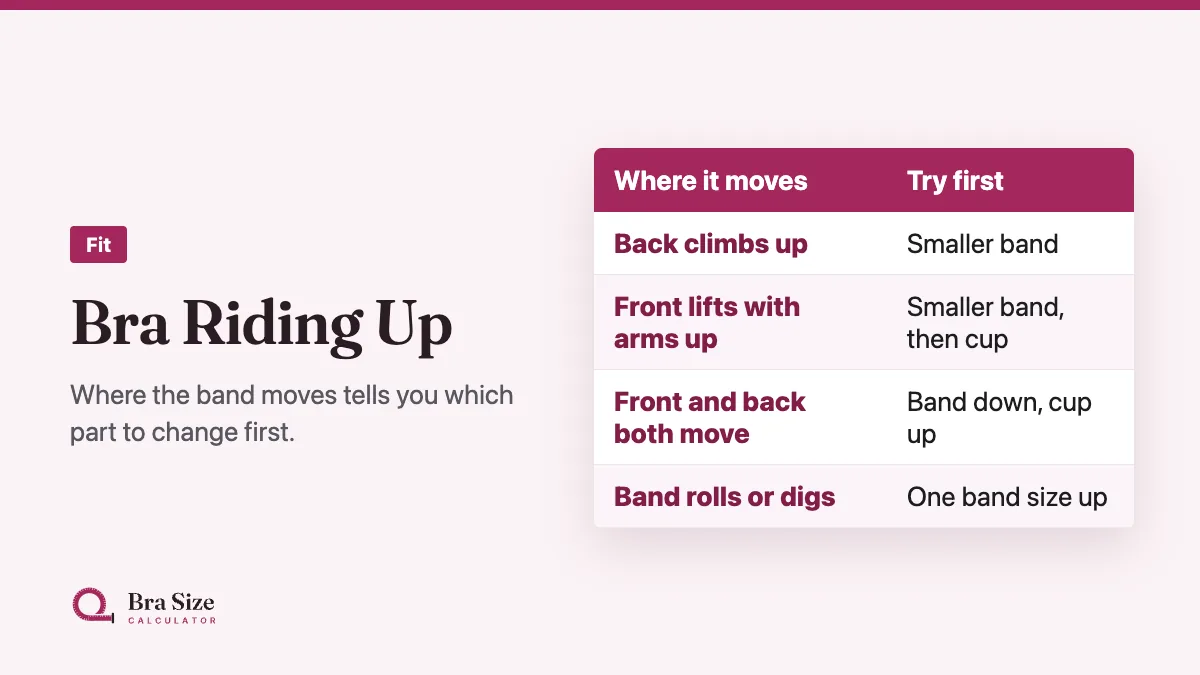
A bra sized to the larger side fails more gently. The smaller cup has a loose edge, or its strap slides off, one of several causes of bra straps falling down. If both cups look loose, the cause is the size and not the difference between sides. Compare yours with the gap spots on bra cup gaping. Find what you see in the table, then make that change first.
| What you see | What it means | Change first |
|---|---|---|
| Spill on one side, other cup smooth | Cup fits the smaller breast | Go up until the spill stops |
| One cup loose, other smooth | Cup fits the larger breast | Keep the size, pad the loose cup or shorten its strap |
| Spill on one side, other cup loose | Cup fits the average | Go up until the spill stops, then fill |
| Both cups loose | Cup too big for both sides | Go down one letter and check again |
| One strap slips, band level | Smaller cup is not held up | Shorten that strap alone |
How to measure uneven breasts for a bra
Measure the two halves apart, because the usual bust reading adds them together. The band needs one reading only. Take it snug under the breasts, as in how to measure bra size.
- Put on an unpadded bra and stand straight.
- Ask a friend to hold the start of the tape on the middle of your spine.
- Wrap it around once, level with the fullest part of the larger breast. Let it span the space between the breasts without pressing in.
- Read the number in front of the middle of your breastbone. That is the first half.
- Read the full number where the tape meets its start, and take the first half away. That leaves the second half.
- Wrap again the other way around, which reads the other side first. Each half should come within 0.25 in (0.6 cm) of its earlier number. If not, measure again.
- Double each half. The results are the two bust readings you would have if both sides matched.
Doubling also doubles any slip, so a half that is 0.25 in (0.6 cm) out moves its reading by half a cup letter. It is plain arithmetic, not a method tested in a study, so treat the answer as a first size. For a second opinion, take the reading across one breast in how to measure cup size and repeat it on the other.
You can also compare volumes with water. Waltho, McRae and Thoma (2020) looked at 47 breast reduction patients with uneven sides who had measured their own gap at home. Their steps were a version of a method in which you lean one breast into a container filled to the brim, then measure the water needed to refill it. For 70% of them, the gap came within 50 grams of the difference between the amounts surgeons later removed. It shows a difference in volume, not a cup letter.
Which cup size to buy
Buy the letter from the doubled larger half. Say a woman's underbust reading is 37.6 in (95.5 cm), so she takes a 38 band. The left half reads 22.1 in (56.1 cm) and the right half 21.2 in (53.8 cm), so three bust readings are possible.
| Reading | Bust | Minus the 38 band (in) | UK size | US size |
|---|---|---|---|---|
| Right half doubled | 42.4 in (107.7 cm) | 4.4, rounds to 4 | 38D | 38D |
| One tape around both | 43.3 in (110 cm) | 5.3, rounds to 5 | 38DD | 38DD |
| Left half doubled | 44.2 in (112.3 cm) | 6.2, rounds to 6 | 38E | 38DDD |
The single tape says 38DD, a cup that is one letter short on the left and one too big on the right. Her size to try is 38E (EU 85F, FR 100F). The right side is two letters smaller, so it needs a pad and not just a shorter strap. The single tape always falls short of the larger side by the gap between the halves, which is 0.9 in (2.3 cm) here.
Choosing a bra for uneven breasts
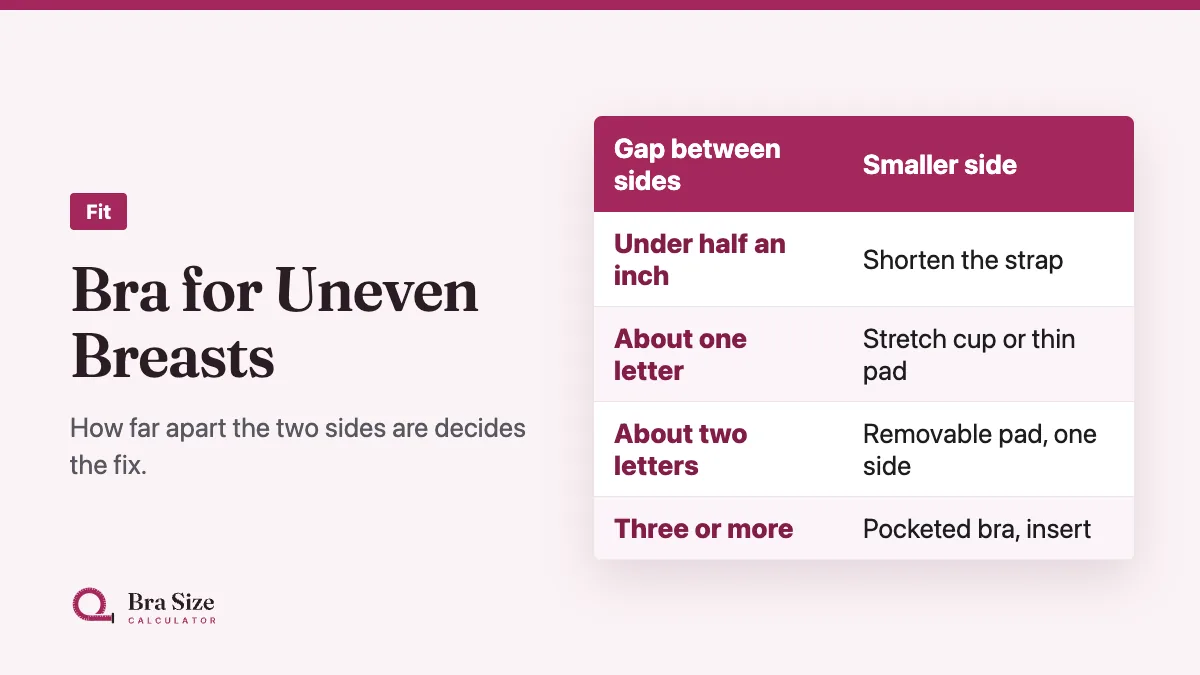
To choose a bra for uneven breasts, look first at how far apart the two doubled readings are. One inch (2.5 cm) is about one cup letter.
| Gap between doubled readings | Letters apart | What to do on the smaller side |
|---|---|---|
| Under 0.5 in (1.3 cm) | None, or a borderline letter | Shorten the strap a little |
| 0.5 to 1.4 in (1.3 to 3.6 cm) | About one | Stretch upper cup, or a thin pad |
| 1.5 to 2.4 in (3.8 to 6.1 cm) | About two | Removable pad, worn on that side only |
| 2.5 in (6.4 cm) or more | Three or more | Pocketed bra with a partial insert |
Stretch upper cups
A firm lower cup with stretch lace above suits a gap of about one letter. The lace gives over the larger breast and lies closer on the smaller one. Still buy it in the larger side's size, because lace stretched tight cuts in along its edge. No pad is needed.
Moulded and padded cups
A foam cup keeps its own shape, so a gap inside it does not show through clothes. It only hides the space, so the smaller side is still not supported. With a gap of two letters or more, add a pad inside it.
Removable pads
Take the pad out on the larger side and leave it in on the smaller. Check the larger breast in the cup with no pad in, because foam takes up room and can make the right size look too small.
Pocketed bras and partial inserts
A pocket holds an insert still, which matters once it has some weight. For a difference a thin pad cannot fill, one option is an external breast prosthesis. The Royal Children's Hospital Melbourne describes it as hollow on the inside, so the smaller breast fits in it. At the Royal United Hospital in Bath, breast care nurses offer to measure and fit one.
Whichever you choose, put the larger side through the five-point bra fit check first, with the other cup still empty.
Bra styles to avoid
Firm, unpadded cups are the hardest to wear with different sized breasts. Cut to fit the larger side, they have no stretch to draw spare fabric flat over the smaller one. Push-up pads sewn into both cups are no better, since you cannot take one out of the larger side. Strapless styles lose the straps, which you can otherwise set separately for each side.
Going down a cup to close the gap does not help, because it swaps a loose edge on one side for spill on the other. Letter sizes such as S or M can cover two neighbouring cups, so they may suit a one-letter gap in a soft bra.
FAQ
When should uneven breasts be checked by a doctor?
See a doctor when the difference is new, grows suddenly, or comes with a lump or skin change. A slight long-standing difference is common, and the Royal Children's Hospital in Melbourne says a teenager still uneven at the end of puberty can ask a GP.
Why is breast size uneven?
One side can grow faster during puberty, and the two usually even out. A children's hospital fact sheet says breasts that still differ at about 16, or near the end of puberty, will probably stay that way.
Can you buy a bra with two different cup sizes?
Rarely. Nearly all bras come with two matching cups, so buy the pair in the larger size. On the smaller side, shorten the strap a little, or use a pad or partial insert when the gap is wider.
Should an insert go in one cup or both?
Put an insert in one cup only, on the smaller side. A pad in both cups keeps the gap between the sides and takes room the larger breast needs. If the bra came with removable pads, take out the one on the larger side.
Do uneven breasts need a different band?
No, uneven breasts do not need a different band. The band goes around your ribcage, so one snug underbust reading sets it. Only the cup choice changes, and that follows the larger side.
Will a sports bra even out my breasts?
No, a sports bra does not change the size of either breast. One with separate shaped cups needs the larger side's size, like any other bra. In S, M or L sizing, one size can cover two neighbouring cups.
Conclusion
The larger side sets the cup, and the smaller side sets the style. To find a bra for uneven breasts, tape both halves, buy the letter from the bigger one and match the fix to the gap. If the new bra still feels wrong on both sides, look through the signs of a wrong bra size before you blame the difference.