Underwire poking or hurting is a fit signal, and the spot tells you the cause. A wire on tissue at the sides means a cup too small, a wire that shifts means a loose band, and a jab under a smooth cup means the style. Start from a measured size from the bra size calculator and change one thing at a time.
Table of Contents
Where should an underwire sit
An underwire should lie flat on your ribcage, in the fold under each breast, the whole way round. No breast tissue should be trapped under it at the side or at the centre. Moulded and seamed cups follow the same rule.
The fold is your landmark. Fitting guides call a wire that rests below it a low-riding wire, and it often means the cup lacks the depth or volume you need. Before you blame the wire, run the full bra fit check on band, cups, centre and straps.
In a design study of 8 wires worn by 21 women (Lee and Hong 2007), matching the wire's curve to the curve under the breast was an important design factor. Women whose under-breast line was skewed rated a wire with a wider inner curve higher. So a wire that presses at one end in every bra of your size may be the wrong curve for you.
What an underwire does
An underwire is a curved strip, often metal, sewn into a channel under each cup. It runs from the centre out to the side and holds each cup in shape. The band still carries most of the weight, which is why a loose band lets even a good wire slide.
Why your underwire is poking or hurting
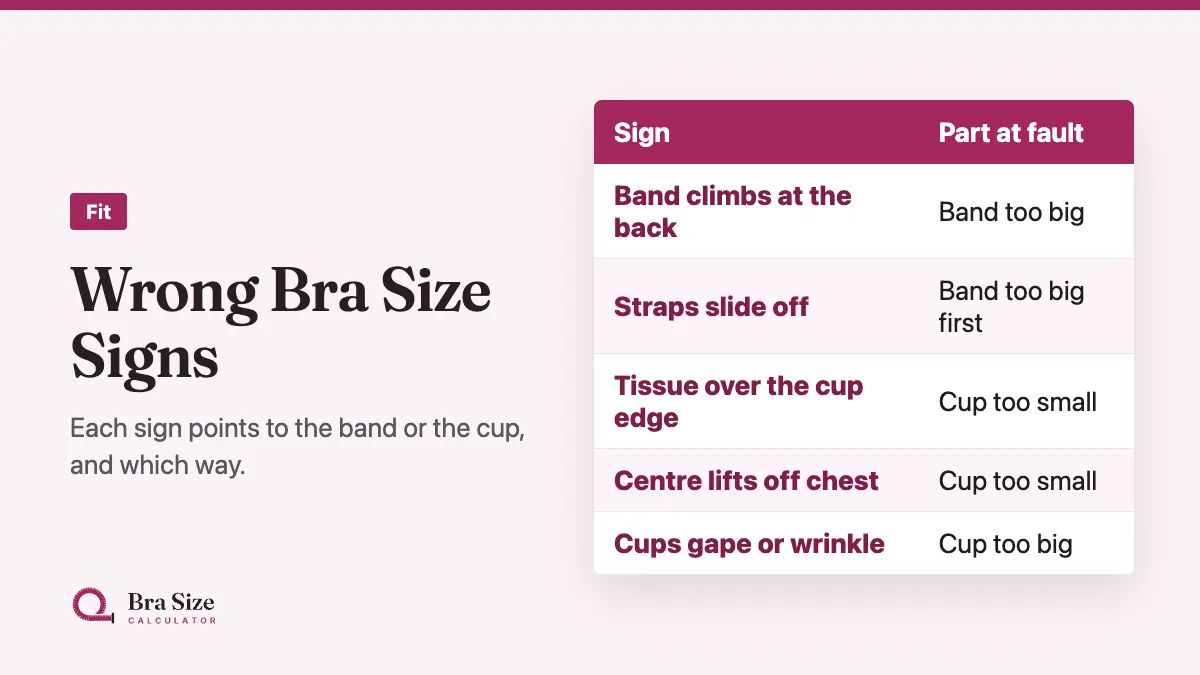
Most underwire bra fitting problems have one of four causes. The cup is too small, the band is too loose, the wire shape does not suit your body, or the bra is worn out. Where it hurts tells you which one to check first.
Underwire sitting on breast tissue
If tissue spills over the edge or the cup line cuts in, the wire has nowhere to go but onto the breast, and the cup is too small. Going up one cup letter on the same band gives the wire room. You can check your cup letter from two tape readings before you buy.
If the cup is smooth and full but the wire still rests on tissue, the wire is too narrow for the base of your breast. That is a style problem, not a size problem. Your breast shape helps you pick a cut with a broader wire in the same size.
Underwire poking your armpit
Fitting guides describe three faults that feel the same under the arm, and the cup shows which one you have.
- Tissue pushed toward the arm: the cup is too small, so try the next cup letter.
- Cup smooth, only the wire end digs in: the wire is too wide or too tall at the side. Keep the size and try a cut with a lower or narrower side.
- Cup wrinkles and the wire stands away from you: the cup is too big, so try one letter smaller.
Underwire hurting your ribs
Fitting guides trace most wire pain on the ribs to a wire that has dropped below the fold, so its lower edge rests on bone. Sitting or leaning forward makes it worse, because the cup tips and turns the wire end inward. A shallow cup pushes the wire down, and a wire that runs too far back digs in behind the cup. If the band itself is what presses, that is a band too small, covered on bra too tight.
Wire pressing at the centre
The gore is the panel between the cups. If it digs into your breastbone while both cups fit, it is too tall or too wide for your chest. Keep the size and look for a lower gore. A gore that floats away from you usually points to a cup too small. A cup size chart shows the next letter on your band.
Underwire poking out of the bra
Underwire poking out through the fabric means the channel has worn open. Stitching the hole buys a little time, but a bent wire or an open channel is a sign to replace the bra. Fitting guides warn that machine washing wears the channel faster. A wire that breaks through soon after you buy the bra may have been moving on a poor fit. Measure again before you buy the same size.
How to fix underwire pain
Start with the change your spot points to, and change one thing at a time. Keep everything else the same, or you cannot tell which change helped.
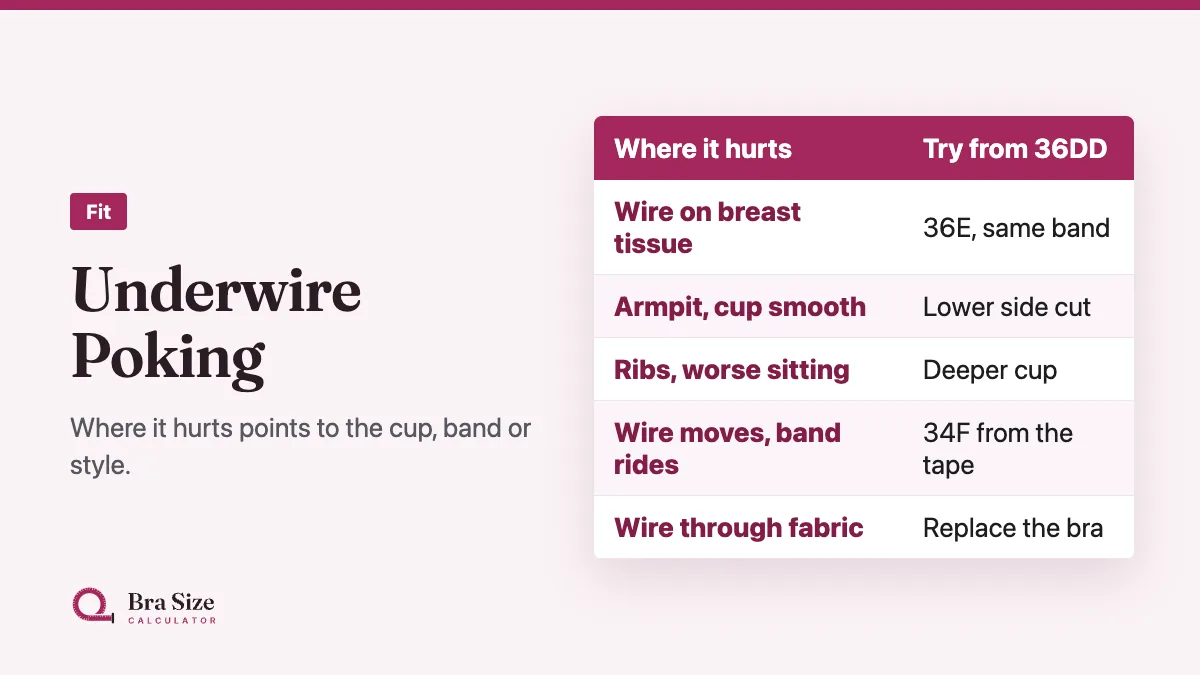
Find where it hurts and what the cup looks like, then read across the grid to the change to try. The sizes are for one reader whose tape gives 36DD.
| Where it hurts | What you see | Likely cause | What to try from 36DD |
|---|---|---|---|
| Side of the breast | Wire on tissue, cup edge cuts in | Cup too small | 36E (US 36DDD), same band |
| Side of the breast | Wire on tissue, cup smooth and full | Wire too narrow | 36DD in a cut with a broader wire |
| Armpit | Tissue pushed toward the arm | Cup too small | 36E (US 36DDD) |
| Armpit | Cup smooth, only the wire end digs | Wire too wide or tall at the side | 36DD with a lower side |
| Ribs, worse when sitting | Wire below the fold | Cup too shallow or small | A deeper 36DD, then 36E |
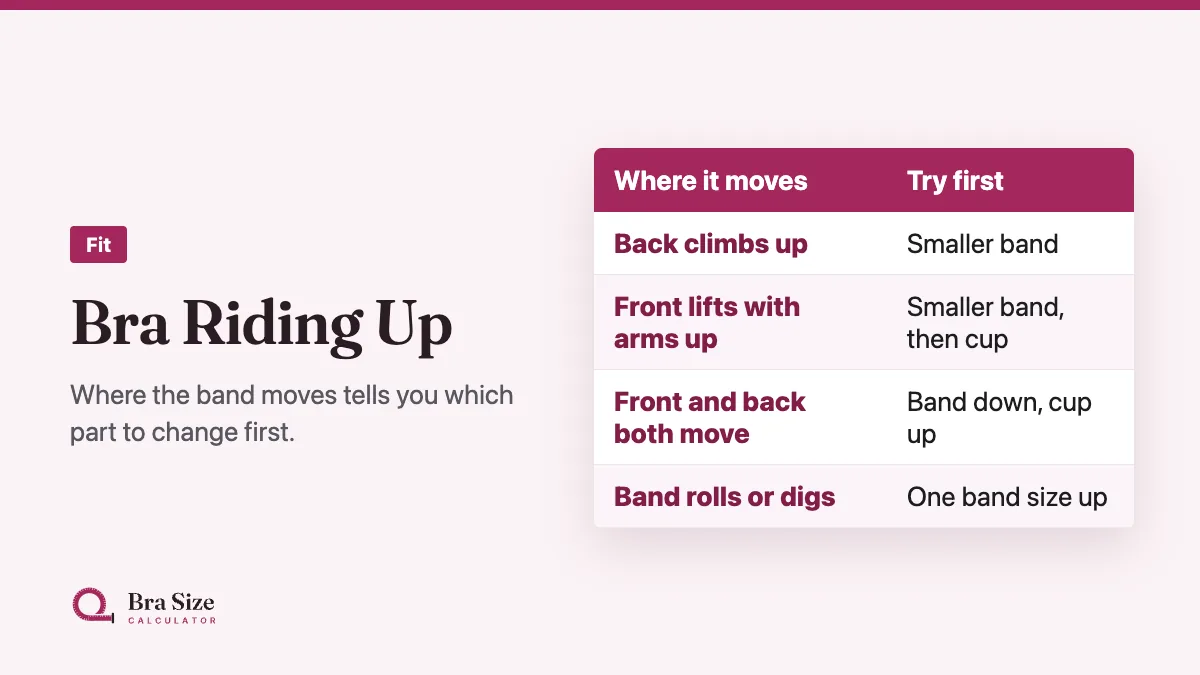
| Anywhere, wire moves | Band rides up at the back | Band too loose | 34F (US 34G) from the same tape |
| Centre | Centre panel floats | Cup too small | 36E (US 36DDD) |
| Centre | Centre panel digs into the breastbone | Centre too tall or wide | 36DD with a lower centre |
| Wire through the fabric | Channel worn open | Worn bra | Replace it, measure first |
This is how that reader gets her sizes from the tape.
- Taking her snug underbust at 34.7 in (88.1 cm), she rounds it to 35, an odd number, so her band is 36 with 34 as the alternative. How to measure band size explains why an odd underbust gives two bands.
- Her bust is 41.4 in (105.2 cm). Subtract the 36 band and the gap is 5.4 in (13.7 cm). Rounded to 5, that gap is a DD, so she is UK and US 36DD.
- Against the 34 band the gap grows to 7.4 in (18.8 cm), read as 7. That gives UK 34F, which is US 34G.
Her 41.4 in (105.2 cm) bust is the top of the 36DD range, so 36E is her first try when the wire rests on tissue.
| Option | Size | Try it when |
|---|---|---|
| Measured size | UK 36DD (US 36DD) | First try |
| Alternative band from the tape | UK 34F (US 34G) | The 36 band rides up and the wire walks off the fold |
| Sister sizes | 34E (US 34DDD) or 38D | The 36DD cup felt right but no band from the tape did |
If her 36 band rides up, her next try is 34F from her own tape. The sister size 34E holds the 36DD cup volume on a smaller band and suits a different body, so it is her second choice. Abroad, 36DD is EU 80E, French 95E and Australian 14DD, and the bra size converter gives the rest.
When underwire pain needs a doctor
An itchy rash along the line of the wire can be an allergy. Metal wires are a possible source of nickel (Jacob 2014), and the NHS lists nickel among the common causes of contact dermatitis. See a GP about the rash. A wireless style, or one where the wire is fully covered, removes the contact.
After breast surgery, the NHS notes that some surgeons suggest a sports bra day and night for up to 3 months after a breast reduction. Ask your surgeon before you go back to wires. See a GP too if pain stays once the bra is off or a bruise does not fade.
Underwire or wireless bra
The difference is where the shape comes from. A wire frames each cup, while a wireless bra relies on the band, the cup seams and the fabric. Both use the same band and cup size, so a size that is wrong in a wire bra is wrong without one too.
A wireless bra makes sense if you react to nickel, if your surgeon advises it, or if a wire hurts in every cut that fits your size. Otherwise, fix the size first.
FAQ
Why does my underwire hurt more when sitting down?
Sitting folds your front, so the cup tips forward and the lower wire edge can press the ribs. Test a new bra at home before you remove the tags: sit, lean forward, and if the wire leaves the fold, try a deeper cup in the same size.
Why does my underwire poke only on one side?
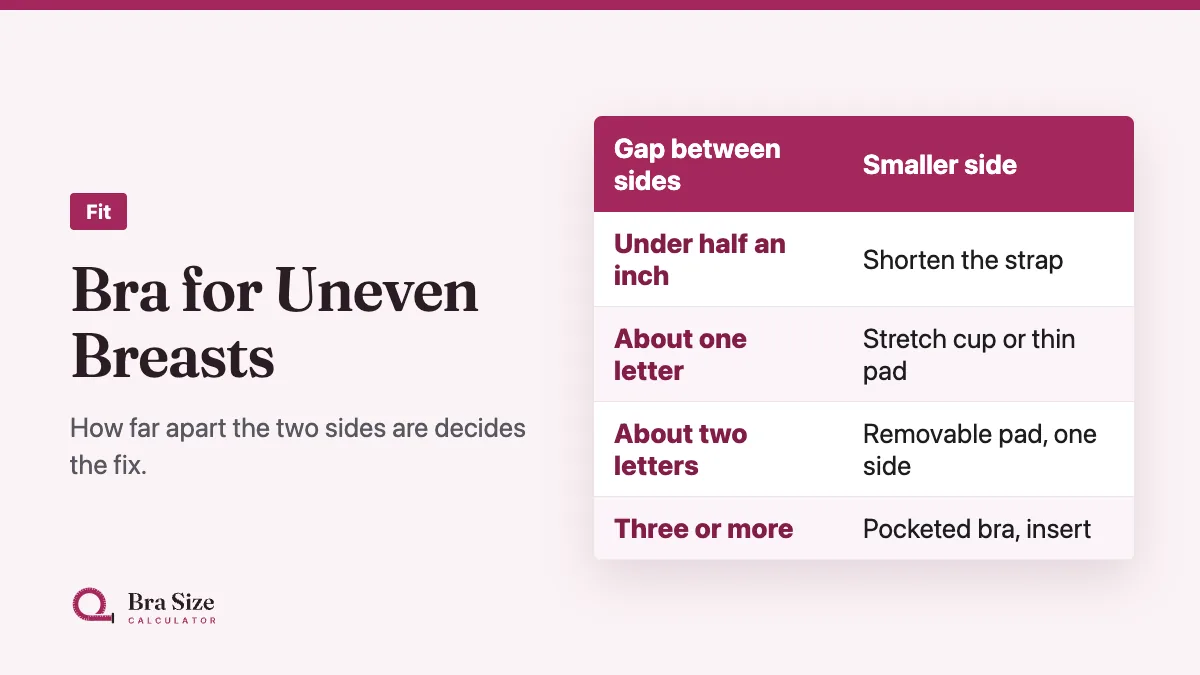
Most people have one breast a little larger than the other, so one wire meets more tissue. Fit the bra to the larger side and adjust the strap on the smaller side.
Can an underwire bra cause a lump?
The NHS says breast lumps are very common and can be caused by many conditions, and it does not name bras among them. Still, show a GP any lump or swelling in your breast, chest or armpit.
How long does an underwire bra last?
Wear signs matter more than age, so check each bra when you wash it. Replace it when the band rides up even on the tightest hook, a wire bends, or the channel wears thin at either end.
Should a new underwire bra hurt at first?
A new band can feel firm for a few wears. A wire that stabs, rests on breast tissue or leaves you sore after you take it off is a fit problem, and wearing it longer will not soften it.
Conclusion
Where the wire hurts tells you whether to change the cup, the band or only the style. Underwire poking through the fabric means it is time to replace the bra. Measure again with how to measure bra size before you buy the next one.