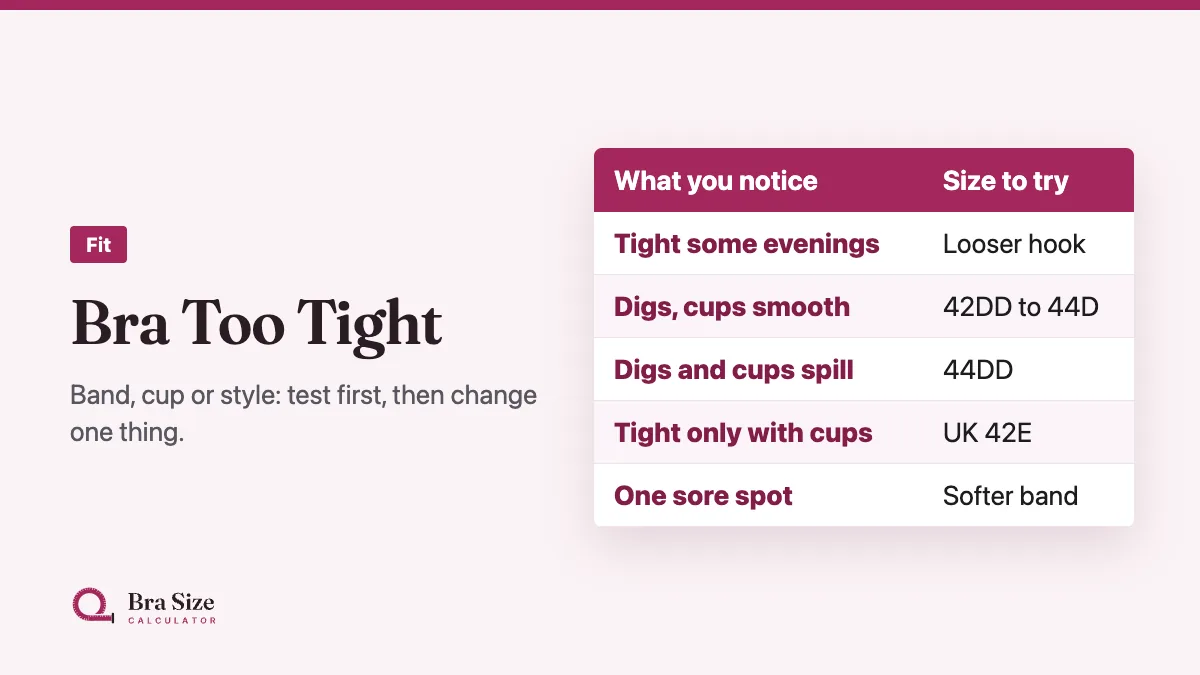
A bra too tight for comfort usually has a band at least one size too small. It digs in on the loosest hook, leaves sore marks or pushes skin over its edge. Small cups can pull a band tight as well, so rule them out before changing the band. Loosen a hook and ease the straps first, then go up one band and re-check your size with the bra size calculator for a starting size to try on.
Table of Contents
Signs your bra is too tight
The clearest sign is pain even on the loosest hook, with sore marks or skin pressed up over the band edge.
Trust what you feel more than the size printed on the label. In a 2024 study by Haworth and colleagues, professionals fitted 24 women with new bras. The women were aged 20 to 46, with D cups or larger and long-term back pain. The researchers then checked each bra against set criteria and still judged the band too tight in 54% of those new bras.
Bra too tight under the arms
The telltale sign is soft tissue under the arm pressed up and over the side of the band. Some fitting guides say this calls for a larger back (band) size.
If the spill is at the outer edge of the cup rather than over the band, the cup is too small, so the cup letter is what changes. You can work out the cup letter from your bust and underbust readings. With smooth cups, a bra too tight under the arms needs a bigger band, as the table below shows. A wire that presses into the armpit is a wire problem, covered in the ribs section.
Back bulge and a band that digs in
When the band edge cuts into your back and pushes soft tissue into a ridge above or below it, the band is most likely too small. A ridge that comes with soreness is the one to act on.
Marks are harder to judge, since fitting guides disagree on how long one may last. A firm band that leaves a sore line even on its widest setting has no room left to give.
To look at the whole bra at once, use the five checks of how a bra should fit: band, cups, underwire, centre front and straps. If the skin breaks, or pain or marks do not fade, see a doctor or pharmacist.
Why does my bra feel tight
Five causes make a bra feel tight:
- The band is a size too small.
- The cups are too small and pull the band tight from the front.
- The style is stiff, narrow or cut low, so the same size feels firmer.
- Your body has changed for a while, such as in the evening, before a period or in pregnancy.
- You have moved from a plus-four size, which adds about 4 in to the underbust, to a modern one, which prints a smaller band number.
If all your bras suddenly feel tight, the change is more likely in you than in the bras. A new bra that is tight from day one points to its size.
Why a bra feels tighter at night
Fitting guides put evening tightness down to bloating after meals and the swelling a long day can bring.
If it is tight only on some evenings, move to a looser hook or use a stopgap that day. If it is tight every day, even on the loosest hook, you have a size question, not a timing one.
Weight change can also move your size over time, so measure again if every bra you own has grown tight.
Bra too tight around the ribs
Sore ribs under cups that fit well usually mean the band is too small. Fitting guides also blame a band worn too low on the back, which can add pressure around the ribs.
The band carries most of the load. Haworth and colleagues describe the underband as running level around the torso, holding the bra in place and lifting the breasts from below, so the straps carry less strain.
If a wire presses into your ribs or breastbone while the band feels fine, the style is the cause, as the last row of the table below shows. Rib pain that stays after the bra is off is one to show a doctor.
Why the bra band rolls up
One fitting guide says a band rolls up because it is too tight, more often when the band is narrow or made of soft fabric. Confirm it with what you see:
- It rolls and digs, or leaves a sore mark: the band is too small.
- It rolls and also climbs up your back on the tightest hook: the band is too big, and straps that dig into your shoulders often come with it.
- It rolls only under the cups at the front: check the cup with the next section, then the wire.
Is it the band or the cup
Either the band or the cup can cause the tight feel, so test both before you buy a new size. Fitting guides report that cups that are too small push breast tissue down and out, and that pressure makes a band that fits feel tight.
Turn the bra round so the cups sit at your back, fasten it and notice how the band feels, a check explained in how to measure band size.
Read across from what you notice to the size a 42DD wearer would try. Swap in your own band and cup letter for any other size.
| What you notice | Quick check | What it points to | Size for a 42DD wearer |
|---|---|---|---|
| Tight only on some evenings | Comfortable on the same hook in the morning | A short-term body change | 42DD on a looser hook that day |
| Digs on the loosest hook, cups lie smooth | Snug underbust reads about 43.6 in (110.7 cm) | Band too small | 44D (one band up, same cup volume) |
| Digs, and the cups spill at the top or sides | Fresh bust reading of 48.6 in (123.4 cm) | Band and cup both too small | 44DD |
| Tight only while the cups are in front | With the cups turned to the back, the band feels easy | Cups too small | UK 42E (US 42DDD) |
| One sore spot while every size check passes | A stiff band edge or a wire on the ribs | Style | 42DD in a softer or wider band |
How to fix a bra that is too tight
Loosen what you can first, then change the size. A bra too tight on its loosest hook needs a bigger band, not a stopgap.
- Move to a looser hook. New bras start on the loosest one, so a new bra has no slack left here.
- Lengthen any strap that digs into your shoulder, then set both straps again with the steps for bra straps falling down.
- For tightness that comes and goes, fitting guides suggest a bra extender as a stopgap. It fixes to the back hooks and adds a little length there.
- Re-measure your underbust with the tape snug but not pulled hard, using the steps to measure your bra size.
- Change one thing at a time. Go up a band if the cups lie smooth, change the cup if it spills, and try another style if both pass.
To make a bra looser today, steps 1 to 3 are all you have.
Is a tight bra bad for you
A tight bra can hurt, but the scarier claims have little evidence behind them. The NHS page on breast pain lists a badly fitting or unsupportive bra among the causes. It advises seeing a GP (family doctor) if the pain does not improve.
In a 2025 study by Harbour and colleagues, 17 trained junior runners ran at race pace until exhaustion in sports bras with three band tightnesses. Their breathing-muscle strength fell 9.8% with the tight band and 1.1% with the loose one. The authors note the band sits over the lower ribcage, so its tightness may affect how the ribcage moves. That was hard running, not an everyday bra at a desk.
On cancer, the American Cancer Society says no evidence shows that wearing a bra raises or lowers breast cancer risk. One study behind that view, by Chen, Malone and Li in 2014, compared 1,044 women with breast cancer and 469 without, aged 55 to 74. It found no link with cup size, hours a day worn or underwire. It did not look at how tight the bra was, or at wearing one at night. Some fit pages claim a good fit lowers cancer risk, but the American Cancer Society finds no data that a bra changes the risk either way.
Going up a band size for a tight bra
When only the band digs and the cups fit, move up one band and drop one cup letter. That keeps the cup volume on a longer band, the rule behind sister sizes.
Say you wear 42DD. Your snug underbust is 43.6 in (110.7 cm) and your bust is 47.7 in (121.2 cm). Rounding 43.6 gives 44, already even, so that is your band. Take 44 from 47.7 and you get 3.7 in, which rounds to 4 in for a D cup. Your measured size is 44D, the sister size one band up from 42DD. The band number you wore was about 1.6 in (4 cm) below your snug underbust. The bra size converter shows the labels other countries use.
The table sets that body beside a second one whose cups are also too small.
| Body | UK and US | EU | French | Australian |
|---|---|---|---|---|
| Underbust 43.6 in (110.7 cm), bust 47.7 in (121.2 cm) | 44D | 100D | 115D | 22D |
| Underbust 43.6 in (110.7 cm), bust 48.6 in (123.4 cm) | 44DD | 100E | 115E | 22DD |
With the same underbust and a 48.6 in (123.4 cm) bust, the difference grows to 4.6 in, which rounds to 5 in for a DD cup. The 47.7 in body never becomes 44DD, so measure again if the cups still spill.
Plus-four charts, still used by some brands, add 4 in to an even underbust like 44. On one of those, the first body would come out as 48AA. A modern size can put a band about 4 in (10 cm) smaller on paper. A firmer feel after the switch is expected, but pain on the loosest hook still means the band is too small.
Sometimes the calculator shows a main band and the next even band down as an option. If that lower band digs, go back to the main size, whose cup already comes from your bust. Do not take the lower size's sister size one band up instead.
FAQ
Should a bra leave marks on your skin?
Fitting guides give clashing time rules, such as a mark still there an hour after removal or one that shows within an hour of wearing. No study backs either. So act on a mark that hurts, or a band that is sore on its widest setting, rather than on a clock. Broken skin is one for a doctor or pharmacist.
Will a tight bra stretch out?
Fitting guides say band elastic loosens with wear, and with washing and tumble drying, which is why bras have tighter hooks to move to later. Do not count on it, though: a band that hurts on the first day is not one to wait out.
Is it bad to sleep in a bra?
For breast pain, the NHS suggests a properly fitted bra by day and a soft bra to sleep in. A 2014 study of bra wearing and breast cancer did not look at night wear, so it shows neither harm nor a need. A band that digs at night raises the same size or style question as it does by day.
Do bra extenders work?
Bra extenders work as a stopgap for tightness that comes and goes, and fitting guides suggest them for that. An extender adds length only at the centre back, and one guide notes it can push the straps outward, so it is no substitute for a bigger band.
Can a bra be the right size and still feel tight?
Yes. A measured size gives you a starting point to try on, and band width, stiffness and cup shape all change how one size feels. Try the same size in a different style before you change the label.
Conclusion
Loosen a hook first, check whether the cups are the real cause, then go up one band with the same cup volume. Measure snug in inches or cm, and find your row in the chart of bra size by underbust and bust before you try a new band.