Bra cup gaping means the cup holds more room than your breast fills at that spot, so the fabric stands off your skin. Most often the cup letter or the band is too big. A gap at the top can also come from a cut that misses you, or from a cup that is too small. Begin with the bra size calculator, then note where the gap sits.
Table of Contents
What cup gaping means
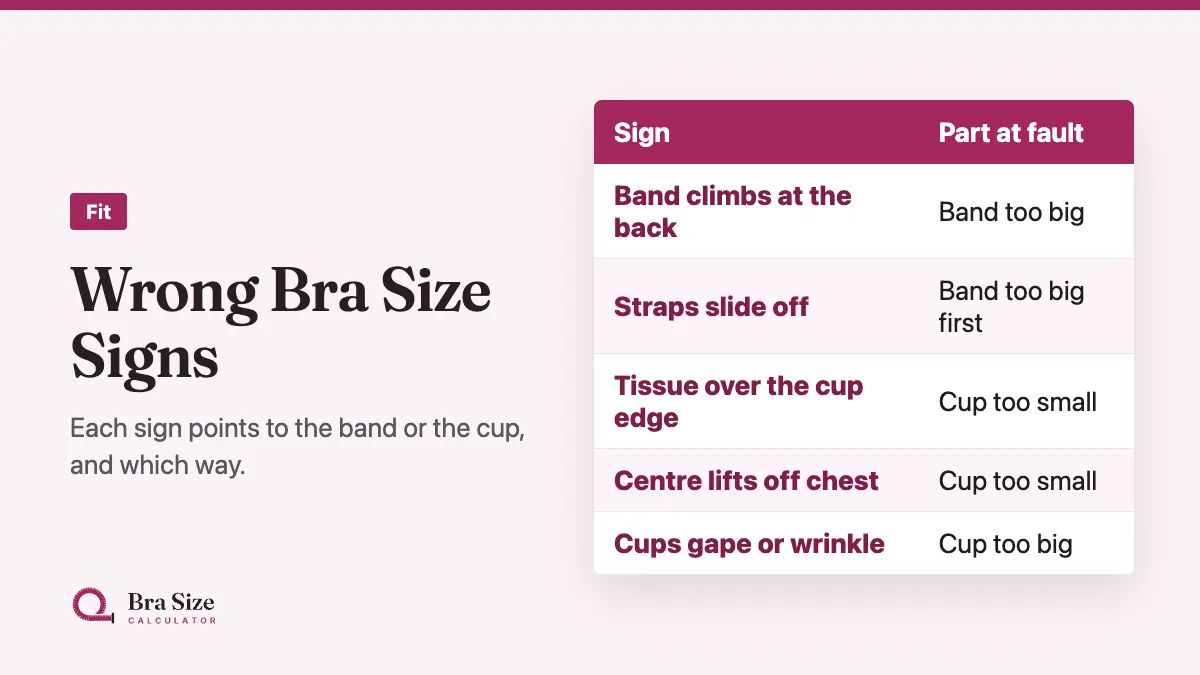
A gap or a wrinkle signals too much cup, or a cup built for another shape. Spill over the edge signals the opposite.
Gaping shows as a hollow at the top edge, a lip of fabric at the side or centre, or wrinkles across the cup.
In a study of 24 women with D cups or larger and back pain (Haworth et al. 2024), researchers found cups too large in 42% of the women's own bras. New bras from professional fitters had the same fault in 33% of cases.
Quick checks before you size down
Four things can make a correct size gap, so rule them out first.
- Settle each breast into its cup, bringing the tissue forward from under your arm.
- Shorten the straps until the top edge lies flat without lifting the band, as bra straps falling down explains.
- Make sure the band runs level and, on a new bra, sits on the loosest hooks.
- On an old bra, stretched straps or limp lace gap even in the right size.
If the cups still gap, the size or cut is at fault, and how a bra should fit covers the rest.
Why bra cups gap
Where the gap sits tells you the cause of bra cup gaping: the cup letter, the band, the cut or the cup width.
A cup letter too big
If the whole cup stands off after you settle the breast, and nothing presses anywhere, there is too much cup. Go one letter down on the same band, after you recheck it with how to measure cup size.
A gap at the top is not always too much cup. If the edge digs a line into the breast, tissue bulges at the side, or the wire rests on tissue, the cup is small or shallow. It pushes the breast away from the top, so go up a letter, not down.
A band too big for you
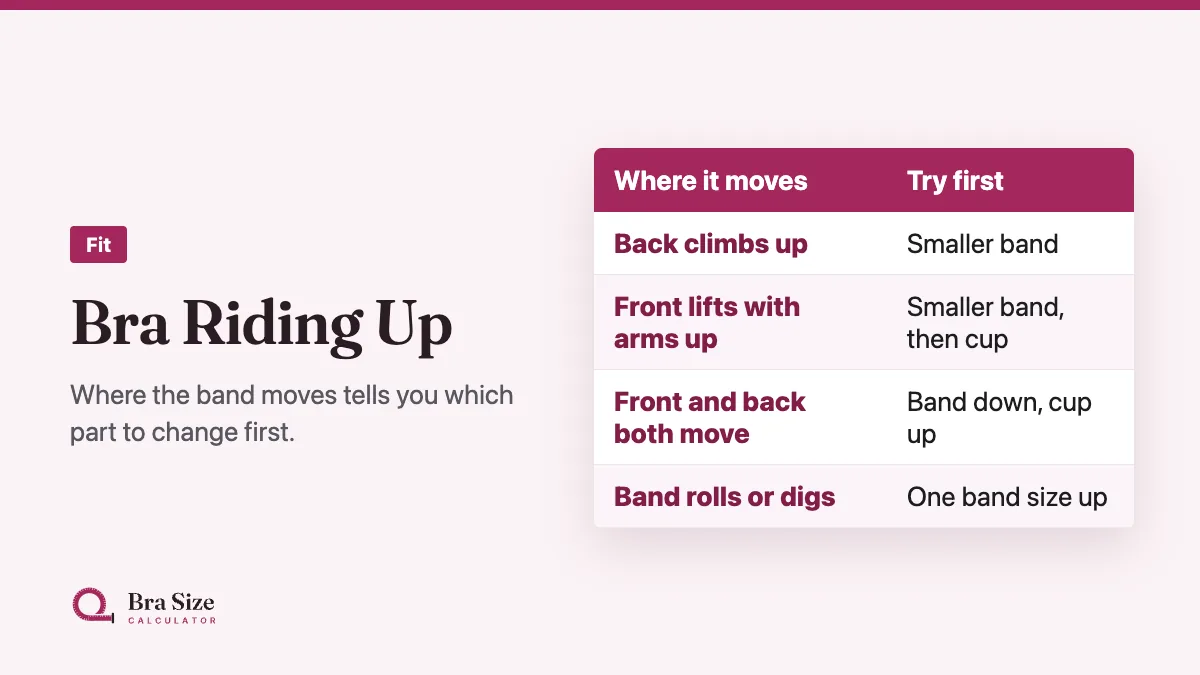
A loose band climbs at the back and drags the cups away from the body. It also adds volume, because a cup grows with the band at the same letter. A 32DD holds the same cup as a 30E.
A sister size keeps that volume, so it keeps the gap. Try going down a band at the same letter, taking it from your own tape.
Same size, different cup cut
One size can gap in one style and lie flat in the next, because the seams decide where the volume goes. In a case study of one 32D wearer (Peterson and Suh 2019), moving the seamlines of prototype bras changed cup volume by up to 13 to 17%.
So if the top gaps while the lower cup is full and smooth, keep the size and try another build. How a cut meets your breast shape decides which builds sit flat on you.
Gaps at the side or centre
An outer gap, with an empty cup and a wire beyond the breast, points to a cup too big or too wide there. Try one letter down or a narrower cut. If the gap runs along the wire itself, the notes on underwire poking or hurting show where a wire should rest.
The panel between the cups should touch your breastbone. If it stands off once the band passes, fitting guides read that as a cup too small. The same 2024 team found the front of the band off the breastbone in 46% of the women's own bras.
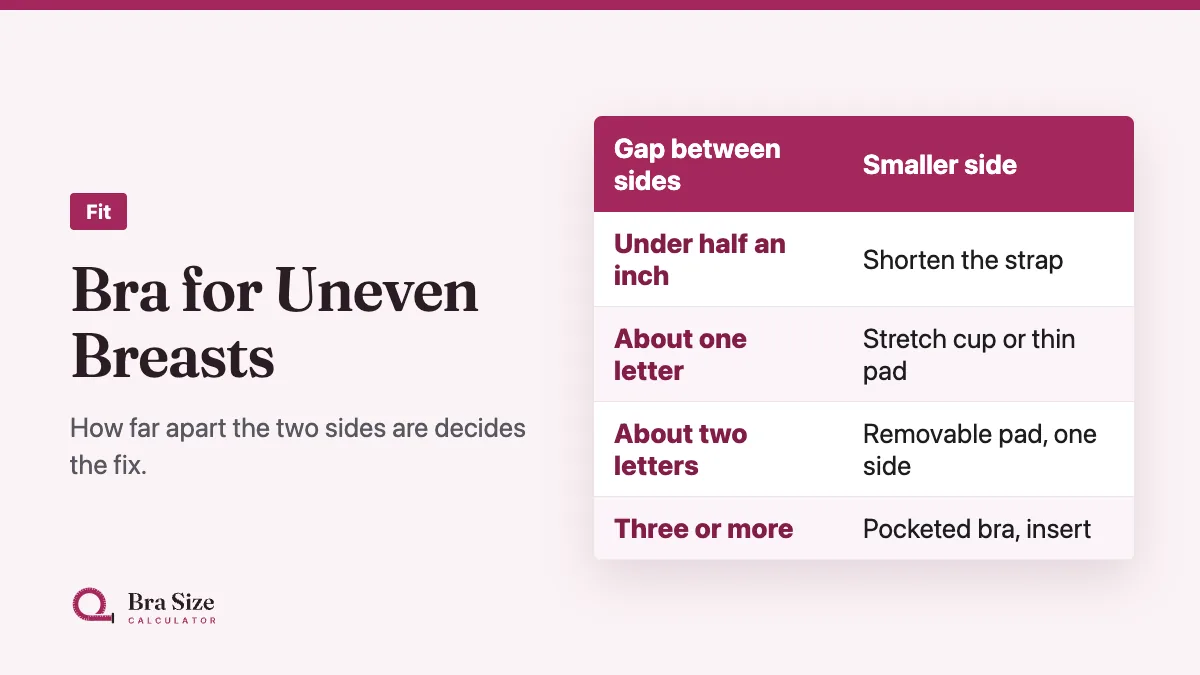
When only one cup gaps, fit the fuller side, since uneven sides are common.
Bra cup wrinkling and puckering
A wrinkle is a gap folded into the fabric, and fitting guides read it by position.
- Across the top: spare room at the edge. Try one letter down or a lower neckline.
- At the bottom: the cup is too deep, or the wire too wide at the base. Try one letter down or a shorter cup.
- Along one seam, rest smooth: the seam shape misses you, so change the build, not the size.
How to fix bra cup gaping
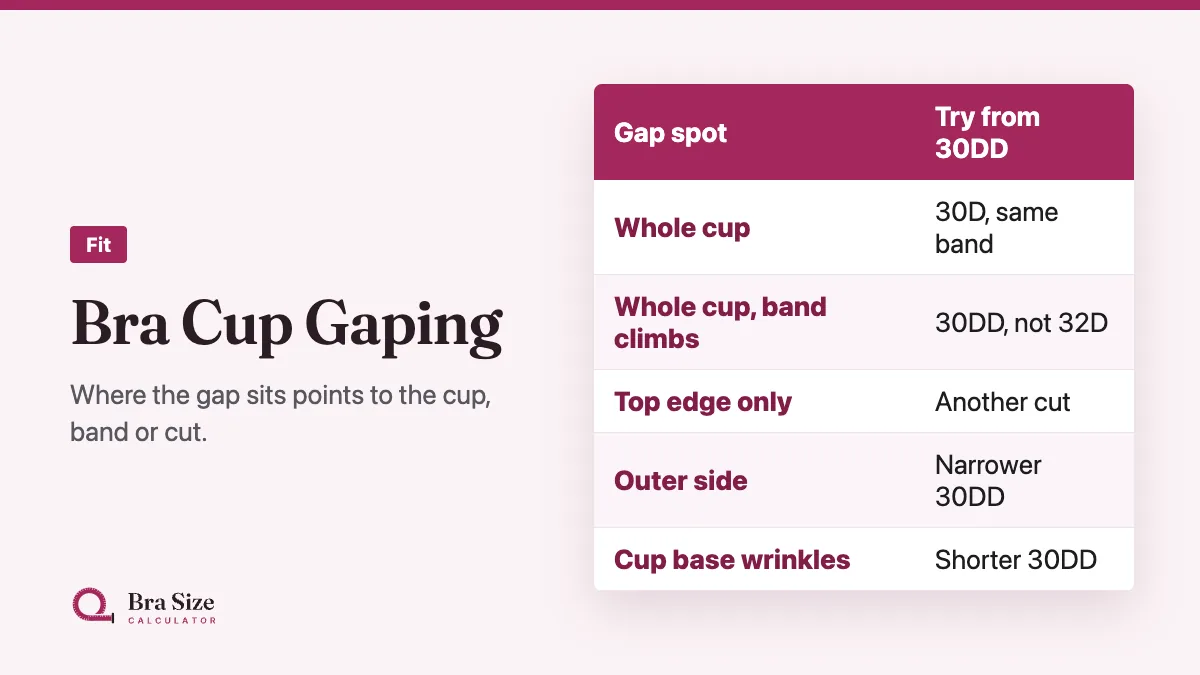
Fix bra cup gaping in a set order: band first, cup letter second, build last. Each row gives the size to try for one wearer who measures UK 30DD.
| Gap spot | Other signs | Cause | Size to try |
|---|---|---|---|
| Whole cup | Stays after settling | Cup too big | 30D, same band |
| Whole cup | Band climbs | Band too big | 30DD from the tape, not 32D or 30E |
| Top edge only | Lower cup full | The cut | Another build in 30DD |
| Top edge, cutting in | Edge digs in, tissue bulges sideways | Cup small or shallow | 30E (US 30DDD) or a deeper 30DD |
| Outer side | Outer cup empty | Cup too big or wide | 30D or a narrower 30DD |
| Centre | Gore off the breastbone | Cup too small | 30E (US 30DDD) |
| One cup | Other cup fits | Uneven sides | 30DD fitted to the fuller side |
| Cup base | Low wrinkles | Cup too deep | 30D or a shorter 30DD |
| Comes and goes | Fitted before | Body change | New readings |
She has worn UK 32DD since an old fitting, and her cups gap at the top while the band creeps up. Her snug underbust is 29.4 in (74.7 cm), close to 29. An odd figure means a 30 band, with 28 as the second option, and how to measure band size covers that step. Her bust is 34.8 in (88.4 cm). Subtract the 30 band and 4.8 in (12.2 cm) is left, close to 5, so the cup is DD. On the 28 band the same bust reads 6.8 in (17.3 cm) over, close to 7, which is F.
| Size | Band vs 30DD | Cup volume vs 30DD | Verdict |
|---|---|---|---|
| 32DD (worn now) | 2 in (5 cm) looser | One letter more, as 30E | Gaps and climbs |
| 32D (sister) | 2 in (5 cm) looser | Same | Keeps the loose band |
| 30E (sister of 32DD) | Same | One letter more | Keeps the gap |
| 30DD (measured) | Same | Same | Try first |
| 28F (second band) | 2 in (5 cm) firmer | About one letter more, as 30E | More cup, not a gap fix |
Her measured 30DD fixes both faults. On EU labels she wears 65E, on French tags 80E, on Australian tags 8DD, and the bra size converter lists every other system.
When your body changes
A bra that used to fit and now gaps often means your body changed. In 3D scans of 356 women aged 18 to 84 (Coltman, Steele and McGhee 2017), breast volume tracked body mass index, not age, so weight loss can empty a cup.
In 30 women aged 18 to 26 with upper back or chest wall pain (Wood, Cameron and Fitzgerald 2008), menstrual cycle stage was moderately linked with bra fit. A gap that comes and goes through the month may follow your cycle. Either way, take new readings.
Bra cup styles that stay flat
Pick the build by where the cup gapped. For a gap at the top, stretch lace or a flexible edge follows the breast, and a lower neckline, such as a balconette or demi cup, removes the empty top.
Fitting guides note that moulded cups hold their own shape, so they show a gap first when size or shape is off. Seamed cups follow the breast more closely. Push-up padding fills a gap but hides the size question.
FAQ
Should I go down a cup size if my bra gaps?
Only once the band and straps pass and nothing presses at the edge. In a 2024 study of 24 women, fitters moved 15 up a cup and only 6 down.
Is a little wrinkling in the cup normal?
Soft ripples in stretch lace that smooth out as you move are just fabric. A fold that stays after you settle the breast is spare room, and its position shows what to change.
How do I get creases out of a moulded bra cup?
A dent from the wash sits in the foam, not the size, so it is no reason to change size. Push it out from inside, reshape the cup while damp and dry it flat.
What makes bra cups curl at the top edge?
An edge rolls outward when nothing holds it flat from behind, which means spare room at the top or a cup too wide. Heat can also soften a moulded edge.
Will a gaping bra cup fill out as I wear it?
No. A band loosens with wear, but a cup does not grow to meet a breast, so a gap on day one stays. Settle the size before the return window ends.
Conclusion
The spot where the cup stands off decides the move: a new letter, a new band or another build. A gap after weight loss, or one that follows your cycle, calls for fresh readings. Take them with how to measure bra size, then change one thing at a time.