A bra riding up at the back nearly always means a band too large for your ribcage, or worn loose. It cannot hold its place, so the straps tug it upward. A front that lifts as you raise your arms is the same slack band, sometimes with small cups. The bra size calculator turns fresh tape readings into a band to try, plus an alternative for an odd underbust.
Table of Contents
Why bras ride up at the back
Why does my bra ride up? In most cases the band is too loose for the ribcage it sits on. Most fitting guides agree on that. One guide blames a band that is too tight. Yet a tight band tends to roll over and dig in rather than climb, as a band that is too tight explains. So a bra band riding up is a sign of slack, and all four causes below lead back to it.
The band is too big
Fitting guides name a band that is too big as the first cause. A loose band has nothing firm to press against, so each movement nudges it higher until it settles near your shoulder blades. The band should carry most of the load, and a floating band carries none. Older plus-four charts can put you in this spot. They add 4 or 5 in (10 to 13 cm) to your underbust, as how to measure band size covers in detail.
The band has stretched
Elastic gives a little with every wear and every wash. If the bra sat level when it was new and only started to climb months later, the size was right but the bra is worn out. To tell which, fasten it on the innermost hook and lift your arms. If the band still slides up, the elastic is spent and the bra needs replacing.
The straps are too tight
Short straps act like a hoist on the back of a loose band. They pull the band up, and then they dig in, because your shoulders now carry weight the band should carry. That is often why bra straps hurt your shoulders. Guides split here: one says to tighten straps when the cups sit low, while the rest say loosen them. Loosen first, then judge the band. For straps that slip rather than dig, see bra straps falling down.
The cups are the wrong size
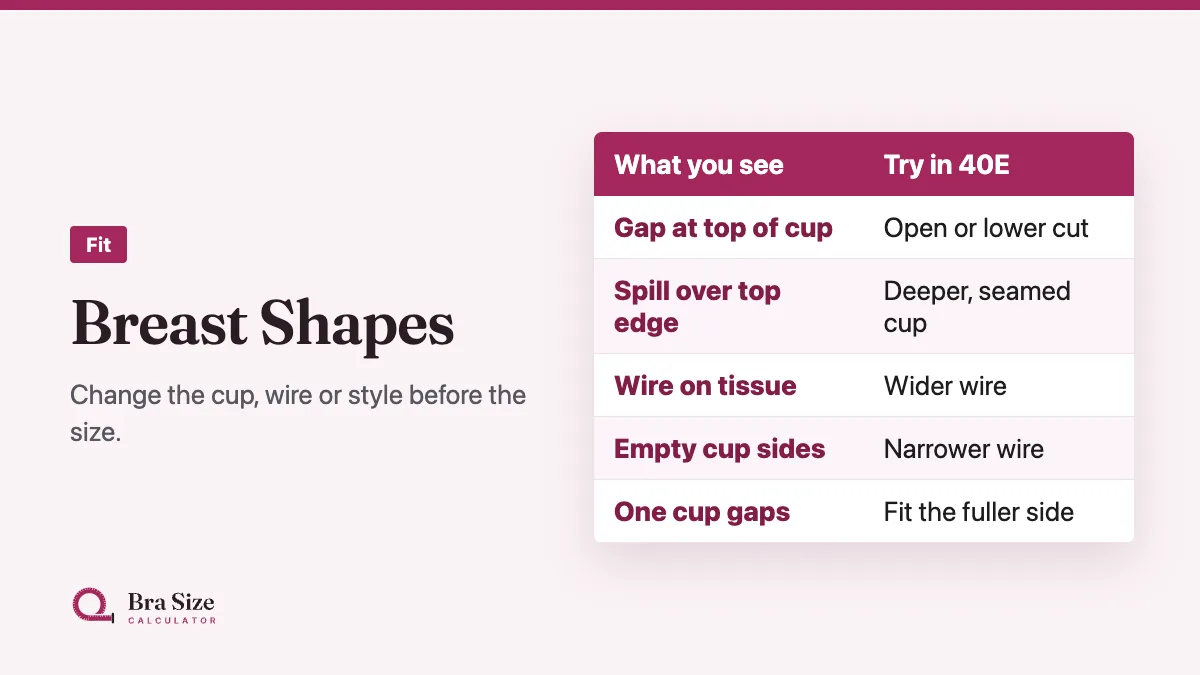
Cups that are too small push the bra away from your chest, and the band climbs along with it. Cups that are too big leave nothing inside them to anchor the front, so the whole bra floats, fitters say. If you see empty space or wrinkles in the cup, bra cup gaping shows how to read where the space sits.
Bra riding up at the front
A bra rides up in front as you lift your arms for two likely reasons. The band is loose enough for the movement to drag it, or the cups are too small to stay seated. If your bra lifts up when you raise your arms to reach a shelf, start with the band. When the front climbs, the wire can end up resting on the breast instead of under it, which underwire poking or hurting sorts by spot.
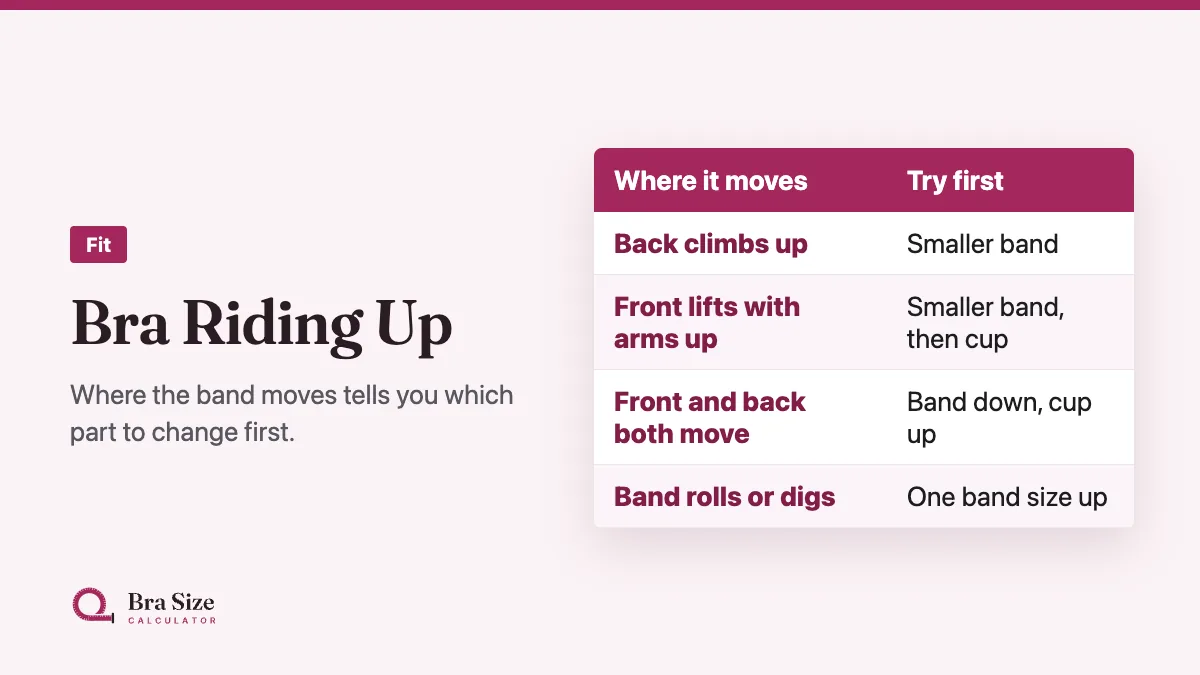
Find where your bra moves, then read across to the part at fault and the first thing to try.
| Where it moves | When | Part at fault | Try first |
|---|---|---|---|
| Back climbs toward the shoulder blades | All day, worse by evening | Band too big or stretched | Loosen straps, then a smaller band |
| Front lifts off the chest | When you raise your arms | Band too loose, or cups too small | Smaller band, then check the cup |
| Front and back both move | Reaching, bending | Band too big, cups too small | Measure, then band down and cup up |
| Band rolls, digs, leaves marks | Sitting, all day | Band too tight (not riding up) | One band size up |
Does your bra band fit
Lift both arms straight up and look at yourself from the side. The band should hold one height all the way round. If the bra moves when your arms are raised, or it ends higher at the spine than under the bust, the band is too loose. Researchers at the University of Portsmouth say the band should stay level as you move around.
Researchers fitting bras for a 3D scanning study of 129 young women ended each fitting with the same arm raise, to check the bra did not ride up. The check can also be learned. In a study of 115 teen athletes, 39% more of the girls given a fit booklet passed a bra fit test four months later.
The arm raise tests only the band. For the cups, wire, centre and straps, see how a bra should fit. If several things feel off at once, look at the other signs of a wrong size too.
How to stop your bra riding up
To stop a bra riding up for good, work through these steps in order and stop at the one that fixes it.
- Let the straps out a little and check whether the back drops level.
- Move one hook tighter as a trial. If that keeps it down, the band is either worn or one size too big.
- Measure your snug underbust and your bust, in inches or cm.
- Try the band the tape gives, with the matching cup. For each band size you drop, add one letter so the cup still holds as much.
- If the new band still climbs even on its loosest hook, try the alternative band for an odd underbust.
Judge any new band on its loosest hook, because that is where it has to stay level on day one.
Why a smaller band stays down
A band that matches your ribcage grips it, so lifting your arms cannot drag it out of place.
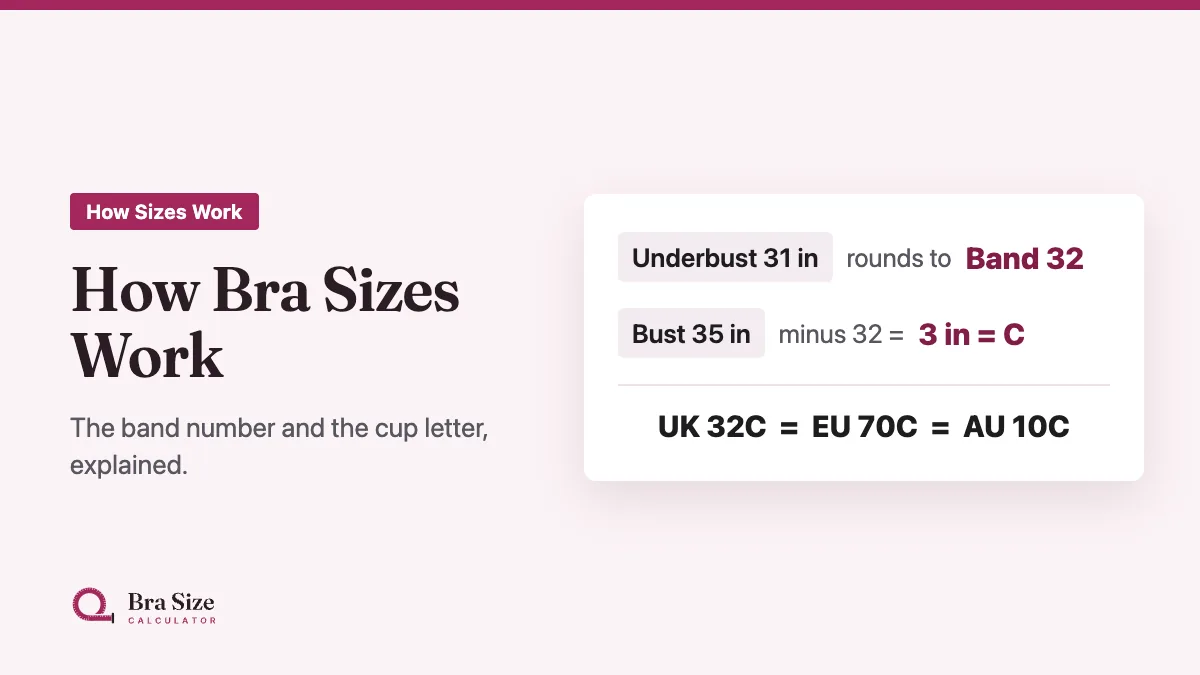
Take a woman who wears 34B. The band creeps up her back, and the front lifts whenever she reaches up. Her snug underbust reads 29.3 in (74.4 cm). Rounded, that is 29, and since 29 is odd the calculator gives band 30 and offers 28 as well. Her bust reads 35.8 in (90.9 cm). Take away 30 and 5.8 is left, which rounds to 6: a UK E cup. So 30E (US 30DDD) is where she starts.
Where did 34B come from? An older chart adds 5 to her odd 29 to make 34, and 35.8 minus 34 leaves 1.8, which rounds to 2: a B cup. That band is 4 in (10 cm) longer than the 30 band her tape gives.
A single sister step down to 32C can look like the easy fix. It firms the band a little but stays two letters short of 32DD (C, D, DD). The sister sizes of 30E are 32DD and 28F. If 30E still climbs, the alternative band gives 28FF (US 28H), a cup above the 28F sister because her bust reading has not changed.
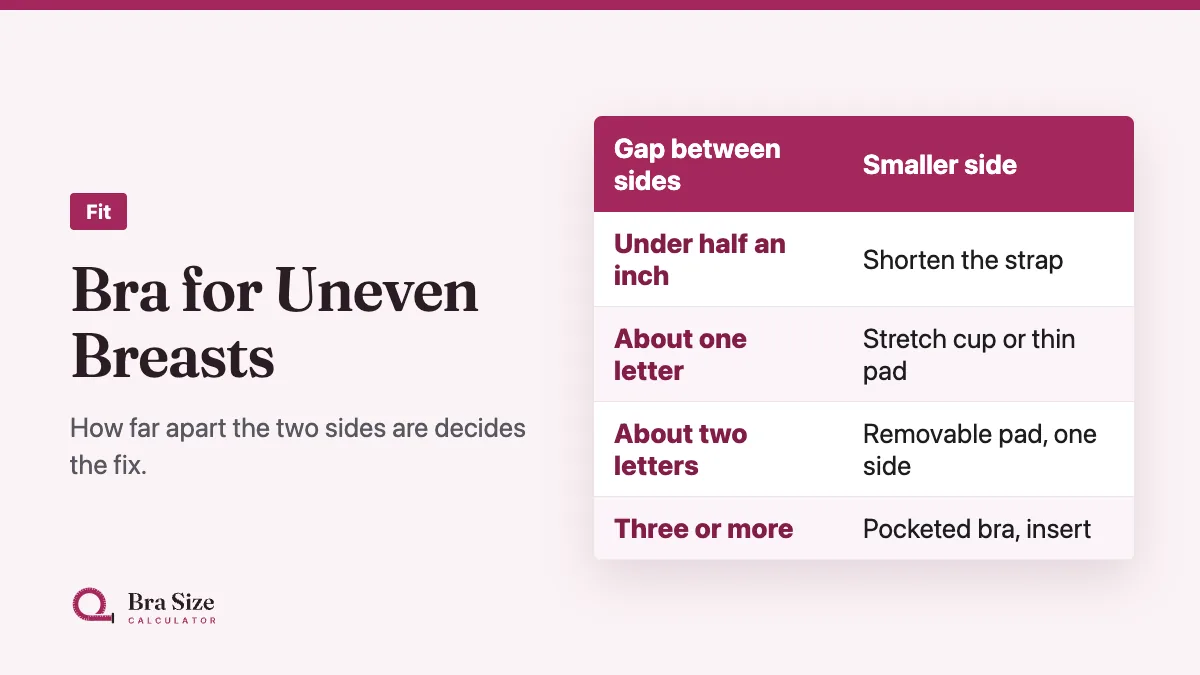
| Size | Band vs her 30 band | Cup vs her 30E | What to expect |
|---|---|---|---|
| 34B (worn, plus-four label) | 4 in (10 cm) longer | Same volume as 30D, two letters short | Climbs at the back, front lifts |
| 32C (one sister step down) | 2 in (5 cm) longer | Same volume as 30D | Climbs less, still short in the cup |
| 30E (tape result, US 30DDD) | Right | Right | Try first |
| 28FF (alternative band, US 28H) | 2 in (5 cm) shorter | One letter more volume than 30E | Only if 30E still climbs on the loosest hook |
Labels vary by country: UK 30E is EU 65F and FR 80F, and in Australia it is band 8 with a cup letter that depends on the brand's chart. Take 30E into the fitting room as a first try, not a final answer.
FAQ
Do tighter straps stop a band riding up?
No. Shorter straps hoist the back of a loose band even higher, and your shoulders end up holding the weight. Get the band sitting level first, then set the straps.
Can sitting make a bra ride up?
Yes. Sitting and slouching shorten the front of your body, so a band that is only a little loose shifts more. If it only climbs when you sit, try the band on the tightest hook first to see if it holds.
Is riding up the same as rolling up?
No. A band that climbs your back is too loose. A band whose top edge folds over is often too tight or worn at the edge, which the bra too tight guide covers.
Does riding up mean the cup is wrong too?
Often, once the band changes. A smaller band needs a bigger cup letter to hold the same volume, so a woman who wears 34B may end up in 30E, not 30B.
Do sports bra bands ride up when running?
Yes, for the same reason: a band too loose to grip. In a 2021 study of 98 sports bras on 77 women, an adjustable band was one of five features that together explained about 37% of how well the bras cut breast movement.
Conclusion
A bra riding up is telling you its band number is too big, and straps or hooks only hide that for a while. Measure again using how to measure bra size, try the band the tape gives with its matching cup letter, and keep the alternative band in mind if it still climbs.